
For three years, the IITA Gender Science Network (GSN) has remained a driving force in strengthening gender integration across agricultural research and institutional processes. Through its Gender Learnings and Exchanges for New inSights (GLENS) webinar series, the team continues to provide a dynamic platform where researchers share gender-focused innovations, broaden knowledge, and accelerate real-world impact.
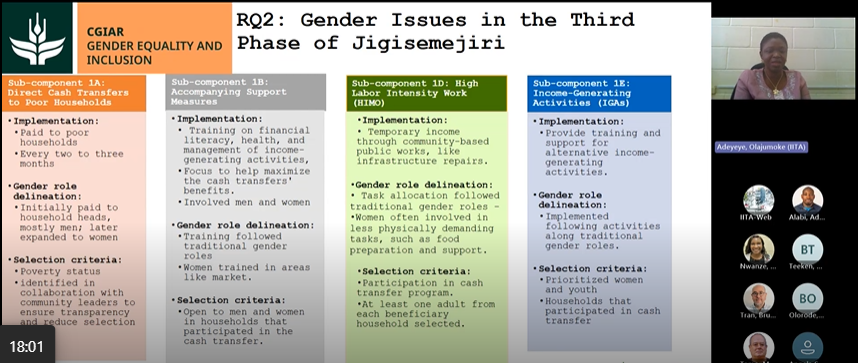
IITA Postdoctoral Fellow in Gender Research, presenting on Harnessing Social Protection to Promote Gender Equality and Climate Resilience.
From July to October 2025, the network hosted four captivating webinars, each led by experienced scientists and project experts. Together, they explored how gender inclusion strengthens equitable and more climate-resilient agricultural systems.
- Gender Inclusion and Monitoring in Large-Scale Agricultural Projects
The series opened with TAAT Regional Country Engagement Officer, Ernest Asiedu, who presented insights on integrating gender and social inclusion within the Technologies for African Agricultural Transformation (TAAT) initiative.
He explained that TAAT Clearinghouse officers work to ensure that agricultural technologies are adopted at scale through partnerships with governments, private sector actors, and development agencies. A key part of this mission is advocating for gender-responsive technology choices. By influencing decision-makers, TAAT promotes innovations that consider the needs of both women and men farmers.
Asiedu emphasized that social inclusion, especially in large-scale technology integration, is essential for accelerating adoption and ensuring equitable impact across diverse farming communities.
Highlighting some gender targeted innovations in large scale agricultural investment, he mentioned communities sensitization to allocate at least 40% of developed land to women; Development of tailored training programs for women; Implement women-centered extension delivery; Provision of Farm machinery and tools to reduce drudgery and enhance efficiency of women farmers; and Innovation Platforms for Women’s Economic Empowerment: To strengthen linkages with other value chain actors for economic empowerment.
The discussion was led by Dr Solomon Gizaw, Head of TAAT Clearinghouse.
The GEYSI team has recently also been working with TAAT to improve the technology profiling in the e-catalogue, so the gender and inclusion potential of each technology gets better articulated.
- Harnessing Social Protection to Promote Gender Equality and Climate Resilience
In the second webinar, IITA Postdoctoral Fellow in Gender Research, Olajumoke Adeyeye, highlighted the role of social protection (SP) in reducing poverty, enhancing food security, and strengthening climate resilience.
She noted that SP programs such as cash transfers, food transfers, training, and public works, have expanded rapidly across Africa due to rising vulnerabilities. The study focused on how these programs can better address gender inequalities in climate-affected settings.
Her case study centered on Mali’s “Jigisemεjiri” social protection program, the country’s largest initiative aimed at improving human capital and reducing extreme poverty. Initially designed to transfer cash to male household heads, the program later evolved to include mobile transfers to women and integrated complementary initiatives.
Findings revealed that gender norms heavily influence who benefits most, often putting women at a disadvantage. Adeyeye recommended engaging both husbands and wives when designing SP programs to support women’s empowerment and equal access to opportunities. Importantly the research reveals the importance of coupling gender research and climate change research because of the emerging linkages between both research strands that include the interactions between climate adaptation strategies and features of social protection programs. The discussion was led by IITA Senior Scientist and Gender Specialist, Steven Cole.
- Strengthening Gender, Climate, and Nutrition Research Using the AAA Atlas
The third series, presented by Lecturer, Research Associate from PiLAF Oladele Ige Osanyinlusi and PiLAF Policy Researcher Peace Ikharelu Aburime, showcased how the Africa Agricultural Adaptation (AAA) Atlas is transforming evidence-based climate adaptation research.
The Atlas is implemented by a consortium of CGIAR centers and partners, led by the Alliance of Bioversity International and CIAT and in collaboration with International Food Policy Research Institute (IFPRI), the Better Planet Laboratory at the University of Colorado, Boulder and previously the CGIAR Big Data Platform.
Osanyinlusi explained that the AAA Atlas, developed collaboratively by CGIAR centers is a user-friendly platform that breaks barriers to data access through interactive data visualizations, interactive stories. By providing interactive, data-rich insights on climate impacts, the Atlas helps policymakers, investors, and researchers make informed decisions. It therefore provides a crucial link between multidisciplinary scientific evidence and practical action.
He emphasized that Africa is the most climate-sensitive continent, with agriculture highly exposed to climate shocks affecting crops, livestock, ecosystems, and human wellbeing.
Aburime expanded on how the Atlas integrates gender and nutrition dimensions into climate adaptation research. The platform highlights how climate change affects women involved in crop and livestock production, and how these impacts ultimately influence nutrition outcomes. Already, more than 13 research papers have been generated using the Atlas.
Together, the speakers highlighted the Atlas’s role in enabling inclusive, data-driven strategies for climate resilience. IITA is also getting more involved in this work through the climate change research program.
The webinar also included an announcement of a IITA AAA training that was held on 10 and 11 November
The discussion was led by IITA Climate Lead, John Choptiany and IITA Gender Lead, Bela Teeken.
- Promoting Gender-Inclusive Practices in AKILIMO Uptake Across Nigeria, Ghana and Tanzania
The last webinar featured IITA Scaling Specialist Thompson Ogunsanmi, who shared gender-inclusive strategies used in scaling AKILIMO, a digital advisory tool that provides tailored agronomic recommendations.
Originally designed for cassava farmers, AKILIMO is now expanding into maize and rice as a response to farmer feedback and addressing gender-specific bottlenecks across value chains. With over 270 partners across Nigeria, Ghana, and Tanzania, the project leverages diverse models for dissemination and improvement.
Ogunsanmi explained how integrating gender considerations through data collection, training, digital access, and culturally sensitive survey design enhances both inclusivity and effectiveness. Gender-sensitive approaches have been key to increasing adoption, bridging digital divides, and ensuring that both women and men farmers benefit from the technology.
The discussion session was moderated by IITA Consultant, Faustina Obeng Adomaa.
Looking Ahead
The webinar series reinforced the IITA and the Gender Science Network’s commitment to building a more inclusive research ecosystem across all research programs. By elevating gender-focused evidence and strengthening cross-research program and crosscenter dialogue, GLENS empowers stakeholders to confront systemic inequalities and unlock opportunities for women, youth, and marginalized groups in agriculture and create the social impact aimed for by the CGIAR
As gender-responsive and transformative research continues to evolve, the Network remains dedicated to driving transformative change, ensuring that agricultural innovations equitably impact everyone.
Contributed by Ochuwa Favour Daramola, Olamide Olaosebikan, Bela Teeken, Millicent Liani, and Jumoke Adeyeye

No Comments