
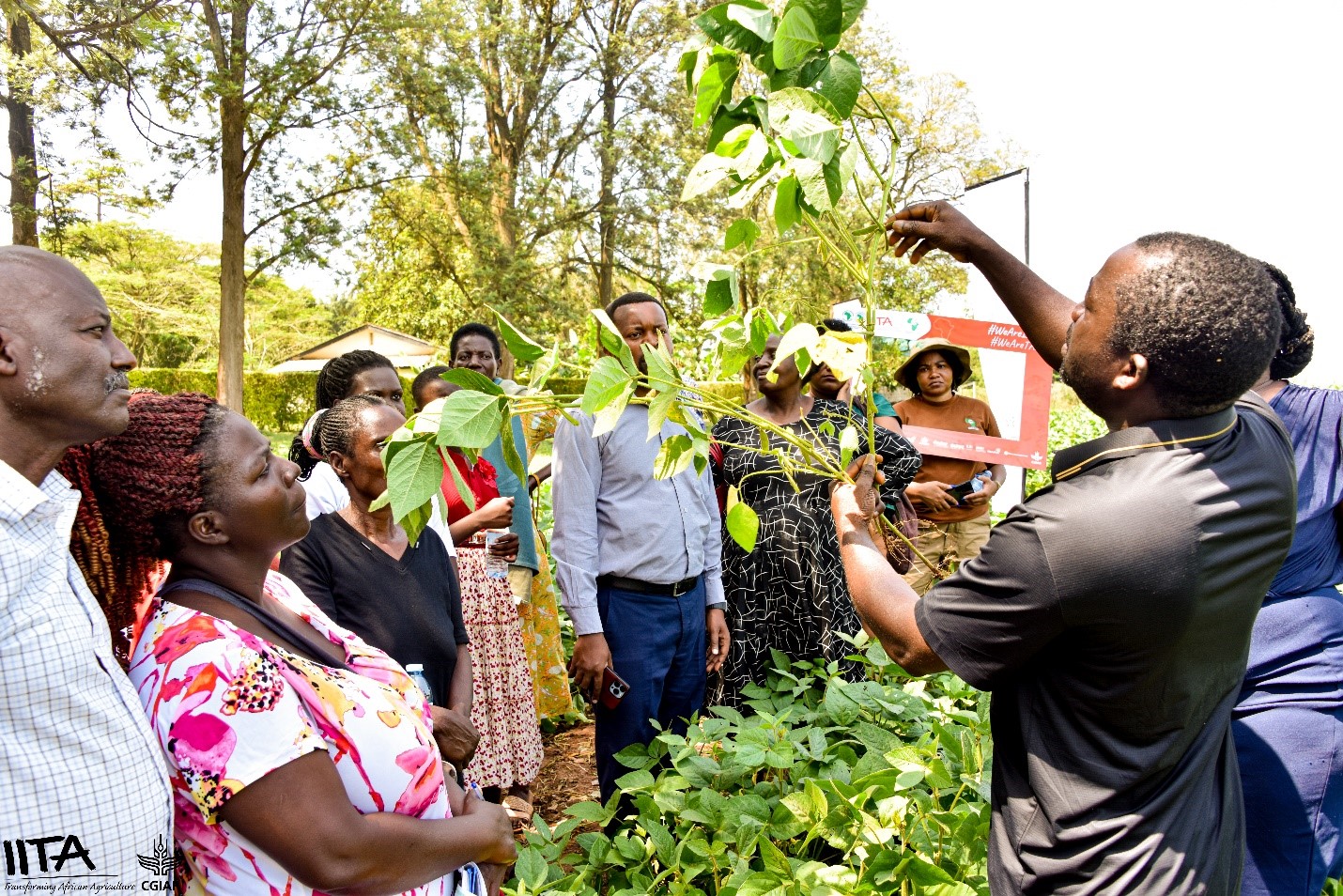
Dr Oluwaseun Omikunle from IITA/TAAT Soybean Compact compares Nodumax and Makerere’s Rhizobia-inoculated soybean plants
On 1 December 2025, IITA-CGIAR hosted the Technologies for African Agricultural Transformation (TAAT) Soybean Green Field Day at its campus in Namulonge, Kampala, Uganda, bringing together over 100 stakeholders to showcase TAAT soybean innovative production technologies. The event aimed to address the optimal productivity and adoption of improved soybean technologies, a strategic commodity in Uganda’s agricultural transformation agenda, by demonstrating and comparing the performance of Nodumax (IITA’s inoculant), Makerere’s Rhizobia and foundation seed (from the soybean breeding program) and farmer practices, and facilitating knowledge sharing, stakeholder networking, and technology exhibitions on improved soybean production and marketing.
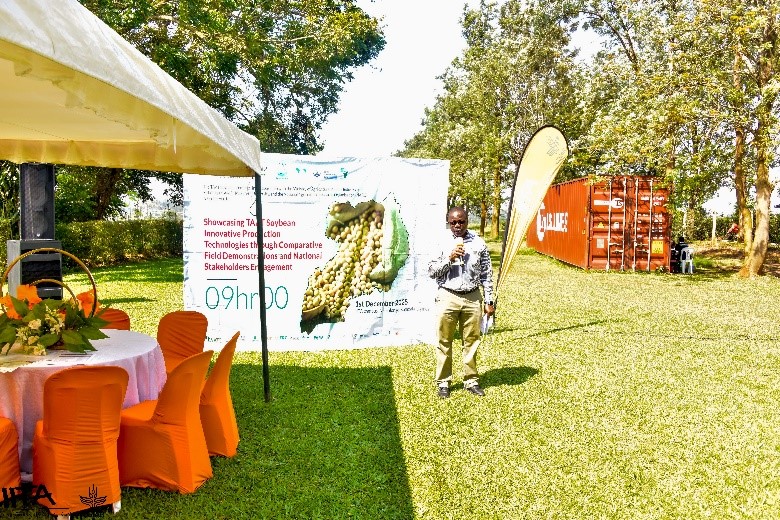
Dr George Mahuku delivering his welcome remarks
The event was opened by Dr George Mahuku, IITA Uganda Country Representative, who highlighted the importance of youth involvement in agriculture. “We actually in Uganda in 2015, and we also have the Enable TAAT Youth Program. We have realized that most African countries have a predominantly young population – in Uganda, over 60% of the population is youth. So, we must involve them in agriculture.”
The TAAT program, a key flagship initiative of the African Development Bank’s Feed Africa strategy (2016 – 2025), aims to boost agricultural productivity across Africa by rapidly delivering proven technologies to millions of farmers. TAAT seeks to generate an additional 120 million metric tons (MT) of agricultural produce and improve the livelihoods of over 40 million smallholder farmers across Africa by 2025.
Dr Omikunle Oluwaseun from IITA/TAAT Soybean Compact’s Technical Expert highlighted four key technologies to improve soybean productivity, including improved resilient seeds, inoculants, good agronomic practices, and timely planting. “The target is to increase the yield from 800kg to 2.5 metric tons per hectare,” he said. He emphasized proper spacing (5cm x 50cm) and highlighted Nodumax, an IITA-developed inoculant that can be stored at room temperature for up to one year. “When farmers follow these principles, their productivity, yield, and overall livelihood will greatly improve,” he noted.
The event featured entrepreneurs’ exhibitions of soybean improved seed varieties (Maksoy 1 to 6), inputs such as Nodumax inoculant, Rhizobia inoculant, herbicides, fertilizers, and Soy processed and value-added products, including soybean composite flour, soybean-fortified products, including soybean beverages, yogurt, ice-cream, bread, and fortified “daddies” and “mummies“.
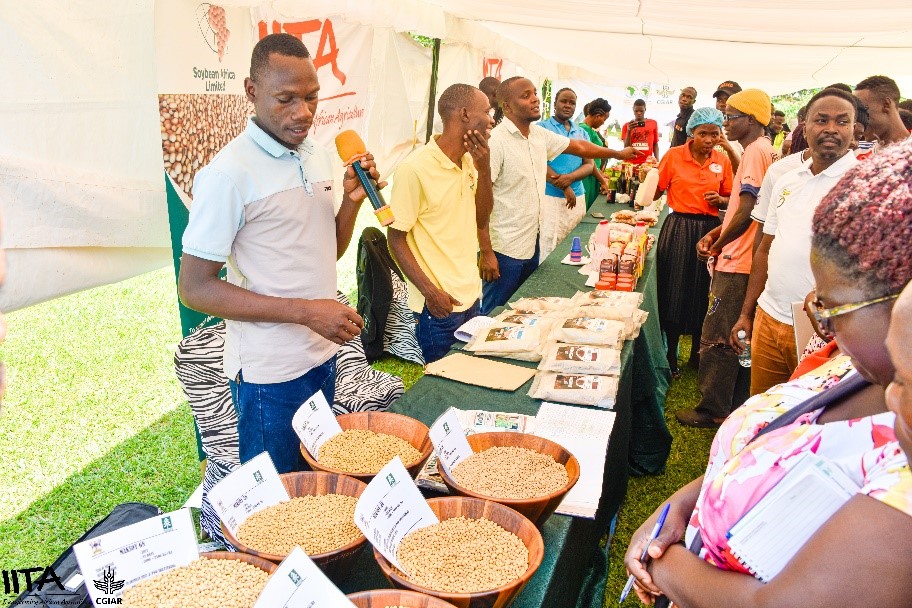
Youth Agripreneurs exhibiting soybean-based products
Prof. Phineas Tukamuhabwe from Makerere University highlighted the university’s work on soybean research and development, including the release of six Maksoy varieties, which account for over 90% of soybean varieties grown in Uganda. “We work with other research institutions, NGOs, and the private sector to enhance seed systems,” he said.
Joel Mbabazi from Soybean Africa expressed enthusiasm about the potential of Nodumax, saying, “It’s good to see how Nodumax is performing in the field, and we are looking forward to working with IITA to commercialize Nodumax.”
A farmer, Jioweria Namutebi from Bombo, shared her experience with soybean production, saying, “Soybean is rich in Vitamin A, and it’s a source of income leading to reduced poverty. To cultivate soybeans, you use few inputs and yet get high yields.”
Dr Martin Chemonges, the Senior Agricultural Inspector for Seed Inspection at the Ministry of Agriculture, Animal Industry, and Fisheries (MAAIF), urged farmers to use certified seeds with green labels, noting that they contribute 50-60% to productivity. “We cannot talk about increasing production without quality seed,” he stressed. He advised farmers to seek local government support for guidance on good practices, aiming to boost production for both home use and market sale.
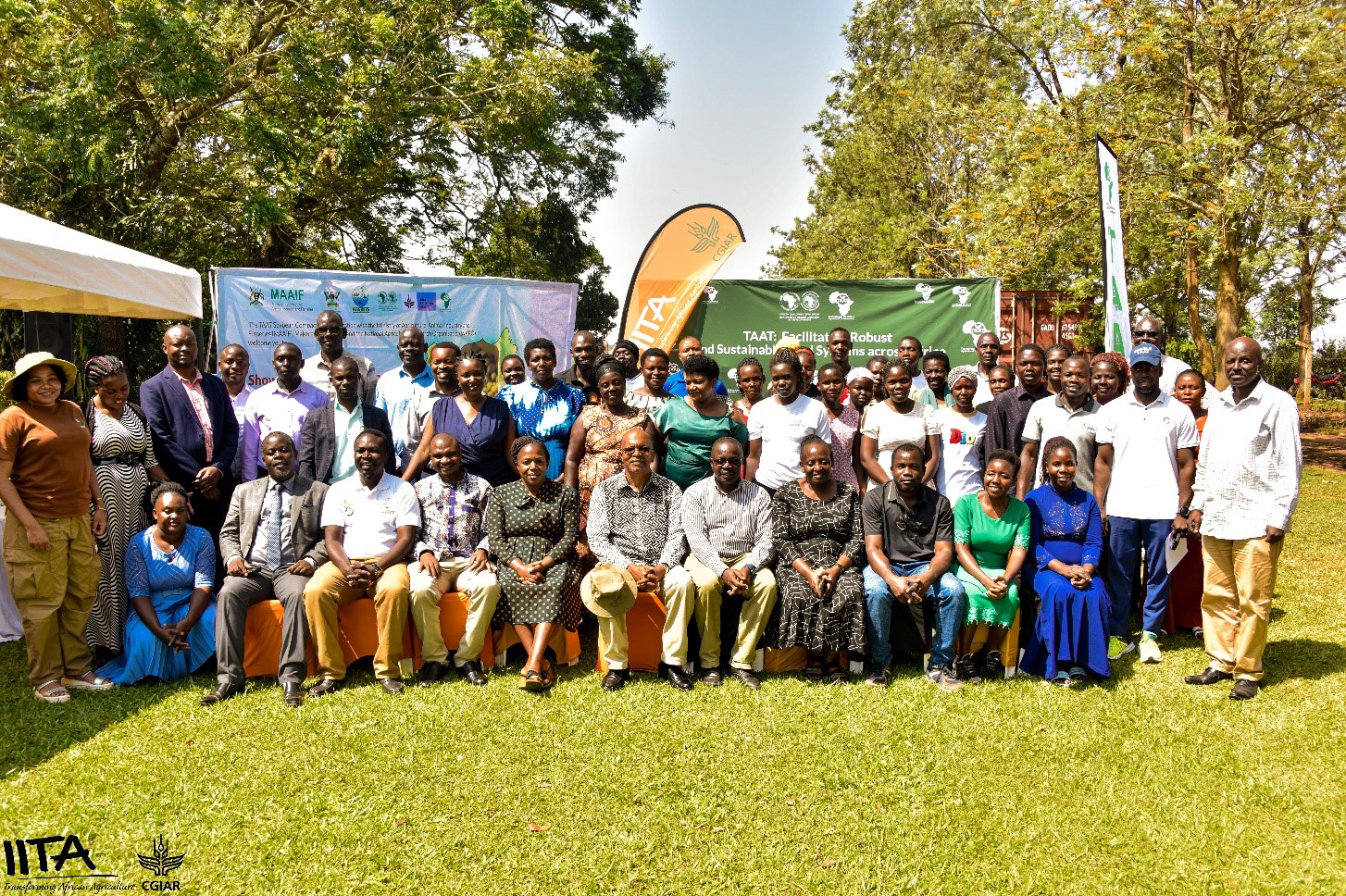
Participants of the Green Field Day
The event concluded with remarks from Dr Eunice Kansiime of the National Agricultural Research Organization (NARO), who highlighted NARO’s efforts to revitalize soybean research and development in Uganda. She encouraged farmers to adopt improved varieties, such as MakSoy 3N and 6N, which offer high yields and tolerance to soybean rust. “Seek guidance from research institutes or online manuals to boost productivity and tap into the strong market demand for soybeans,” she advised, emphasizing the use of inoculants like Rhizobium and Nodumax, and following best agronomic practices.
The Soybean Green Field Day provided a platform for stakeholders to share knowledge, experiences, and best practices in soybean production. It highlighted the potential of soybeans to improve livelihoods and contribute to Uganda’s agricultural transformation agenda.
Contributed by Moureen Awori (IITA-Uganda) with contributions from; Welissa Mulei (IITA-Kenya/TAAT), Beckie Nakabugo (IITA-Uganda/TAAT), Dr Oluwaseun Omikunle (IITA-Nigeria/TAAT), John Obaniyi (IITA-Nigeria/TAAT)


No Comments