
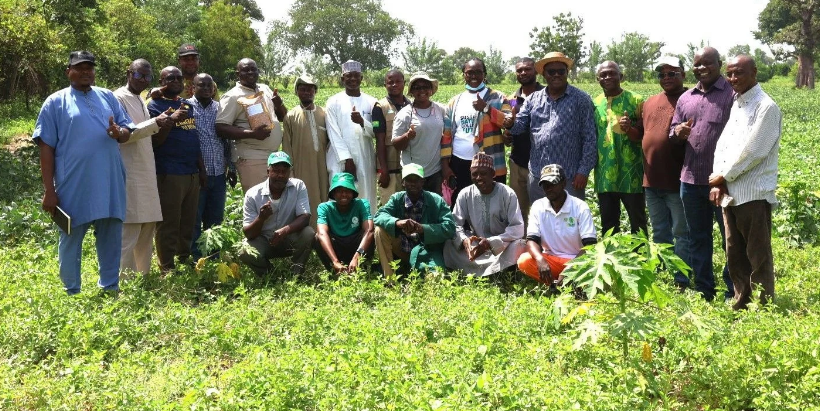
Farmers and researchers after the Zaria field day.
IITA–CGIAR has showcased promising soybean and cowpea varieties at its research farm in Samaru, Zaria, Kaduna State, highlighting the importance of aligning crop improvement with farmers’ needs, industry requirements, and reliable seed supply systems, while strengthening farmers’ livelihoods. The field walk, led by Professor Lucky Omoigui, an IITA Seed Systems Specialist, brought together seed companies, industrial processors, research and development partners, other stakeholders, and local farmers to foster stronger partnerships and align crop quality with market demands, exchange technical knowledge, and expand access to quality seeds for Nigerian farmers. Participants examined selected varieties, including recently released materials and promising varieties undergoing seed multiplication, and discussed opportunities to improve access to quality seed and accelerate adoption of improved crop varieties.
“The field day provides an opportunity for stakeholders to meet, discuss, and see the potential of these improved varieties,” Prof. Omoigui explained, highlighting the importance of creating awareness about varieties that may not yet be widely known among seed companies and processors. During the field walk, he explained that modern crop breeding goes beyond developing high-yield varieties. It also considers farmers’ and consumers’ characteristics such as maturity period, resistance to pests and diseases, adaptation to different environments, seed characteristics, and market preferences.
For soybean, different varieties are developed to meet the requirements of distinct market segments. While some processors prioritize varieties with high oil content, others require varieties with desirable high flour and protein content for food processing and confectionery production. Two soybean varieties, TGx 1951-3F and TGx 2020-4E, were highly rated by the seed companies and industrial processors that attended the field walk.
The Seed Specialist emphasized that these requirements must be considered alongside farmers’ production realities, including climate variability, limited land availability, and the need to improve returns on investment. For cowpea, the evaluation included plant architecture, pod characteristics, disease tolerance, and other traits that influence productivity, processing, and consumer acceptance.
Participants also observed cowpea trials on research fields that have been used for decades for crop screening. These trials help researchers assess how promising materials perform under disease and pest pressure, providing useful information for breeding decisions before varieties are advanced towards release. The approach reflects an increasingly market-oriented breeding strategy in which researchers engage stakeholders early to ensure that new varieties respond to the needs of farmers, processors and consumers.
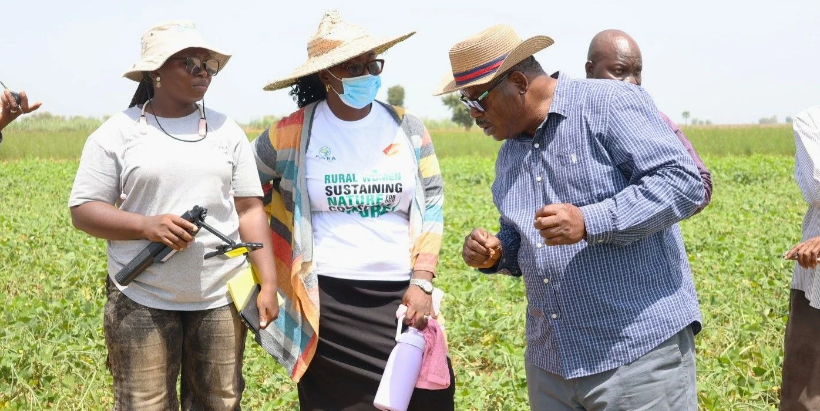
Particpants at the Zaria field day.
Strengthening the seed supply chain
A key issue highlighted during the event was the seed multiplication fields for early-generation seeds (EGS) production, particularly breeder and foundation seeds, which form the basis for producing certified seeds for commercial distribution.
Prof. Omoigui noted that even when improved varieties have been developed and released, farmers cannot fully benefit if seed companies lack access to the high-quality EGS materials required for certified seed production and distribution. He explained that IITA works with national agricultural research programs, private-sector seed producers, and universities to strengthen the supply chain, thereby increasing the availability of improved varieties and responding to growing market demand.
The field walk also allowed seed companies to assess promising materials directly, ask technical questions, and discuss opportunities for multiplication and wider distribution. By bringing researchers and commercial seed producers together, the initiative aims to shorten the gap between variety release and adoption, ensuring that improved genetics translate into practical benefits for farmers.
Similarly, Emmanuel Nandom Sunday, Assistant Research Officer with Premier Seeds Nigeria Limited, described the field walk as an opportunity to learn more about improved cowpea and soybean varieties suited to different production environments and understand the quality characteristics required by processors. He welcomed the focus on seed multiplication, noting that farmers’ demand for improved varieties makes access to enough quality seed essential for the coming planting seasons.
Stakeholders highlight performance and adoption
Dr Esther Ibrahim, a Program Officer with the Alliance for a Green Revolution in Africa (AGRA) in Nigeria, commended the collaboration with IITA and expressed optimism about the performance of the cowpea varieties being evaluated. She noted that the field walk provided an opportunity to observe promising materials, particularly varieties with encouraging pod characteristics and the potential to perform under challenging field conditions.
Dr Ibrahim also highlighted the importance of making improved varieties available alongside appropriate crop management practices. She observed that Nigeria’s soybean productivity remains below the potential demonstrated by improved varieties under suitable conditions. According to her, combining access to quality seeds with greater farmer awareness and appropriate agronomic practices could help improve national yields. She further expressed hope that promising cowpea varieties still undergoing evaluation would progress through the necessary stages towards release and eventually reach farmers, supporting improved nutrition and access to affordable plant-based protein.
Representing Flour Mills Nigeria, John Blessing Oyekanmi also commended IITA’s breeding efforts. He highlighted improvements he observed in soybean performance, particularly reduced root lodging and encouraging pod formation. His observations underscored the importance of evaluating crop characteristics that can influence farmers’ experiences in the field and the performance of varieties under production conditions.
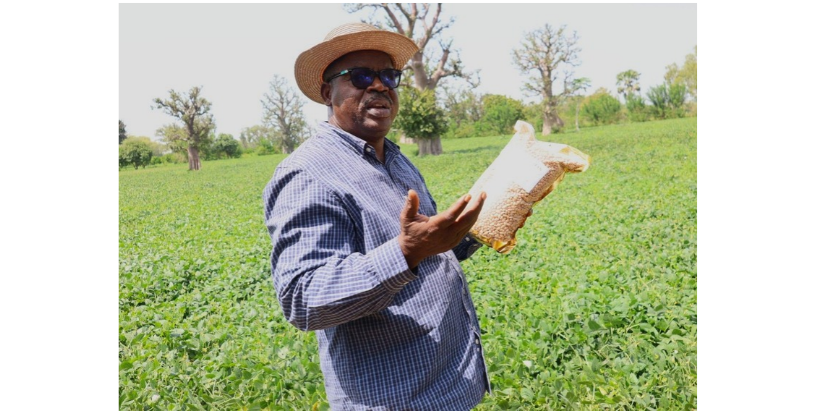
Prof Lucky Omoigui talking about ALKAM-SUPER cowpea variety.
Consumer preferences also matter
Among the cowpea varieties discussed was ALKAM-SUPER, released in 2025, which Prof. Omoigui said was gaining traction among farmers, consumers, and other value-chain actors. He attributed interest in the variety to its desirable seed characteristics, attractive appearance, adaptability, and relatively short cooking time. These qualities can make it appealing to consumers, particularly households seeking to reduce the time and energy cost required to prepare meals.
The variety illustrates why crop improvement must consider consumer preferences alongside agronomic performance. A variety that produces well but does not meet market or household preferences may struggle to achieve widespread adoption.
Prof. Omoigui encouraged stakeholders to promote varieties with established market potential and work together to improve awareness, seed availability, and market linkages. He also highlighted the importance of maintaining product identity and quality throughout aggregation and marketing.
The discussion reinforced the need for sustained collaboration among breeders, seed experts, seed companies, processors, aggregators, and farmers to ensure that improved varieties deliver value across the agricultural value chain. Beyond showcasing crop performance, the field walk reinforced the importance of partnerships in scaling agricultural innovations. Participants discussed opportunities to multiply promising varieties, strengthen seed supply, and promote production practices that can help farmers improve yields while managing production costs.
Prof. Omoigui encouraged farmers to obtain seeds from accredited or registered seed companies, stressing that using quality seed is an important foundation for improved crop productivity. He also called for continued investment in breeding, seed systems, and awareness-creation activities to accelerate the adoption of improved varieties.
For IITA and its partners, the next step is to ensure that the new promising crop materials progress through the appropriate evaluation and release processes, while strengthening the systems needed to multiply and distribute released varieties.
The field walk demonstrated that the journey from research to impact depends not only on developing improved crops, but also on ensuring that farmers can access the right varieties, supported by suitable agronomic practices and reliable markets. As Nigeria seeks to improve agricultural productivity, strengthen food and nutrition security, and meet growing demand from agro-industries, collaboration among researchers, seed producers, processors, and farmers remains essential to turning crop-breeding advances into tangible benefits for farming communities.
Contributed by Sarah Sallau


No Comments