
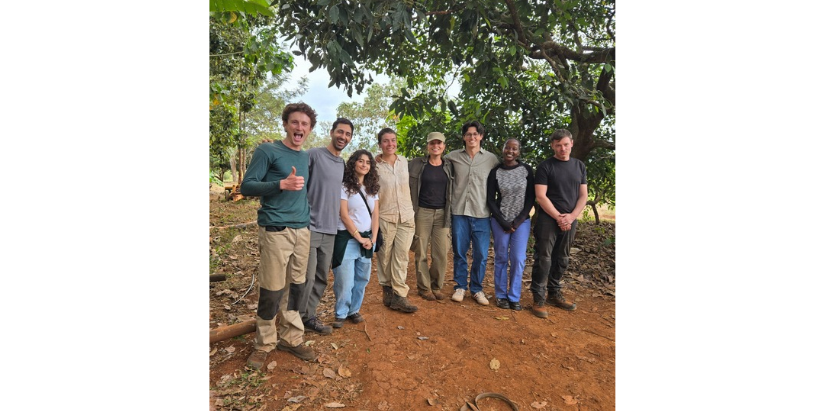
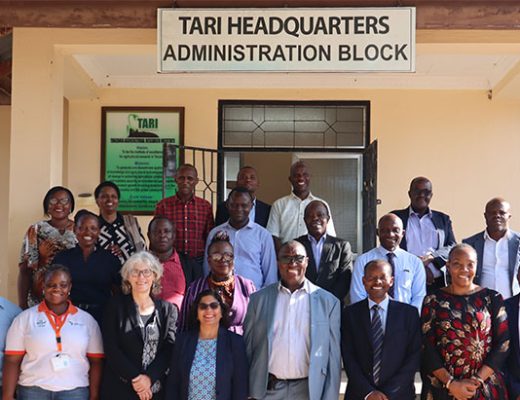
The CarboRestore research team at the Maragua field site in Murang’a County, Kenya.
In Maragua, Murang’a County, researchers are testing whether combining crushed basalt, biochar, and compost can help restore soil fertility, improve crop productivity, and remove carbon dioxide from the atmosphere. The CarboRestore field experiment brings together IITA, the University of Antwerp, and Tukalime Ventures to investigate an approach that links soil restoration with climate change mitigation and sustainable agriculture. Led by John Choptiany from IITA’s CGIAR Climate Action program, the project is investigating how degraded soils can be restored to support productive agriculture while storing carbon.
Building a new soil layer
After nearly two years of planning, the experiment moved into field implementation. The approach combines three techniques: enhanced rock weathering, biochar application, and soil carbon sequestration through organic matter. Together, these are intended to improve soil properties while increasing carbon storage. Crushed basalt supplies minerals that release nutrients as the rocks weather and react with carbon dioxide. Biochar, produced from biomass under low-oxygen conditions, provides a more stable form of carbon and can improve soil properties. Composted manure adds organic matter and nutrients, supporting soil fertility and water retention.
The team is applying different rates of basalt across eight plots, while keeping the biochar and compost application rate constant. Control plots will help researchers compare the treatments with unamended soil and conventional fertilization. This design will help identify how basalt application rates influence soil development, plant growth, and carbon sequestration.
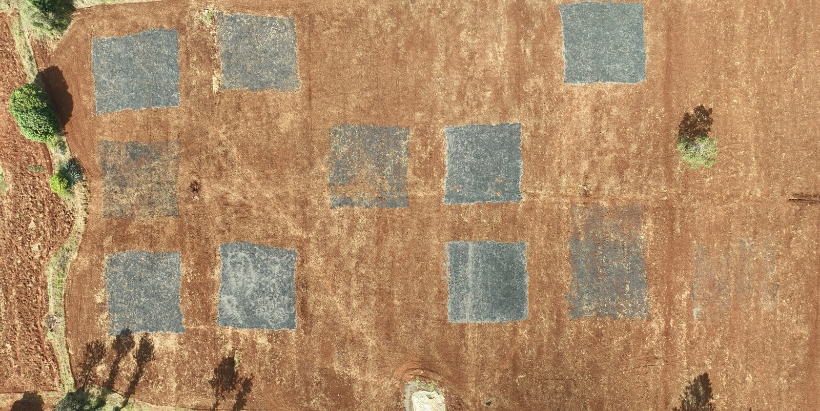
Aerial view of the experimental plots established to investigate how crushed basalt, biochar and compost can improve soil health and support carbon removal.
Testing the approach in the field
The experiment took place on a 1.6-hectare farm in Maragua. Although the site has supported crops such as maize, tomatoes, and beans, soil analyses indicate that its clay-rich soil has low capacity to retain nutrients. This presents an opportunity to investigate whether basalt weathering can improve the soil’s chemical properties and nutrient availability.
The initial crop is Castor. Its deep roots and ability to fix atmospheric nitrogen make it useful for studying plant performance and its contribution to soil fertility. Researchers will measure plant growth and biomass, as well as changes in soil properties and nutrient concentrations.
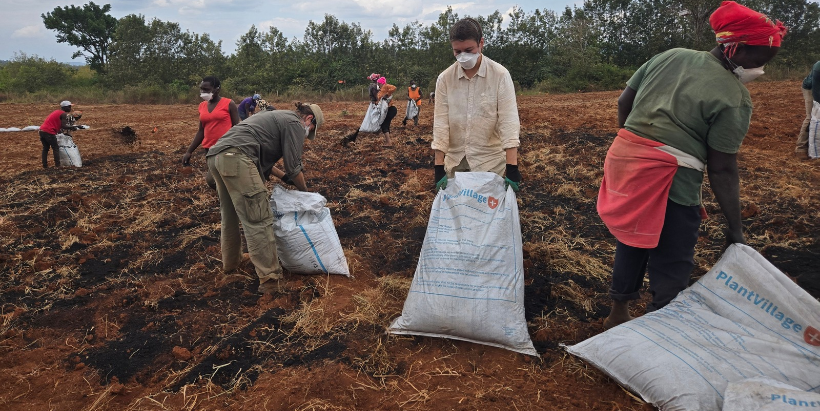
University of Antwerp fellows working on the plots University of Antwerp research fellows work on the field plots as part of the CarboRestore experiment.
Measuring carbon and soil change
Carbon removal is a central objective, but demonstrating its effectiveness requires more than applying soil amendments. Researchers will monitor soil and water chemistry, moisture, carbon levels, mineral weathering, and plant performance over time. Soil and plant samples will be analyzed to assess changes in nutrient availability, carbon storage, and other indicators of soil development. These measurements will help identify which treatment rates offer the greatest benefits and whether the amendments can improve crop production while removing carbon dioxide from the atmosphere.
The team will also investigate potential heavy metal releases from the project to help assess the suitability of the site for agricultural use. This multi-year monitoring will provide evidence of how the treatments perform under real field conditions and whether improvements in soil quality and carbon storage can be sustained.
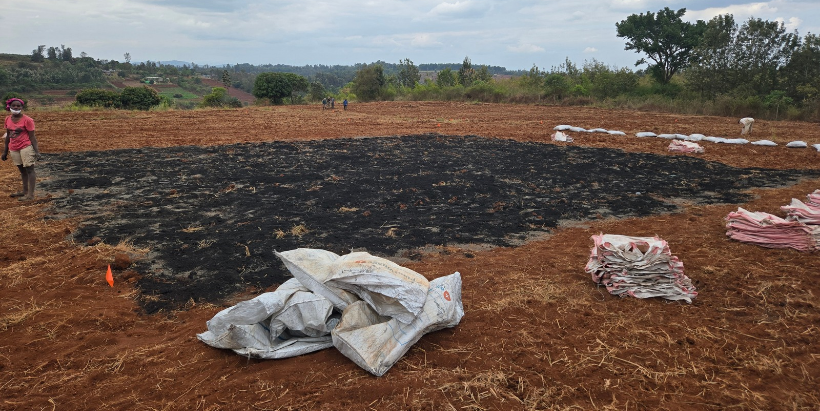
Close-up of an applied plot A close-up of a treated plot following the application of soil amendments for the Maragua field experiment.
Connecting soil restoration to opportunity
Beyond the field experiment, the approach raises questions about how carbon removal could support agricultural investment. The project explores the potential for verified carbon credits to help finance soil restoration and other agricultural improvements. Castor production is also being considered for its potential to supply oil for sustainable aviation fuel, creating a possible link between agricultural production and emerging markets.
These opportunities will depend on the evidence: whether the treatments improve soil and crop performance, how much carbon they remove, and whether the approach can be implemented economically.
For farmers working with nutrient-depleted soils, the long-term goal is to find practical ways to restore productivity without compromising food production. The coming years of monitoring and analysis will help determine whether this combination of soil restoration techniques can deliver measurable agricultural and climate benefits.
Contributed by Purity Khaoya


No Comments