
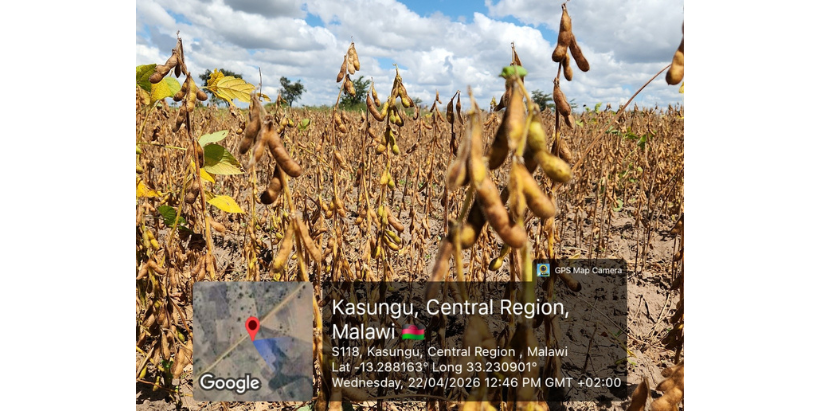
Close-up shot of mature, pod-heavy soybean plants at the Kasungu demo site in Malawi.
The challenge: Economic vulnerability
Malawi currently stands as the world’s most tobacco-dependent economy, with the crop accounting for nearly 70% of its foreign exchange earnings. This narrow reliance has left the nation vulnerable to global market shifts, a situation recently worsened by acute foreign exchange shortages and a severe fuel crisis. To build a more resilient economy, the Soybean and Youth Compacts of the Technologies for African Agricultural Transformation (TAAT) program, in partnership with the Department of Agricultural Research Services (DARS), is working to establish soybean as a viable, high-value alternative.
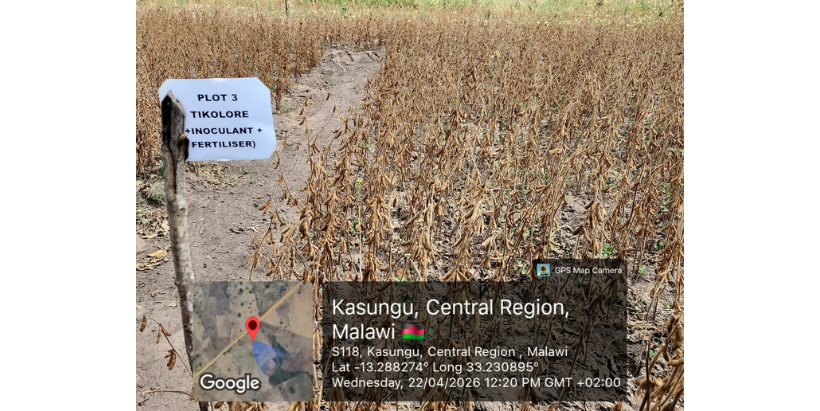
Trial demonstration with the core technical intervention and trial comparisons.
The intervention: Proving the business case
From 22 to 24 April 2026, agricultural leaders and farmers gathered at the Kapaladzala EPA in Kasungu District for a series of on-site processing and Farmers’ Brown Field Days. The event was designed to move beyond theory and demonstrate the practical “business case” for soybeans.
A central highlight was the stark contrast in production costs. In Malawi, a single bag of NPK fertilizer costs approximately 220,000 MWK ($125.40 USD), and the price is rising. For a one-hectare field, a farmer typically needs two bags, totaling $180 USD—an amount that is out of reach for many. However, the field trials showcased a powerful alternative organic inoculant. Six sachets of Biofix inoculant are required for the same hectare and cost only 6,000 MWK (roughly $3 USD).
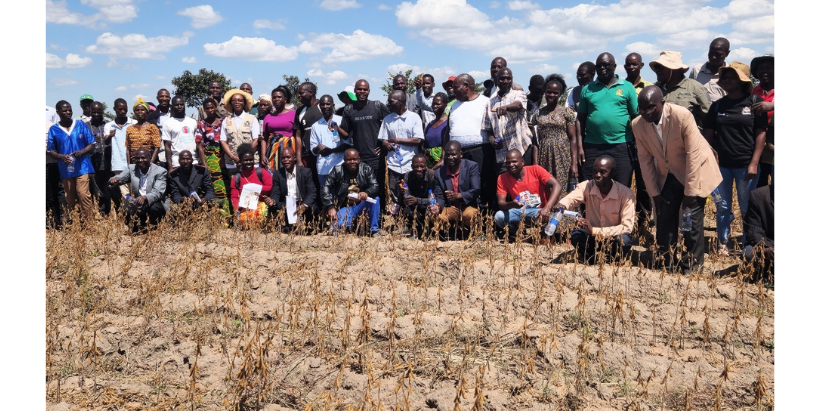
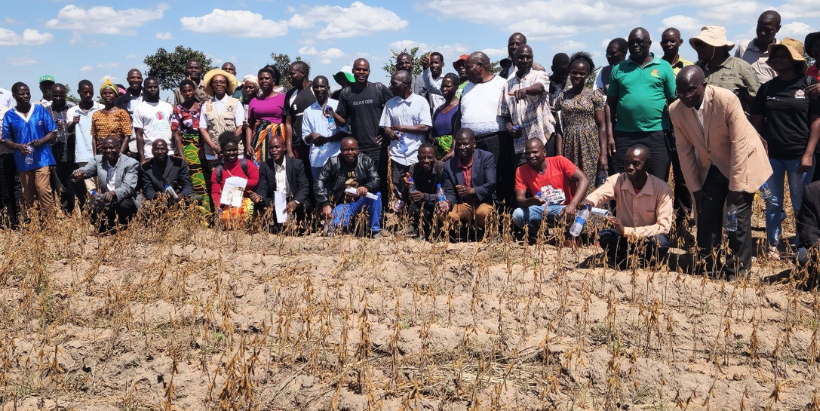
A section of field day participants and facilitators.
Because properly inoculated soybeans extract most of their nitrogen from the air, these $3 sachets allow farmers to achieve yields nearly equivalent to those of expensive synthetic fertilizers. With switching to this solution, farmers can reduce their primary input expenses by 98%, providing a vital financial lifeline during the country’s ongoing economic crisis.
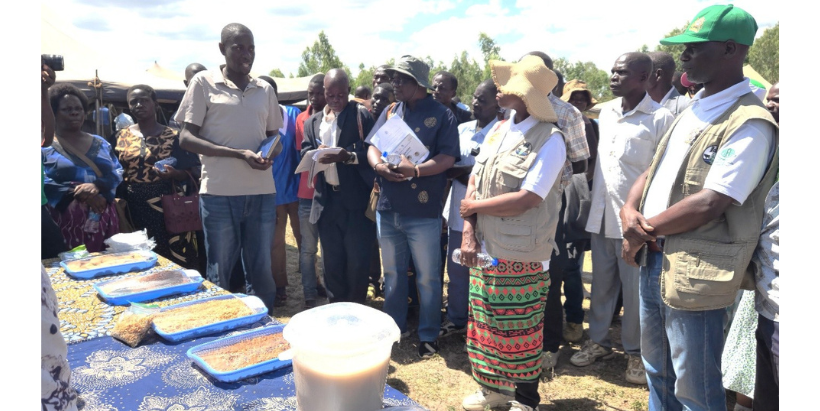
Field Day participants gathered around the demonstration table listening to the trainer about value addition to soybeans.
The impact: Youth leadership and market value
The transformation in Kasungu is being driven by a new generation. Youth agripreneurs like Timothy Munthali, CEO of Tawonga Edibles, led practical value-addition sessions, showing participants how to process raw soybeans into highly nutritious food products. “Many were surprised at how soybeans can create highly nutritious foods,” a participant noted, observing how these youth-led activities are turning a raw commodity into a diverse business portfolio.
The market logic is increasingly clear to local growers. While maize currently fetches approximately 400 MWK/kg, soybean grain is valued at 1,600 MWK/kg. This fourfold increase in value, combined with lower production costs, is changing how farmers approach their land. Beyond direct profits, the TAAT compact is actively promoting soybeans as a strategic rotation crop for Malawi’s traditional maize fields. Because continuous maize cultivation heavily depletes the soil, introducing soybeans is a vital Good Agricultural Practice (GAP) that naturally fixes nitrogen and replenishes essential soil nutrients in staple-crop fields.
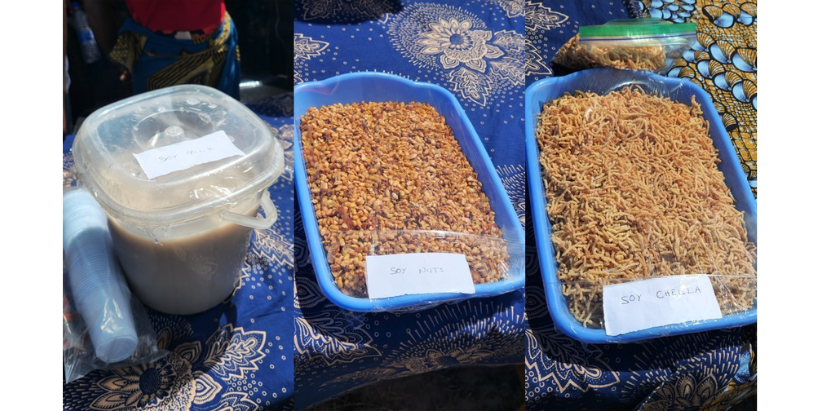
Soy-based products prepared practically on-site by the participants.
Reflecting on the tour of the high-density demo plots, one local farmer shared: “Before, we only planted our seeds—often recycled—and hoped and prayed for a good harvest. Now we see that if a farmer doesn’t have a lot of funds, he can use quality seeds with inoculant only and still get a very good yield. The fact that inoculant is so much cheaper than fertilizer addresses our biggest hurdle: the cost of production.”
The TAAT-DARS partnership is fundamentally modernizing Malawi’s seed system by shifting the focus to a market-led business case. This initiative bridges the gap between research and reality, making climate-resilient varieties and low-cost technologies accessible to smallholders. In an era of economic uncertainty, soybeans are no longer just a crop; they are “Green Gold,” securing farmers’ livelihoods and the nation’s economic future.
Contributed by David Kolawole Ojo, Oluwaseun Ayoola Omikunle, John Obaniyi, and Welissa Mulei

No Comments