
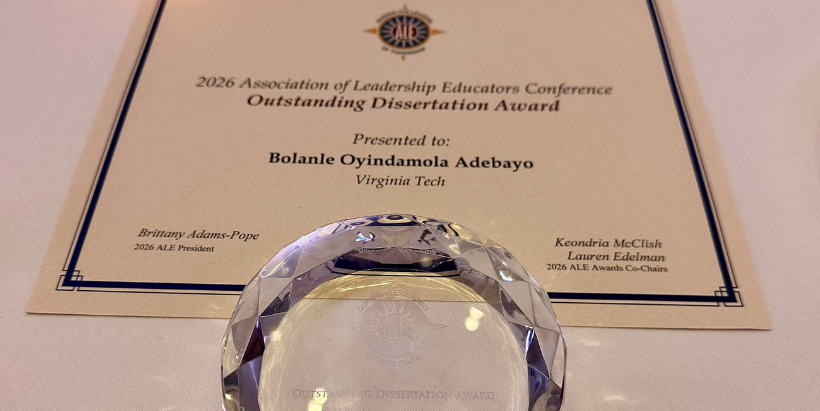
Dr Bolanle Oyindamola Adebayo’s award.
When farmers participate in crop breeding as citizen scientists, their knowledge and experience can shape which varieties are advanced and released. But participation can also strengthen farmers’ own knowledge, agency and leadership—capacities that can, in turn, make breeding and variety dissemination more effective.
This reinforcing relationship is at the heart of the research of Dr Bolanle Oyindamola Adebayo, whose Virginia Tech dissertation, Exploring Participation in Citizen Science for Leadership Identity Development and Food Systems Leadership: A Case Study of Tricot, received the 2026 Association of Leadership Educators Conference Outstanding Dissertation Award. The Association of Leadership Educators (ALE) is a professional association bringing together scholars, educators, and practitioners to advance leadership education through research and practice. The award therefore recognizes the dissertation within the broader professional field of leadership education, placing research conducted through IITA’s tricot work within a wider community of leadership scholars, educators, and practitioners.
The recognition followed the dissertation’s selection by Virginia Tech’s Department of Agricultural Leadership and Community Education (ALCE), within the College of Agriculture and Life Sciences, as its Outstanding Dissertation among departmental submissions for 2025. It was subsequently nominated for Virginia Tech’s university-wide Outstanding Dissertation Award in the Social Science, Business, Education, and Humanities category.
Bolanle’s interest in IITA’s citizen science research led to her appointment as an IITA Research Fellow and to conducting her PhD research within the ongoing tricot work. Her research was carried out in collaboration with participating farming communities and the IITA GEYSI program team. At Virginia Tech, the doctoral research was conducted under the academic guidance of Dr Hannah M. Sunderman, Bolanle’s advisor and dissertation chair.
Her research provides important new evidence of the social processes associated with diverse women and men participating as citizen scientists and knowledge partners in breeding. Specifically, she investigated how such participation can strengthen farmers’ and other community members’ leadership agency and enable them to exercise wider leadership within agricultural food systems.
Farmers as citizen scientists
The tricot – Triadic Comparisons of Technologies – approach enables large numbers of farmers to test small sets of varieties on their own farms and evaluate them under their own production, processing and consumption conditions. Farmers are not merely sources of data: they experiment with varieties, observe their performance and contribute knowledge based on their own priorities and circumstances.
IITA and its partners have been developing this approach in cassava breeding for more than a decade. The objective is not simply to consult farmers, but to systematically bring the priorities and experiences of diverse crop users into variety design, testing and deployment. Within the joint IITA–NRCRI cassava breeding programme, evidence from farmers and processors—including social and gender-differentiated preferences—has informed product profiles and variety advancement.
This has also translated into the formal breeding process. IITA and NRCRI worked with Nigeria’s variety release system to adapt tricot for official on-farm testing. Trials with 120 farmers across six states were subsequently inspected by the variety release committee. In October 2024, two cassava varieties evaluated through this process, Renewed Hope and Biggie, were formally released.
The development of this process is documented in earlier IITA stories on using tricot for on-farm testing for variety release and the subsequent monitoring and inspection of the trials with Nigeria’s variety release committee.
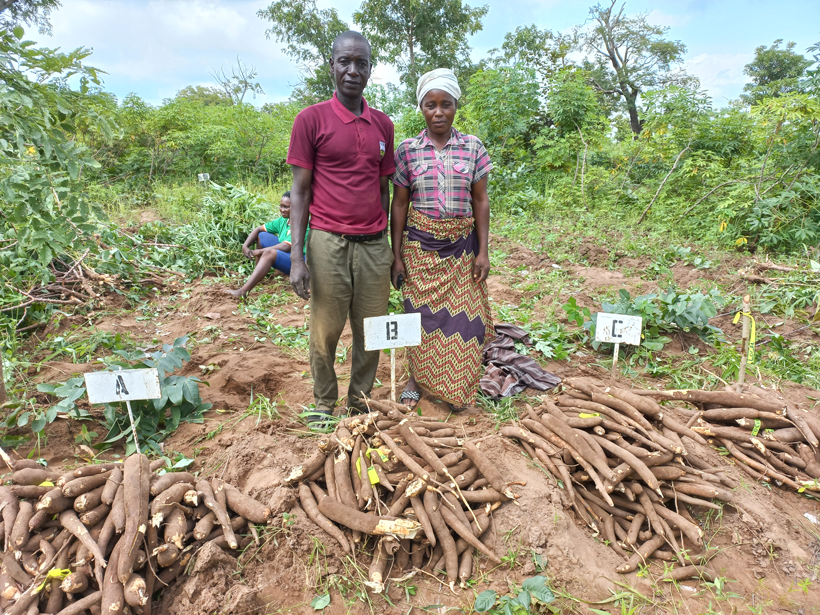
A Tricot farmer and his wife at Daudu, Benue state.
What happens to the people who participate?
Bolanle’s research helps us understand another dimension of this process. Working with tricot participants, other farmers, community leaders and IITA staff in Osun State, Nigeria, she examined how participation in citizen science related to the development of farmers’ leadership identity and agency, and how this could translate into wider leadership within agricultural food systems.
She found that participants gained knowledge and competencies through experimentation. Importantly, this was accompanied by changes in how some participants saw themselves and how others in their communities perceived them. Farmers described becoming recognized as knowledgeable people in their communities. This strengthening of leadership identity and agency created a basis from which participants could take on wider roles.
These wider leadership roles were visible in practice: participants advised other farmers, shared knowledge and planting material, independently multiplied and shared planting materials of varieties they preferred, taught processing practices, and acted as bridges between their communities and researchers. Some of these activities extended beyond what was formally required by the tricot project, illustrating how participation could stimulate farmers’ own initiative and agency within their communities. Importantly, participants also wanted to do more. “Aspiring to extend food systems leadership” emerged as a distinct theme in the research, with farmers expressing interest in working with a wider range of varieties and crops, multiplying preferred planting materials more widely, and extending the benefits of their knowledge and experimentation to other farmers. In this way, Bolanle’s research connects personal leadership agency with leadership exercised more broadly in agricultural food systems.
This is particularly interesting because tricot was not designed as a leadership programme. The findings point to what can happen when citizen science is taken seriously.
The findings also reinforced a direction in which the IITA team has continued to develop tricot: greater attention to human-centred design and to closing the feedback loop with participating farmers. This includes co-designed tricot results feedback sheets, which return trial results to participating farmers in an accessible form, and participatory video work with tricot farmers, which creates opportunities for farmers to communicate, interpret and exchange their own experiences. These developments seek to strengthen horizontal communication, recognition and continued engagement, which Bolanle’s research identified as important for leadership agency and wider leadership in agricultural food systems.
When social and breeding outcomes reinforce each other
Bolanle’s findings complement earlier research on the social impact of participation in tricot. An MSc study by Gospel Oghosa Edughaen examined both the social outcomes associated with participation and the subsequent spread of cassava varieties through farmers’ networks. The study found strengthened community interactions and increased knowledge, recognition and leadership opportunities among participants. Participants described tricot as a learning platform and reported feeling empowered, gaining respect and becoming better connected to authorities within their communities.
At the same time, women and men continued to replant and share varieties they had evaluated. The study traced access to these varieties to 392 secondary and tertiary beneficiaries, with varieties spreading within and beyond the original trial communities. Much of this happened through farm visits, gifting and informal social networks. Participants became important sources of information about the varieties, while their experiences and testimonies helped generate trust in them.
Taken together, this work points towards a reinforcing relationship between meaningful participation, social outcomes and effective breeding. Through citizen science, farmers gain knowledge and opportunities to exercise agency. This can strengthen their interaction with breeders and their contribution to identifying priorities and evaluating varieties, helping breeding respond more closely to the realities of diverse crop users. When varieties respond to those priorities and circumstances, farmers have reasons to continue growing, sharing and exchanging knowledge about them through their own networks.
The process can therefore continue beyond an individual trial. As knowledge and planting material circulate, the leadership agency developed through participation can extend into wider agricultural food-system leadership, with farmers taking on roles as advisers, experimenters, seed sharers and connectors between research and their communities. These wider roles can, in turn, strengthen local networks for varietal evaluation, knowledge exchange and dissemination.
This suggests that social outcomes associated with citizen science should not be seen only as additional benefits of participatory breeding. They may also form part of the social conditions and capacities through which breeding becomes more responsive, varieties move through farming communities, and continued innovation becomes possible.
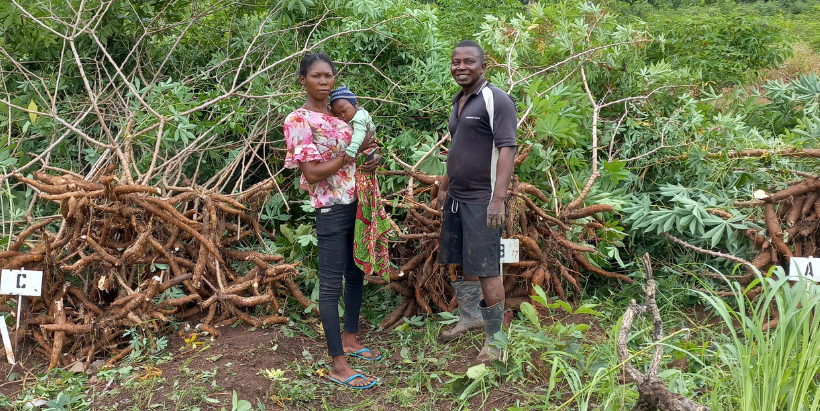
A Tricot farmer and his wife at Gboko, Benue state.
Meaningful participation as part of effective breeding
For this reinforcing process to work for diverse crop users, who participates matters, but so do the conditions under which they participate. Gender and social differences shape people’s access to land and other resources, their responsibilities and the opportunities they have to participate in research. Bolanle’s research describes, for example, how small trial plots and flexibility around participants’ time helped reduce barriers to participation, including constraints faced by women.
Who participates, whose knowledge is heard and under what conditions people can participate therefore affect both who benefits from citizen science and what evidence becomes available to breeders.
These principles form part of IITA’s wider transdisciplinary management approach for cassava breeding, which connects breeding with the social, gender, processing and food-quality realities of crop users.
Bolanle’s award is first and foremost recognition of her research achievement. At the same time, her work draws attention to processes that can remain less visible when breeding is assessed mainly through technical and varietal outcomes.
Her findings suggest that leadership agency and wider leadership in agricultural food systems are important social outcomes in their own right, while the knowledge, relationships and local networks associated with these forms of agency may also strengthen the farmer–researcher interaction, learning and dissemination on which effective participatory breeding depends.
Congratulations to Dr Bolanle Oyindamola Adebayo on receiving the 2026 Association of Leadership Educators Conference Outstanding Dissertation Award.
Bolanle conducted her PhD research as an IITA Research Fellow in collaboration with participating farmers and communities and the IITA team. Béla Teeken (IITA GEYSI Program Lead) provided on-the-ground supervision of the field research, working with Abolore Bello (Senior Research Supervisor), Olamide Nwanze (Senior Research Associate), Durodola Owoade (Senior Research Supervisor), and Gospel Edughaen (Data Curation Officer / On-Farm Verification Support Officer). At Virginia Tech, Dr Hannah M. Sunderman served as Bolanle’s academic advisor and dissertation chair, with Dr Eric K. Kaufman, Dr Kim Niewolny, Dr Mac Benavides (Kansas State University), and Dr Raphael Landaverde (Texas A&M University) serving on her doctoral committee.
Contributed by Béla Teeken
Further reading
- Bolanle Adebayo’s award-winning dissertation – Virginia Tech
- Transdisciplinary management system for cassava breeding
- IITA–NRCRI: Using tricot for on-farm testing for variety release
- IITA–NRCRI: Monitoring tricot trials with the National Varieties Release Committee
- Amplifying tricot farmers’ voices through participatory video
- Capturing lived experiences of voluntary contributions with Participatory Video: A manual and lessons learned
- IITA Cassava breeding adapts tricot for inclusive breeding (video)
- Adoption of the Tricot approach: Transforming seed selection at One Acre Fund Rwanda
- Tricot approach: How farmers actively support research. Success story by One Acre Fund Rwanda(video)

No Comments