
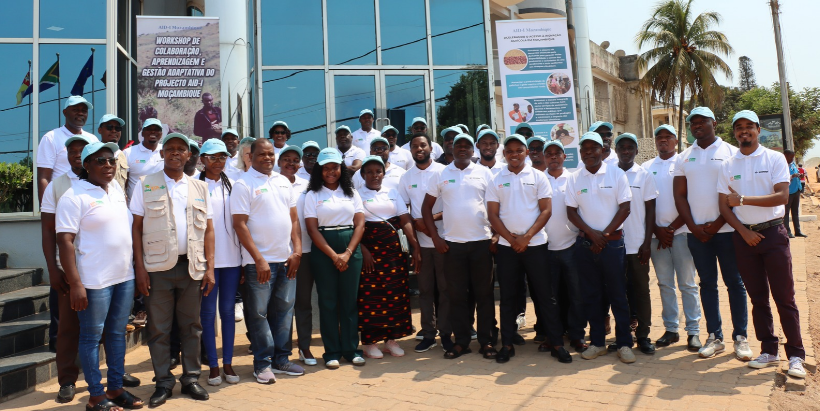
AID-I partners in Nampula for the collaboration, learning, and adaptive management workshop
After two years of implementing agricultural innovations across northern Mozambique, partners of the Accelerated Innovation Delivery Initiative (AID-I) came together in Nampula with a critical question: What is working, what needs to change, and how can promising approaches be delivered more effectively and sustainably to farmers?
Held on 22–23 September 2026, the AID-I Collaboration, Learning and Adaptive Management Workshop brought together 15 implementing partners to examine implementation experience and evidence, share lessons, identify bottlenecks, and strengthen collaboration across the consortium.
Rather than focusing only on completed activities, the workshop provided an opportunity to look across two years of implementation and consider how field experience can inform the next phase of AID-I.
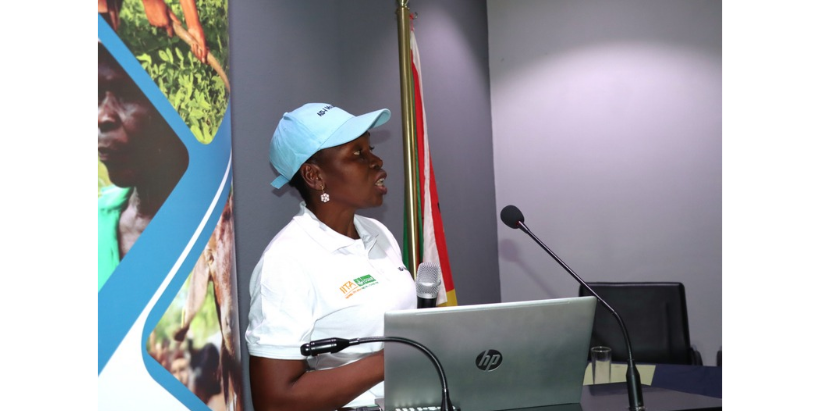
AID-I partners presenting the two-year implementation work.
Learning from two years of implementation
Across the two days, partners examined progress and experience across AID-I’s interconnected areas of work, including seed systems; soil and crop management and advisory services; livestock production; nutrition; and markets and credit. The discussions considered achievements alongside implementation challenges, emerging opportunities, and lessons that could strengthen future delivery.
A central message was that learning must lead to action. By comparing implementation progress against planned targets and discussing experiences across institutions, partners identified practices that should be strengthened and areas for adjustment and opportunities for greater collaboration. For AID-I Project Coordinator António Aljofre, one of the most immediate benefits is the ability to use these lessons to improve implementation. “The first immediate benefit is that, based on the lessons learned, we can adjust our implementation plan for the third year; we can influence specific changes—drawing on the project’s overall scope—and perhaps ask partners to focus more on aspects we know yield results,” Aljofre said.
This approach reflects the principle of collaboration, learning, and adaptive management: implementation should not remain fixed when evidence and field experience indicate opportunities for improvement.
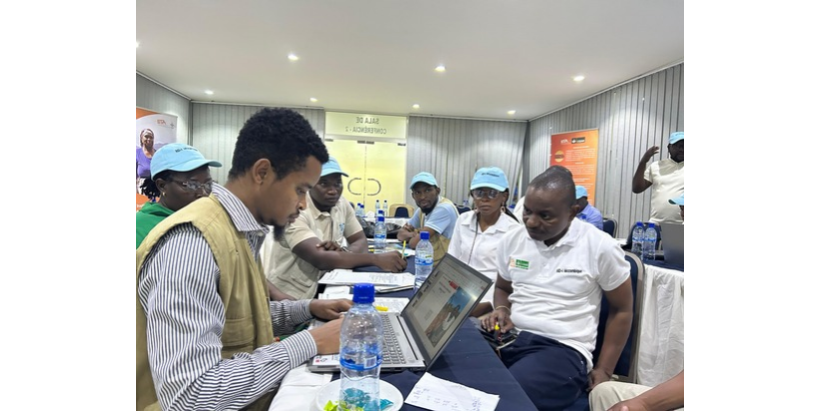
Mixed working groups examined lessons across AID-I interventions and identified opportunities for stronger collaboration and more integrated delivery.
Strengthening evidence for better decisions: Learning from what works and what does not
The workshop also reinforced the importance of moving beyond reporting activities undertaken toward understanding what happens after an innovation reaches farmers. This means asking deeper questions: Are farmers using the promoted innovation? Do they continue using it? What factors encourage or constrain adoption? Which delivery approaches are performing well? What needs to be adapted?
The discussions, therefore, emphasized generating stronger evidence and using implementation experience to guide subsequent decisions. This is particularly important for distinguishing between an innovation that has simply been delivered and one that farmers have adopted and continued to use. In this way, monitoring and learning become management tools—not only reporting requirements.
Another important feature of the workshop was creating space for partners to discuss not only successes but also implementation difficulties and opportunities for improvement. This distinction matters. Understanding why an approach did not perform as expected can be as valuable as documenting success because it allows implementation teams to identify constraints, test alternatives, and avoid repeating ineffective approaches.
For Isabel Uacheta of Nossara Cooperative, interaction among partners provided an opportunity to learn from how other organizations operate and to use that knowledge to improve work with communities. “This meeting was extremely helpful for exchanging experiences and understanding how other institutions operate; it was a valuable learning opportunity,” she said, adding that discussing weaknesses and opportunities can help partners improve results for communities and the project.
This culture of reflection is particularly important for a multi-partner initiative. Instead of knowledge remaining within individual organizations or components, experience can be shared across the consortium and translated into collective improvement.

Partners explored opportunities to strengthen coordination across seed production, quality assurance, distribution, and demand planning to improve farmers’ timely access to quality seed.
From individual interventions to connected solutions
An important dimension of the workshop was looking beyond individual partner activities to understand how interventions and institutions can better complement one another.
Agricultural innovation does not end with making a technology available. Farmers may simultaneously require access to quality seed and planting material, appropriate agronomic knowledge, advisory services, markets, finance, and other supporting services. Strengthening the connections among these areas can therefore be as important as strengthening the individual interventions themselves.
Mixed-group discussions enabled partners working in different areas to exchange experiences, identify potential complementarities, and explore opportunities for stronger coordination.
Participating partners also highlighted the value of bringing institutions together. “It is excellent for fostering synergies among institutions working on the same project—institutions that previously hadn’t had the chance to sit down, talk, or showcase their work—a situation that improved with the arrival of AID-I,” said Abdul Sumará of Aflalivre. Sumará also emphasized the value of creating coordination forums ahead of agricultural campaigns so that partners can identify opportunities to support one another before implementation begins.
Rethinking how quality seed reaches farmers
Seed-system discussions provided one example of how implementation experience can stimulate broader thinking about sustainable delivery. A sustainable model would require clearly defined and complementary roles among government and regulatory institutions, research organizations, seed companies, and other private-sector actors, local seed producers, extension services, development partners, and farmers. Participants discussed challenges associated with the timely availability of high-quality seed and explored how a more decentralized early-generation seed system could strengthen production and delivery. The discussion considered how demand forecasting, source-seed production, decentralized multiplication, quality assurance, distribution, and traceability could be better connected.
The emerging pathway can be summarized as: farmer & market demand → joint seed planning → source/EGS production → decentralized multiplication → quality assurance → processing & inventory → last-mile distribution → farmer use → tracking & feedback → next-season planning
Such a system would move seed planning closer to actual demand while maintaining the genetic purity, quality assurance, certification, and traceability required for a reliable seed system.
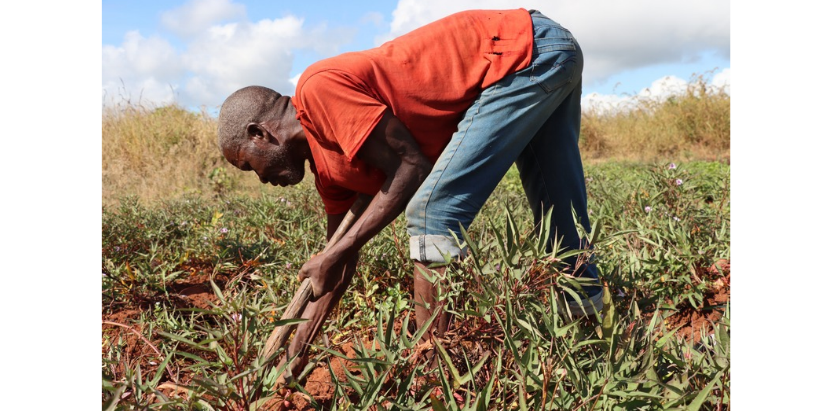
Learning from farmer experience will be critical to understanding which innovations are adopted, sustained, and suitable for wider scaling.
From learning to adaptation and scale
The Nampula workshop demonstrated that the value of collaboration goes beyond bringing organizations into the same program. Its greater potential lies in connecting expertise, implementation experience, and evidence around common problems faced by farmers.
The next step is therefore to translate the lessons generated during the workshop into practical changes in implementation. A simple learning pathway captures this ambition:
This learning will also provide material for documenting AID-I’s experience beyond routine project reporting—capturing what worked, what did not, why, what was adapted, and what future agricultural programs can learn from the initiative. Ultimately, the objective is not simply to count innovations delivered, but to understand how those innovations can become accessible, adopted, sustained, and capable of contributing to resilient livelihoods at scale.
About AID-I Mozambique
The Accelerated Innovation Delivery Initiative (AID-I) is a four-year initiative implemented by 15 partners across the Nampula, Niassa, and Zambézia provinces in Mozambique. It aims to accelerate the adoption of innovations that help smallholder farmers address production challenges while strengthening their resilience to environmental and other shocks.
As AID-I moves into its next phase, the lessons generated in Nampula provide an opportunity to strengthen coordination, adapt implementation, and document approaches with potential for continued adoption and wider application. The central message emerging from the workshop is straightforward: innovation delivery becomes stronger when evidence informs decisions, partners work across institutional boundaries, and learning leads to adaptation.
Contributed by Safira Chirindza



No Comments