
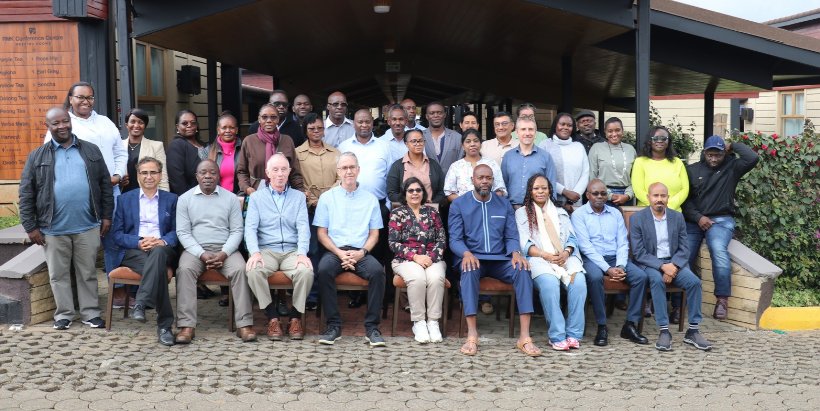
IITA Eastern Africa Hub Internationally Recruited Staff during the retreat.
A promising technology. A pressing need. What connects the two?
That question shaped discussions at the 2026 IITA Eastern Africa Hub Retreat, held from 16 to 18 September at Ridge Cabin Resort in Limuru, Kenya. Colleagues from across East African countries, programs and disciplines gathered to review progress, examine delivery challenges and sharpen priorities for the Hub.
Dr Leena Tripathi, Director of the IITA Eastern Africa Hub, emphasized the collective effort required.
“Our strength lies in working as one Hub, bringing together our diverse expertise, aligning our priorities and turning strong research into solutions that deliver tangible benefits for communities across Eastern Africa,” she said.
Discussions on IITA’s Impact Bundles brought that ambition into focus. Teams examined technology readiness, investment needs and the partnerships required for implementation. Is the technology ready? What evidence is missing? What will it take to operationalize the impact bundles?
The answers to these questions will guide country representatives as they refine the bundles, address gaps and strengthen engagement with governments and partners. Greater visibility and resource mobilization will be essential to support delivery.
The conversation also reached a familiar place: the school lunch plate.
Participants explored how IITA could support healthier, safer, and more affordable school meals through baseline studies on what learners eat, in what quantities, and aflatoxin contamination in maize flour. Such evidence could help partners improve both nutrition and food safety.
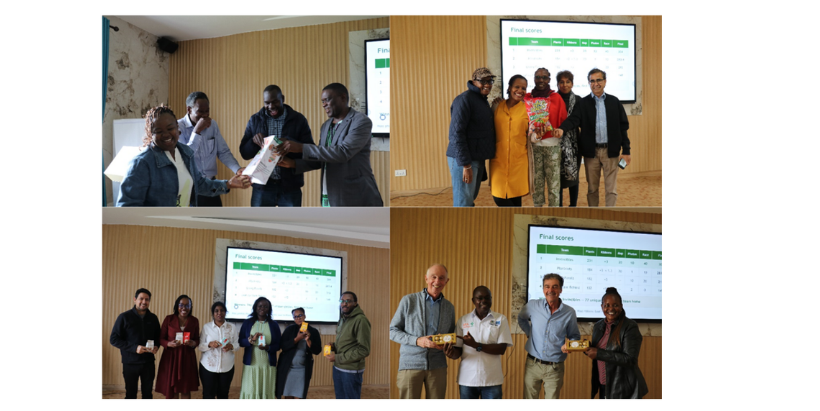
Prizing the winning teams. Some loved their gifts. Others couldn’t stop laughing at theirs.
A full plate is a start. A safe, nutritious one is the goal.
Climate discussions widened the view. Teams presented ideas across six priority areas, exploring how to develop them into initiatives and funding proposals. A proposed climate hub would consolidate datasets and improve access to information for research and decision-making. The climate team will now define the next steps.
Artificial intelligence ignited both interest and scrutiny. Alongside opportunities to improve research and institutional efficiency, participants considered risks to data integrity and confidentiality. Clear guidance and practical training were identified as key measures to help staff make informed decisions about how to use these tools responsibly, as well as a potential role for ‘AI Champions’ to support other team members.
The traditional team building activity in the middle of the retreat provided a different kind of research assignment.
Grouped by age, colleagues formed teams for a plant-identification challenge that brought a playful twist to the retreat. It also highlighted the Hub’s balance across generations. From its youngest colleagues – the self-styled ‘Invincibles’ – to its most seasoned members, affectionately called the “Living Fossils.”
The label was light-hearted. The energy was unmistakable. Here was a productive, dynamic and enthusiastic Hub, where fresh perspectives and years of experience had plenty to contribute. Beyond identifying plants, achieved through applying the full range of IT and AI tools, the activity gave colleagues a chance to connect, appreciate one another’s strengths and enjoy being a team.
That need for connection carried into discussions on communication capacity and information-sharing, with participants identifying gaps that limit how effectively teams draw on one another’s expertise.
The retreat closed with concrete priorities: refine the Impact Bundles, advance climate proposals, explore school nutrition research and strengthen the systems that support delivery. The next measure of progress lies in how teams translate those priorities into their programs, partnerships and daily work.
Contributed by Rose Harriet Okech

No Comments