
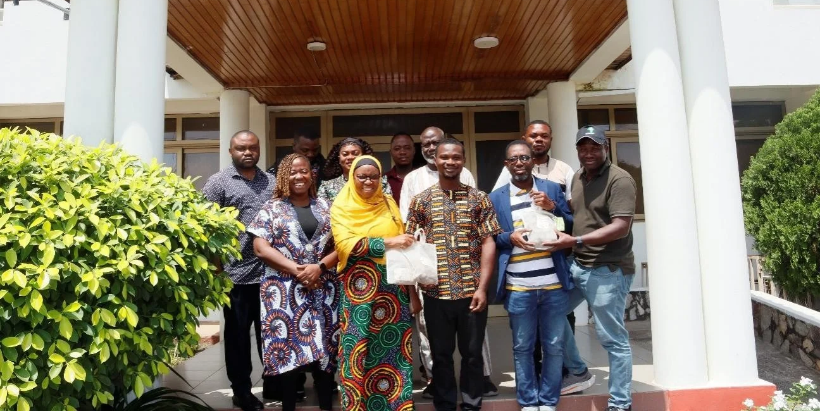
Participants during the Early Generation Seed engagement meeting in Accra, Ghana. Prof. Morufat Balogun, IITA (2nd left) and Dr Djana Mignouna, IITA (1st right) handing over the yam seeds to Dr Kwabena Darkwa, SARI (middle) and Dr Victor Acheampong Amankwaah (2nd right).
As part of efforts to support the availability of quality planting material for farmers ahead of the 2027 production season, IITA donated breeder seeds of two improved yam varieties to seed producers and national research institutions in Ghana recently.
The breeder seeds of SARI Pona and SARI Tila were distributed to private seed companies and national research institutions during a stakeholder engagement meeting on Early Generation Seed (EGS) yam demand estimation and production planning held in Accra.
The seeds have the potential to produce about 2.92 million foundation seed units in 2027 when multiplied using high-ratio propagation technologies, including hydroponics and leaf bud cuttings.
The meeting brought together key actors across Ghana’s yam seed system, including the Savannah Agricultural Research Institute (SARI), Crops Research Institute (CRI), the Plant Protection and Regulatory Services Directorate (PPRSD), private seed companies Hikmah Farms and IRIBOV, and agribusiness consulting firm Sahel Consulting Ltd.
The engagement formed part of IITA’s Inclusive Delivery area of work under the Breeding for Tomorrow (B4T) Science Program, which seeks to strengthen seed systems and improve access to high-quality seed of improved varieties.
Speaking on behalf of the IITA Seed Systems Program Lead, Dr James Legg, workshop lead Prof. Morufat Balogun said effective seed systems must be responsive to farmers’ needs while also enabling seed producers to build sustainable businesses.
“Our goal is to have a network of seed producers who can make a profit and sustain their businesses and, through this, meet the needs of the hundreds of thousands of farmers who stand to benefit from high-quality seed of improved or registered varieties,” she said.
She emphasized that seed production should be driven by actual demand, requiring closer collaboration among actors across the seed value chain to determine the varieties and quantities farmers need.
As part of the engagement, IITA and CRI presented findings from surveys conducted to better understand farmers’ demand for seed yam varieties and quantities in Ghana.
The findings, presented by Dr Victor Acheampong Amankwah, showed that SARI Pona was the most preferred variety among surveyed farmers, followed by SARI Nyamenti.
The results are being used by Early Generation Seed actors—including SARI, CRI, Hikmah Farms, and IRIBOV—to plan seed production for 2027 ahead of the planting season.
According to Prof. Balogun, who coordinates EGS yam production under Inclusive Delivery, understanding demand is critical to ensuring that seed producers invest in varieties and volumes that farmers actually want.
“Quality and improved varieties are key to producing better crops,” she noted, stressing the importance of connecting seed demand with production planning.
The engagement also introduced stakeholders to the Seed Requirement Estimation (SRE) tool, a web-based application developed by CGIAR centers to support seed agribusiness planning and estimate national seed requirements.
Participants contributed practical information on seed propagation ratios for different high-ratio multiplication technologies, including hydroponics and leaf bud cuttings. The information will be used to establish parameters for the SRE tool and support seed producers in planning their 2027 businesses.
The engagement reflects IITA’s broader effort to strengthen national seed systems through partnerships with research institutions, regulators and private-sector seed producers.
Under B4T, the Inclusive Delivery area of work focuses on building the capacity of national partners to deliver high-quality seed to farmers. The approach is particularly important for crops such as yam, which is highly valued for food, livelihoods and markets across Ghana and other parts of Africa.
By combining farmer demand information, production planning tools and access to breeder seed, IITA and its partners aim to help seed producers plan more effectively while expanding the supply of quality planting material to farmers.
The breeder seed provided at the meeting is expected to stimulate production of foundation seed in 2027, strengthening the pipeline from research institutions to commercial seed producers and, ultimately, to farmers.
Contributed by Francisca Ocloo, Morufat Balogun and ‘Timilehin Osunde

No Comments