
To mark the International Women’s Day (IWD), on 9 March 2026, CGIAR women staff in Tanzania, led by the International Institute of Tropical Agriculture (IITA), stepped away from their offices and research work to visit the Antonia Verna Rehabilitation Center for children living with disabilities in Kawe Municipal, Dar es Salaam.
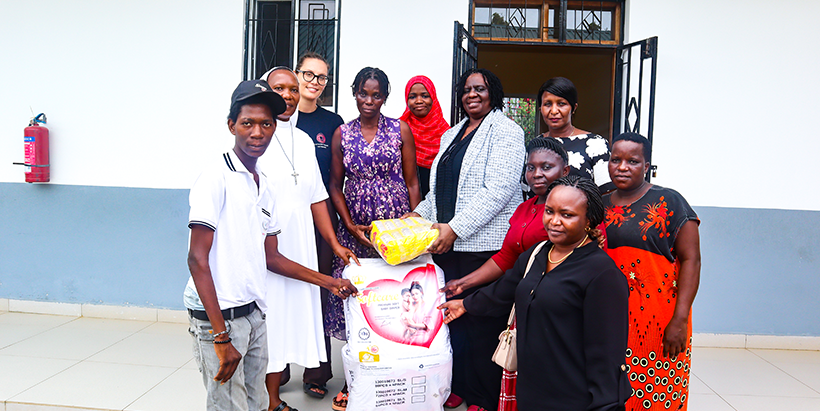
Some of the CGIAR women with beneficiaries and representatives of the Center in Tanzania.
This year’s IWD was under the UN theme “Rights. Justice. Action. For ALL Women and Girls” was a call to action to dismantle barriers such as discriminatory laws, weak protection and harmful norms to ensure equal rights for all women and girls. The official campaign theme “Give to gain,” emphasized collaboration and reciprocity because when individuals, organizations and communities give through donations, mentoring, time or resources, everyone gains. The visit by the CGIAR to the rehabilitation center targeted the women caring for children with disabilities, whose contributions in Tanzania are often ignored or forgotten.
Over one million children under 18 are estimated to be living with disabilities across Tanzania, and a significant number of their primary caregivers, mostly women, report experiencing domestic violence linked to disability and social stigma within the family. These mothers, aunts, and caregivers carry out demanding and largely unrecognized work of raising children with disability in a country where that work is almost entirely unsupported.
“As women and mothers, we understand your exhaustion and the sacrifice you make every day to care for these children. We appreciate the support the center provides to these women and their children,” said Mwantumu Omary, a researcher at IITA.
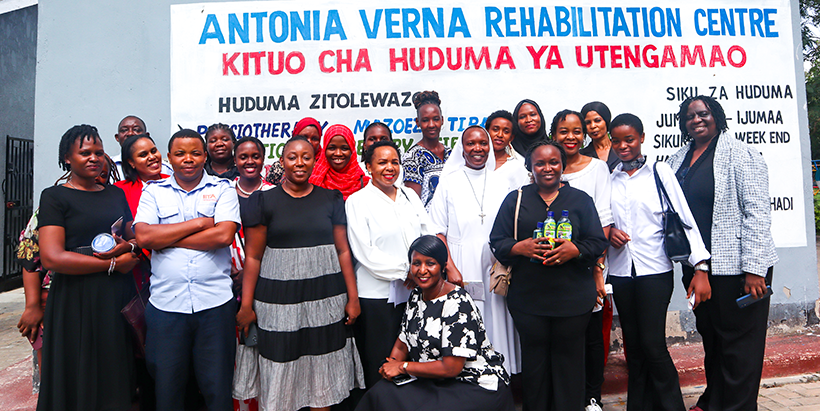
CGIAR representatives and the staff of the Antonia Verne rehabilitation center.
These women caregivers experience what advocates and researchers call “Double discrimination and compounded inequalities.” They are disadvantaged at the intersection of gender bias and disability stigma. They live in a society that still, in many spaces, measures a woman’s worth through productivity, marriage, and motherhood. The children, meanwhile, are too often framed within the social models of disability, who are treated as burdens, sources of shame, or ridiculed and treated as cursed.
Many women with children living with disabilities also face tradeoffs balancing between productive and caregiving roles. They often leave income-generating work to give full-time care to their children, which exposes them economic risks with no safety net. Some are abandoned by spouses who reject children with disabilities or face community and religious discrimination, and isolation from being too exhausted and too stigmatized to maintain a social life.
“We appreciate your visit. It has renewed our strength and given us hope in our challenges,” said Eva Moses, a mother of a child with disability at the Antonia Verna Rehabilitation Center.
During the visit, the CGIAR women donated diapers, food items such as fortified flour, soybean, rice, and powdered milk, to help address malnutrition among the children and a cash contribution toward health insurance coverage. In line with the IWD campaign theme, the donation was based on contributions by CGIAR Tanzania women and men staff. “CGIAR recognizes that the support of youth, women, and people with disabilities plays an important role in achieving more equitable and sustainable food systems,” Anthony Whitbread, Country Representative for ILRI Tanzania reflected.
“Our work in Africa is about creating the environment that better supports business opportunities and the creation of decent and fulfilling jobs.”
The occasion gave the women the opportunity to recognize that, despite their different backgrounds, they share common challenges, and that a shared understanding is the foundation from which women can work together. Staff from IITA, the International Livestock Research Institute (ILRI), the International Rice Research Institute (IRRI), and WorldFish, participated in the visit.
Contributed by Gloriana Ndibalema and Millicent Liani


No Comments