
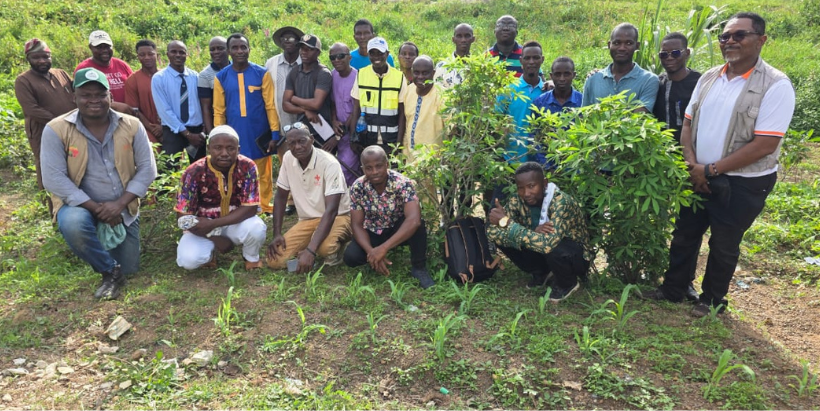
Field campaign activity in Sierra Leone.
For decades, farmers, researchers, and policymakers in Sierra Leone have worked with limited and outdated soil information, making it difficult to determine where crops perform best, what nutrients are needed, and how fertilizer/other input investments can deliver the needed impact.
Today, that is beginning to change as the technical assistance program launched in January 2026 under the World Bank-supported Food Systems Resilience Program (FSRP) is translating plans into action across the country.
Implemented by the Regional Hub for Fertilizer and Soil Health for West Africa and the Sahel, the initiative is advancing nationwide digital soil mapping, fertilizer and lime response trials across 10 districts, and capacity development for national technical teams. Together, these efforts are building the scientific evidence needed to support more precise fertilizer recommendations, improved soil management, and evidence-based agricultural decision-making.
This work directly supports the Government of Sierra Leone’s Feed Salone agenda to transform agriculture, strengthen food security, and reduce reliance on food imports. Achieving these ambitions requires more than increased access to agricultural inputs. It depends on reliable scientific information that helps farmers, researchers, and policymakers understand soils, target interventions, and manage nutrients more effectively. The initiative is helping Sierra Leone move from generalized soil management approaches toward a system informed by updated soil information, field-based evidence, and site-specific management recommendations.
Generating soil data and translating it to decision support systems
A central component of the initiative is the development of a national Digital Soil Information System that will provide the data needed for improved fertilizer and soil management decisions.
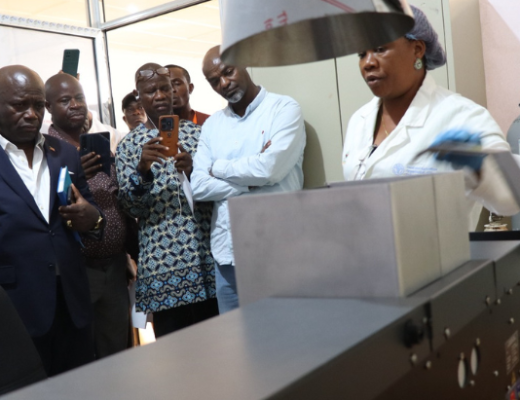
The process combines existing national soil knowledge with new field data. A total of 641 legacy soil samples collected during a 2022 national survey by the Sierra Leone Agricultural Research Institute (SLARI) and Njala University were recovered and shipped to the International Institute of Tropical Agriculture (IITA) laboratory in Ibadan, Nigeria, where they are being analyzed using conventional wet chemistry and Mid-Infrared (MIR) spectroscopy.
These legacy samples represent an important national resource. By integrating them with new field data, the initiative will strengthen Sierra Leone’s existing National Comprehensive Soil Survey database, which was previously too coarse to support detailed, site-specific recommendations.
To complement the legacy dataset, a nationwide soil sampling campaign is being implemented to generate additional high-quality data. The campaign targets 250 Primary Sampling Units, covering approximately 500 Secondary and 500 Tertiary Sampling Units nationwide. Samples are collected at different soil depths to capture variations in soil properties and generate the information required to produce validated digital soil maps. Together, historical records and new field observations will provide a stronger evidence base for agricultural planning, fertilizer recommendations, and sustainable land management.
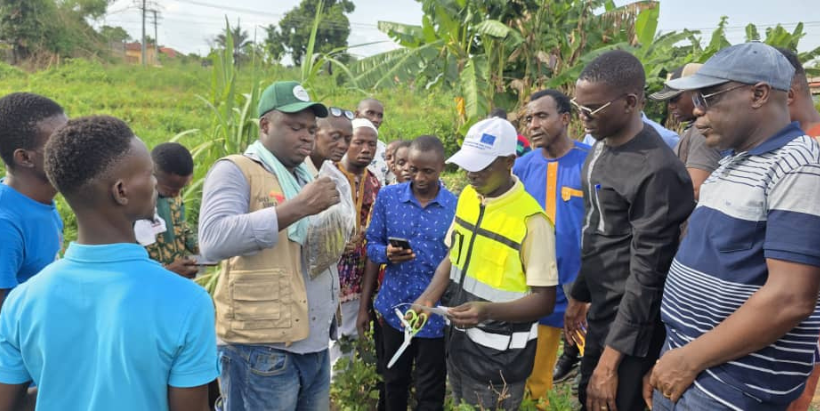
Field campaign activity in Sierra Leone.
Towards a site-specific nutrient and sustainable land management decisions
Developing effective fertilizer and other sustainable land management recommendations requires more than information about soil properties. It also requires evidence on how crops respond to nutrients under different soil conditions and farming environments.
Through structured on-farm trials, researchers are generating the data needed to develop and validate site-specific fertilizer and lime recommendations for rice and maize production.
The trials include:
- Nutrient omission trialsto determine how much of each nutrient the soil can naturally supply to crops, and how yields respond to added nutrients, will enable crop-soil modeling to set and develop crop and site-specific fertilizer recommendations. This ensures that farmers apply the right type and amount of fertilizer for each crop and location, optimizing crop productivity and soil resilience.
- Lime × fertilizer trialsto determine where and when farmers need lime, how much they should apply, and how to combine it with fertilizer to improve soil health and increase crop yields. The results will be used to develop practical, location and crop-specific lime recommendations for farmers to address soil acidity constraints.
- Lime demonstration plotsto educate farmers on the benefits of using lime to manage acidic soils. Through hands-on demonstrations, farmers learn how proper lime application can improve fertilizer use, increase crop yields, and support more productive and sustainable farming.
Trial sites have been selected across 10 districts, including Kambia, Tonkolili, Moyamba, Bo, Kenema, Bonthe, Port Loko, Bombali, Karene, and Falaba, covering different agroecological zones, including uplands, inland valley swamps, and bolilands.
Rice trial establishment has commenced, while maize trial implementation will follow during the August 2026 planting window. The evidence generated from these trials will support improvements to recommendation systems, including calibrating decision-support tools that translate scientific data into practical guidance for farmers.
Investing in national capacity
A key feature of the initiative is its focus on strengthening Sierra Leone’s own technical capacity. Before the nationwide soil sampling campaign began, 21 field personnel were trained across seven survey teams on soil sampling procedures, digital data collection, field navigation, and site characterization.
Additional training was provided to 14 field personnel responsible for implementing rice field trials, equipping teams with the skills needed to establish, manage, and collect reliable data from on-farm experiments.
The technical assistance program is also supporting the next generation of soil scientists. Three postgraduate students—two from the Federal University of Agriculture, Abeokuta, Nigeria, and one from Njala University, Sierra Leone—are conducting research aligned with the project’s objectives, gaining practical experience while contributing to project outputs.
By investing in people alongside data systems and research infrastructure, the initiative is helping ensure that Sierra Leone has the expertise needed to sustain improved soil management approaches over the long term.
Building a stronger agricultural future
The transformation underway in Sierra Leone is about more than producing new maps or conducting field trials. It is about building the systems required to make better agricultural decisions. By combining digital soil mapping, laboratory analysis, field-based research, and national capacity development, the initiative is laying the foundation for a future where fertilizer and other soil management recommendations are based on scientific evidence and adapted to local conditions.
For Sierra Leone’s Feed Salone agenda, stronger soil information means stronger decision-making, from government planning and agricultural investment to farmer-level choices about how best to manage land and nutrients.
Through collaboration among government institutions, research organizations, and technical partners, Sierra Leone is building the science needed to improve productivity, strengthen soil health, and support more resilient food systems.
Contributed by Ilerioluwa Oladipupo


No Comments