
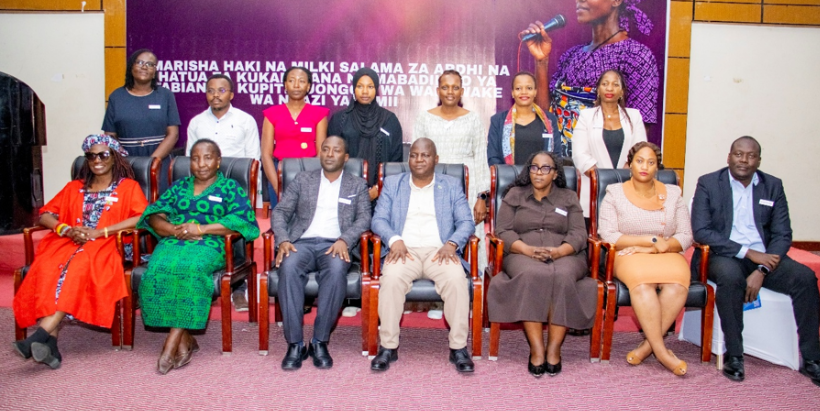
S4HL Symposium sponsor representatives, with the Deputy Minister for Lands, Housing and Human Settlements Development in the middle of the front row. (Photo credit: Landesa)
For over 70 percent of rural women in Tanzania, land is more than an agriculturally productive asset. It is the foundation for livelihoods, household food and nutrition security, economic empowerment, dignity, voice, and decision-making. Yet, despite legal protections, many women in Tanzania still face social norms, customary practices, and unequal power relations that constrain their ability to access, use, and control land.
The Stand for Her Land (S4HL) Symposium, themed “Advancing secure land rights and climate action through grassroots,” convened from 12 to 13 August 2026, in Dodoma, Tanzania, provided an important platform for reflecting on how community leadership, legal empowerment, and collective action can advance women’s land rights and contribute to more inclusive agrifood systems. Over 200 participants attended the event, which was officiated by Hon. Kaspar Mmuya, Deputy Minister for Lands, Housing and Human Settlements Development, who urged for more women’s land ownership.
“The government of Tanzania calls on women across the country to stand firm and use the opportunities available under the law to acquire, own, and use land securely,” he said, “land ownership is a critical foundation for women’s empowerment, family welfare, and community development.”
In her remarks, Hon. Angellah Kairuki, Minister for Information, Communications, and Information Technology, emphasized that although Tanzanian laws guarantee women equal rights to access and own land, major gaps remain between legal protection and women’s lived realities. With women accounting for about 38 percent of land ownership, she noted that stronger action is needed to address the social, cultural, and institutional barriers that continue to prevent many women from owning and controlling land.
Connecting land rights to the cassava seed system
The symposium also provided an opportunity to highlight efforts to address these barriers within Tanzania’s cassava agrifood system. The Muhogo Bora Project, led by the International Institute of Tropical Agriculture (IITA) in partnership with Cornell University and the Tanzania Agricultural Research Institute (TARI), seeks to improve Tanzanian livelihoods by expanding access to improved cassava varieties and empowering women and youth through a gender-responsive, transformative cassava seed system. The Gender Equality and Inclusion (GEI) Accelerator (GEI Accelerator), a CGIAR initiative, advances gender equality and social inclusion and influences global dialogue on gender and youth in food, land, and water systems.
During her presentation titled “Strengthening women’s land rights for inclusive cassava seed system development in Tanzania,” Dr Millicent Liani from IITA noted that the project seeks to connect existing community justice mechanisms with cassava seed development by working with community-based paralegal aid organizations as an important mechanism for strengthening women’s land rights within the cassava seed entrepreneurship ecosystem in Western Tanzania. “The project envisions that a rural woman farmer entering the cassava seed business should not have to choose between her economic aspirations and her land rights,” Dr Liani explained. “She should have the knowledge to understand her rights, the legal support to claim them, the resources to use them productively, the voice to participate in decisions, and the institutional protection to defend her,” she added.
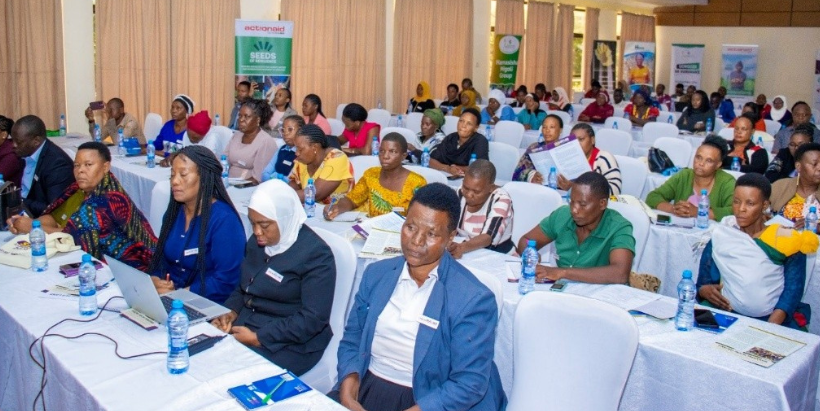
Symposium participants listening to the S4HL discussions. (Photo credit: Landesa)
Symposium lesson 1: Land rights as the foundation for rural women’s economic empowerment
Secure land rights strengthen women’s position in household and community decision-making, while economic empowerment increases their ability to engage in productive activities and businesses. Legal aid and education support enable women to know, claim, and protect those rights.
This relationship is particularly important in Tanzania’s commercialized cassava seed system, spearheaded by cassava farmers who are trained and certified as Cassava Seed Entrepreneurs (CSEs), a role that requires land that meets seed production requirements, including appropriate isolation distances.
For potential women CSEs, however, access to suitable land can be constrained by insecure tenure, dependence on husbands or relatives, gender norms, and limited decision-making power. Women’s limited knowledge of human and land rights worsens inequalities, limiting their participation as cassava seed producers. For women, therefore, participation as CSEs requires not only technical training in seed production but also the ability to address land rights, resources, agency, and institutional support to establish and sustain their enterprises. Bringing legal aid closer to grassroots communities is a promising avenue for transforming women’s land rights.
Symposium lesson 2: Bringing legal aid closer to grassroots communities
The symposium also highlighted the need to bring legal aid services to the grassroots. It was clear that rural women should not have to navigate complex and distant justice systems alone.
The Tanzania Women Lawyers Association (TAWLA), through the Mwanamke Imara project experience, demonstrates what is possible when legal aid is combined with community-based paralegal services, land documentation, economic empowerment, and leadership development.
Such approaches can help women move from simply knowing that they have rights to having the knowledge, support, and confidence to claim and protect those rights.
Symposium lesson 3: Securing women’s land rights requires a whole-of-community approach
It was clear that while it is critical to empower women to claim their rights, women cannot secure their land rights alone. There is also a need to engage men, spouses, traditional leaders, community leaders, local government officials, and justice institutions as part of the transformation. Use of community conversations and dialogues can provide safe spaces to question norms that portray land ownership and decision-making as men’s responsibilities. Men champions in the women’s agenda can help to challenge discriminatory practices. Local leaders can support equitable land governance. Paralegals can provide information and referrals. Local governments can institutionalize gender-responsive mechanisms.
This whole-of-community approach was highlighted as critical given land rights intersect with economic opportunity, household power, and gender-based violence (GBV). While there are emerging school clubs focused on GBV awareness, these activities should also include content on women’s land rights. Legal aid must therefore be linked to economic empowerment, changes in social norms, and institutional accountability.
At the family level, household dialogues can challenge norms around land ownership, while at the institutional level, engaging leaders, land committees, paralegals, and local government authorities can strengthen women’s access to land rights information, legal support, and documentation.
Symposium lesson 4: Shifting social norms through gender-transformative approaches
Davis Mwakanyamale from IITA presented GEI’s work on “Advancing women’s land rights through gender-Transformative approaches (GTAs): A pilot from Kagera.” He highlighted that insecure land rights can limit women’s ability to invest in improved agricultural technologies, and addressing this challenge requires more than legal reform and individual capacity building. Early reflections suggest that combining the reach of radio with locally facilitated dialogue can help shift harmful social norms, strengthen support for women’s secure land rights, and increase their investment in improved agricultural technologies.
“The experience from Kagera offers early lessons for development practitioners and the wider Stand for Her Land movement on how evidence-informed, locally owned approaches can contribute to social and institutional change,” he emphasized.
Transformative pathways to secure land rights
The S4HL Tanzania symposium offered an important reminder that securing women’s land rights in agrifood systems is not an issue that can be addressed at the margins of development. It is central to building inclusive economies and resilient rural communities, which can be achieved through transformative legal aid interventions.
IITA acknowledges the invaluable support provided by the CGIAR Multi-Functional Landscape Science Program, which enabled its effective participation in the symposium.
Contributed by Millicent L. Liani, Fortunatha Mollel, Devis Mwakanyamale, and Gloriana Ndibalema


No Comments