
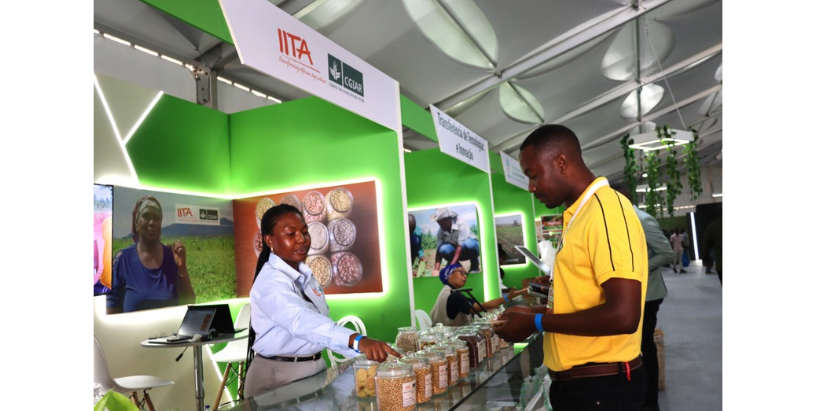
Visitors interact with IITA researchers and learn about improved crop varieties and agricultural innovations showcased at FACIM 2026.
As part of efforts to strengthen engagement with the Government of Mozambique, farmers, private-sector actors, researchers, and development partners, IITA–CGIAR participated at the 61st edition of the Mozambique Agricultural, Commercial and Industrial Fair (FACIM) in Maputo recently. IITA used the country’s largest multisectoral trade fair to showcase agricultural innovations, contribute to national dialogue on seed systems, strengthen strategic partnerships, and explore opportunities to scale proven technologies.
Held under the theme “Digital and energy transformation towards a sustainable economy,” FACIM 2026 provided an important platform for connecting agricultural research and innovation with government priorities, private-sector investment, markets, and farmers’ needs.
Showcasing innovations for productive and resilient agriculture
Hosted in the pavilion of the Ministry of Agriculture, Environment, and Fisheries (MAAP), IITA showcased technologies and innovations to address some of the major challenges facing Mozambique’s agricultural sector.
Among the innovations presented were newly released, high-yielding, climate-resilient, and short-cycle varieties of soybean, cowpea, and sesame with the potential to increase agricultural productivity and resilience. IITA also showcased Aflasafe, a biocontrol technology developed to reduce aflatoxin contamination in food and feed, as well as inoculants that can enhance biological nitrogen fixation and improve legume productivity.
Over the seven-day exhibition, the IITA stand attracted hundreds of visitors, including farmers, students, researchers, government representatives, agricultural enterprises, and prospective partners. The interactions provided opportunities not only to demonstrate technologies but also to listen to stakeholders, understand emerging needs, and identify areas for collaboration.
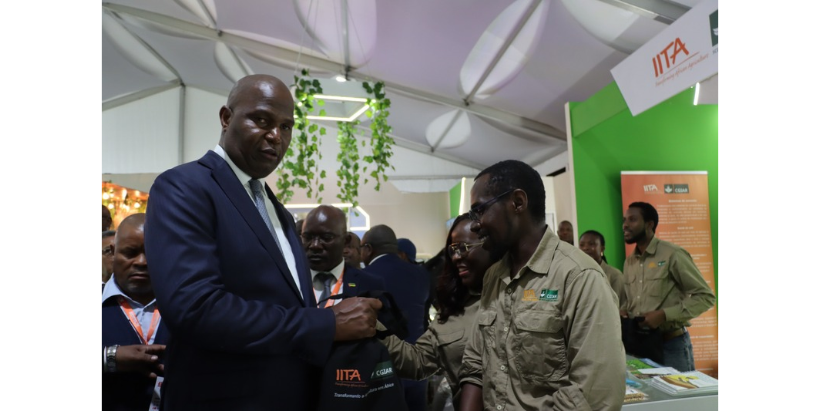
President of Mozambique, His Excellency Daniel Chapo, visiting the IITA stand and encouraging the Institute to keep working
From variety release to farmer access: Strengthening Mozambique’s seed systems
Seed systems emerged as an important part of IITA’s contribution to FACIM. IITA was invited by MAAP’s National Directorate of Plant Health and Biosafety (DINASAB) to participate in a panel discussion on the seed value chain and the role of different actors in controlling counterfeit seed in Mozambique.
Speaking on IITA’s research efforts in early-generation seed production, IITA, Senior Research Supervisor Nelito Rosário highlighted the importance of maintaining quality throughout the seed value chain—from research and varietal development through multiplication, quality assurance, and distribution to farmers.
A central message from IITA was that releasing an improved variety is only the beginning. The genetic gains embodied in a new variety create impact only when its identity and quality are maintained during multiplication and genuine seed becomes available to farmers at the right time, in the right locations, and in sufficient quantities.
“To ensure the widespread availability of quality seed, IITA has established partnerships with seed companies that can multiply seed in larger quantities and across larger areas to meet market demand. We produce and supply pre-basic and basic seed to these companies, which then take the multiplication process forward,” Rosário explained.
The discussion highlighted that combating counterfeit seed requires more than detecting poor-quality products once they enter the market. A strong seed system must protect quality and varietal identity from the source seed through multiplication, processing, certification, distribution, and ultimately to the farmer.
IITA also highlighted the importance of strengthening seed documentation and traceability, including mechanisms that more closely link certification information to specific seed quantities and lots. Such approaches can help reduce opportunities for legitimate documentation to be misused in marketing counterfeit seed.
The broader message was clear: quality must be protected from the source seed to the farmer’s field. For newly released varieties, this means moving deliberately from variety release to variety delivery—ensuring adequate early-generation seed, engaging capable seed multipliers, maintaining quality assurance, and developing distribution systems that enable farmers to access genuine improved seed.
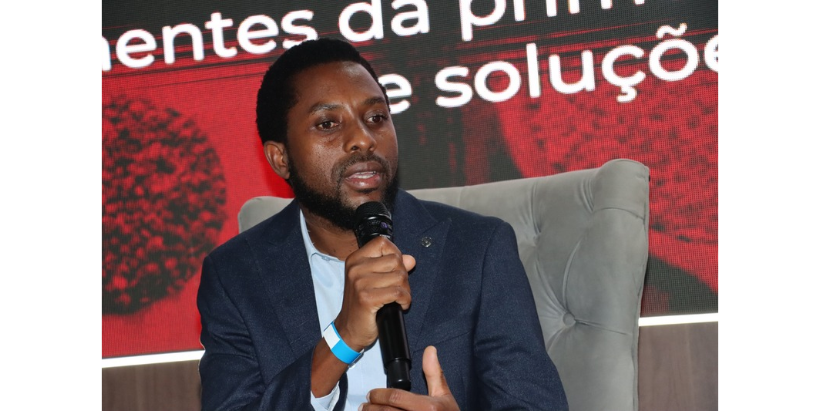
IITA Senior Research Supervisor, Nelito Rosário shares IITA’s experience in early-generation seed production and quality assurance during the FACIM seed value-chain seminar.
Taking agricultural innovation to the last mile
IITA’s participation at FACIM also provided an opportunity to communicate its broader work in agricultural research, innovation, and scaling in Mozambique.
During a podcast hosted by MAAP, IITA discussed its work in agricultural research and innovation, including five newly released soybean varieties (Bela, Malonda, Olima, Ovilela, and 10E) and ongoing efforts to ensure that improved technologies reach smallholder farmers.
The discussion highlighted the Accelerated Innovation Delivery Initiative (AID-I) as one mechanism through which IITA and its partners are addressing a persistent challenge in agricultural research: moving proven innovations beyond research stations and demonstration plots and into widespread farmer use.
Through partnerships with research institutions, extension services, private-sector actors, and other development partners, AID-I has supported the dissemination of agricultural innovations and strengthened last-mile delivery to smallholder farmers.
This approach reflects IITA’s broader understanding that improved seed alone does not guarantee higher productivity. Farmers need access to a combination of quality seed, appropriate agronomic practices, healthy soils, climate-relevant information, extension support, and functioning markets. Connecting these elements is critical for translating scientific innovation into higher productivity, climate resilience, profitable farming, and improved livelihoods.
Strengthening strategic partnerships for agricultural transformation
Beyond showcasing technology, FACIM provided IITA with an important platform to strengthen its engagement with the Government of Mozambique and other strategic partners.
Interactions with senior government officials, including the Minister of Agriculture, provided opportunities to reinforce IITA’s commitment to supporting Mozambique’s agricultural research, innovation, and transformation agenda and to explore areas where IITA’s scientific capabilities and partnerships can contribute to national priorities.
FACIM also provided a platform to advance collaboration on the Inclusive Agri-food Value Chain Development Program (PROCAVA). During the event, IITA finalized the signing of the project agreement with the Government of Mozambique to implement the program.
“One of the important opportunities at FACIM was engaging with partners, including the Minister, particularly as we advance PROCAVA, which includes activities related to the production of pre-basic and basic seed for orange maize and soybean,” said Dr John Omondi, IITA Mozambique Country Representative.
He noted that FACIM also provided an important opportunity for IITA to demonstrate its capabilities and the value it can bring to agricultural research and development, as well as to the scaling of innovations in Mozambique.
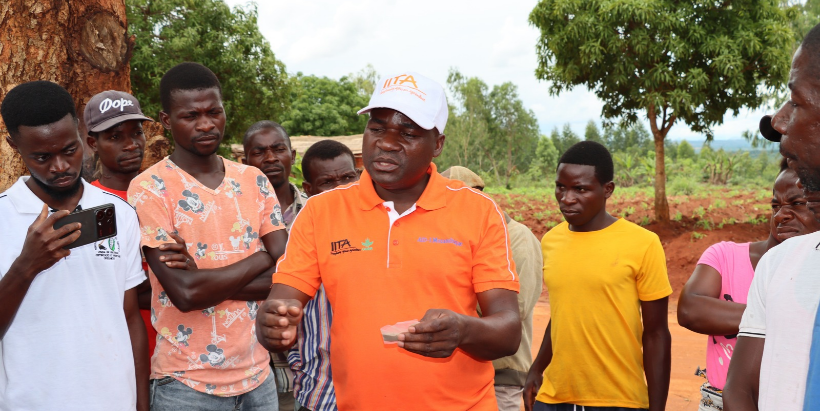
IITA representative shares impact of agricultural research, newly released crop varieties and approaches for accelerating innovation delivery to smallholder farmers during a MAAP podcast at FACIM.
From FACIM connections to impact
FACIM 2026 demonstrated the importance of bringing research, government, farmers, and businesses together in the same space. For IITA, the event created opportunities to identify potential partners, strengthen existing relationships, and explore new mechanisms for collaboration and resource mobilization. The Institute will build on these connections to strengthen partnerships and advance opportunities in improved seed systems, climate-resilient agriculture, agricultural innovation, and technology scaling.
The experience also reinforced an important principle underlying IITA’s work in Mozambique: agricultural innovation creates lasting value when it reaches farmers and responds to their production, resilience, and market needs. By connecting improved genetics and quality seed with sound agronomy, agricultural research, strong public-private partnerships, and effective delivery systems, IITA aims to help translate science into higher productivity, stronger value chains, greater resilience, and improved livelihoods for farming communities across Mozambique.
Contributed by Safira Chirindza

No Comments