
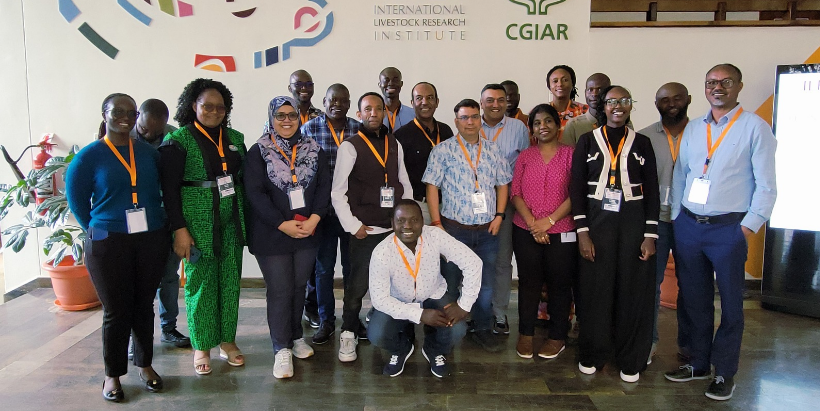
Participants at the Pangenome workshop at IITA, Nairobi.
What does it take to move from understanding pangenomes to using them to solve real-world crop breeding challenges?
That question brought 20 researchers to the IITA–CGIAR campus in Nairobi from 31 August to 4 September 2026 for a five-day workshop on the construction and application of pangenomes for CGIAR crop breeding and precision genetics.
The workshop convened breeders, bioinformaticians, molecular biologists, and genomics experts from across CGIAR and partner institutions, creating a rare opportunity for specialists from different disciplines to examine how pangenomes can help unlock crop diversity and accelerate breeding.
Experts from IITA, the Salk Institute, Bayer Global, Inqaba Biotec, the University of Western Australia, the Alliance of Bioversity International and CIAT, Diplomics, Corteva, and the University of Tennessee guided participants through topics ranging from genome assembly and sequencing to pangenome construction, annotation, visualization, and breeding applications.
Looking beyond a single reference genome
For decades, genomic research has relied heavily on reference genomes. While these resources have transformed our understanding of crop genetics, a single reference genome can only tell part of the story. Crop species contain enormous genetic diversity, much of which remains invisible when viewed through the lens of a single genome.
Pangenomes offer a broader view. By capturing the full set of genes present within a species, they reveal genetic variation that would otherwise be overlooked and provide a richer foundation for crop improvement.
With this context, participants explored a central question: Do researchers simply need more genomes, or do they need better genomes?
The answer, workshop discussions suggested, is neither straightforward nor universal. Instead, the genomic resources required depend on the questions researchers are seeking to answer. Sessions examined approaches for generating high-quality, haplotype-resolved genomes, integrating Hi-C technologies, and constructing robust pangenomes capable of capturing meaningful diversity.
Rather than advocating a one-size-fits-all strategy, participants discussed a tiered approach. A small number of representative accessions could be sequenced at greater depth and assembled at chromosome scale, while broader diversity could be captured through additional genomes and population-scale resequencing. Such an approach may offer a practical balance between cost and biological insight.
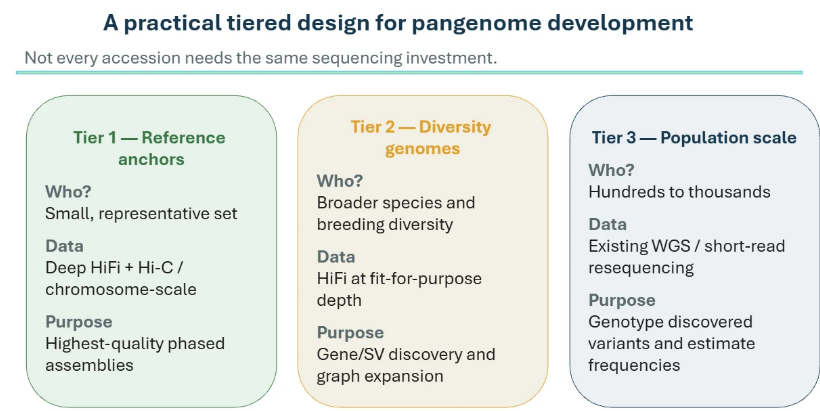
Tiered design for pangenome development. (Courtesy: Agre Paterne, IITA).
Moving from resources to results
While building pangenomes remains an important scientific goal, much of the workshop focused on a more pressing question: how can these resources be used to improve crops?
Discussions spanned banana, cassava, yam, taro, pyrethrum, moringa, and other tree species, highlighting the different stages of genomic readiness across crops. Some, including banana and cassava, already benefit from substantial genomic resources, while others are only beginning to develop foundational reference genomes.
These differences led participants to think beyond pangenome construction itself and toward practical implementation. Where genomic resources already exist, the priority may not be generating new datasets, but assessing quality, standardizing resources, identifying critical gaps, and linking genomic information more directly to breeding programs and decision-making.
Throughout the discussions, a recurring theme emerged: the real measure of success is not the number of genomes generated, but whether those resources help breeders develop better, more resilient, and more nutritious crops.
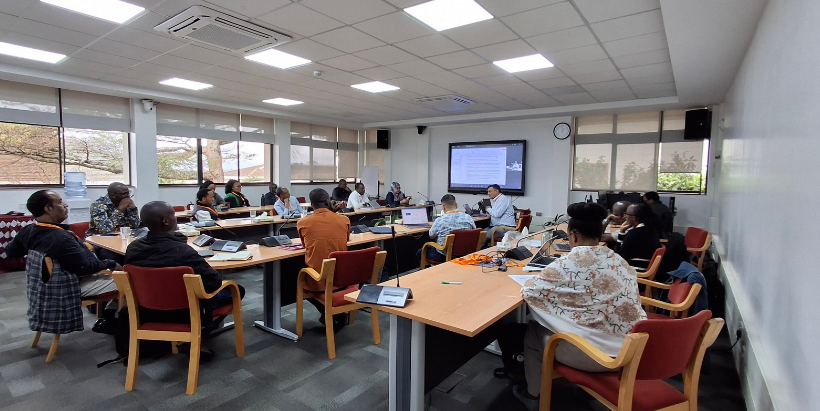
Participants discussing during the workshop.
What will it take to make pangenomes routine?
The workshop which had support from CGIAR Digital Transformation Accelerator (DTA), African Bioinformatics Institute (ABI), Genetic Innovations Public–Private Partnerships Platform (GI–PPP), and African Plant Breeders Association (APBA), also highlighted that scientific advances alone are not enough.
Building and applying pangenomes requires a combination of expertise, computational infrastructure, biological materials, sustainable funding, and effective collaboration. Capacity development emerged as a common challenge across nearly every crop discussed.
In banana, participants identified limited analytical expertise as a bottleneck. Yam researchers pointed to the challenge of translating existing pangenome resources into information that breeders can readily use. Work on tree species faces additional hurdles, including difficulties in obtaining high-quality DNA, understanding ploidy complexity, and securing the resources needed to study wild relatives.
These discussions reinforced an important reality: creating pangenomes is only the first step. Ensuring that researchers can interpret and apply them may ultimately be the greater challenge.
Breaking down silos
If one message resonated throughout the week, it was the importance of collaboration.
Developing comprehensive pangenome resources requires significant investments of time, expertise, and infrastructure. Participants therefore explored opportunities for stronger partnerships across CGIAR centers, national agricultural research and extension systems (NARES), universities, gene banks, and the private sector.
Such collaboration could help researchers share germplasm, sequencing platforms, computational resources, and technical expertise while reducing duplication of effort. More importantly, it could help ensure that future investments build on existing foundations rather than creating isolated, parallel initiatives.
Contributed by Laurah Nyasita Ondari


No Comments