
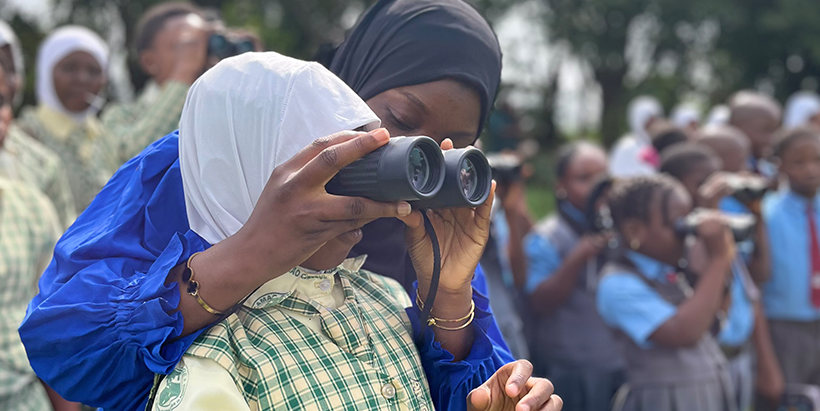
![Ademola Ajayi guiding students during the birdwatching session]Caption: Student gets hands-on guidance from Ademola Ajayi of the IITA Forest Centre during the birdwatching exercise. Photo: Ogheneovie Kome](http://blogs.iita.org/wp-content/uploads/2026/10/Mr-Ademola-Ajayi-scaled.jpeg)
Student gets hands-on guidance from Ademola Ajayi of the IITA Forest Centre during the birdwatching exercise. Photo: Ogheneovie Kome
For many of the students, binoculars were the only thing standing between them and a world they had never noticed. Looking through the lenses for the first time, the quiet rustle in the canopy suddenly had a shape, a name, and a story that stretched across oceans.
This was the scene at the International Institute of Tropical Agriculture (IITA), where area school students gathered for a day of learning to mark World Migratory Bird Day 2026. Observed globally every October 10, the date fell on a Saturday this year. So, the IITA Forest Centre welcomed students from the School Conservation Club the following Monday not just to teach them about birds, but to help them fall in love with them.
“You can’t ask them to conserve what they don’t know and what is not of interest to them,” said Ademola Ajayi of the IITA Forest Centre, who led the event.
“When we started, how many of them loved birds? Not so much. But after this experience, they are excited to do birdwatching again.”
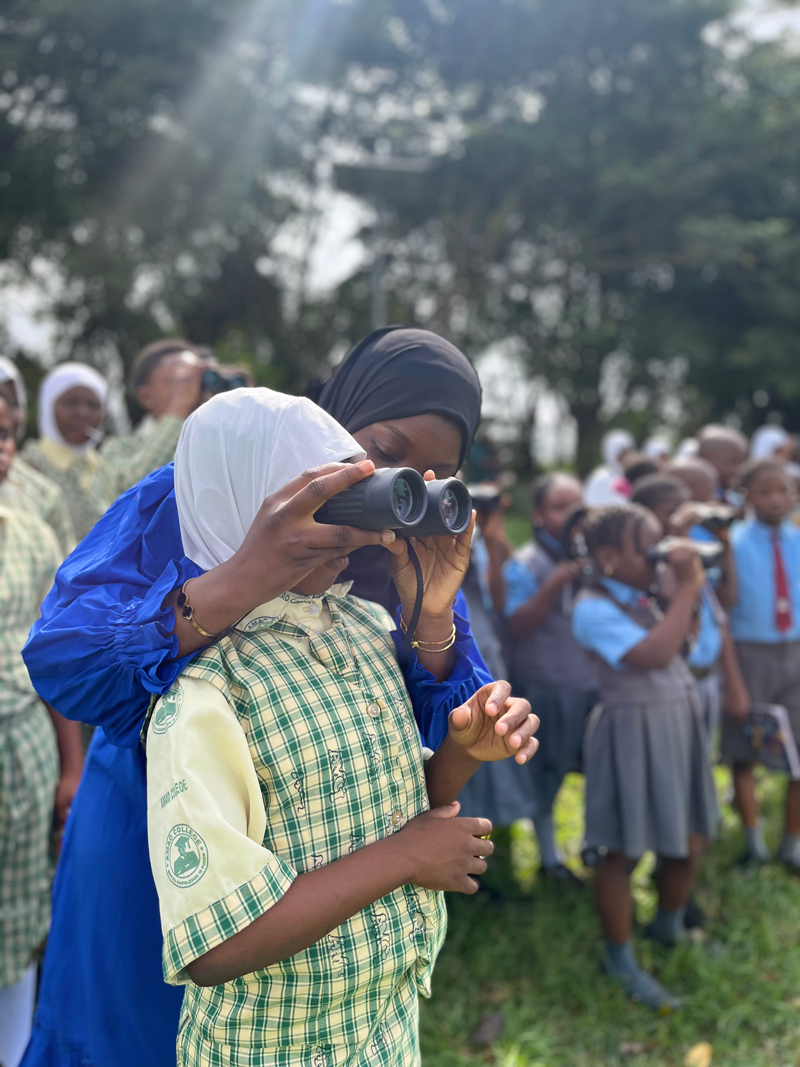
Getting a closer look: A student is assisted with using binoculars during the birdwatching session at the IITA Forest Centre. Photo: Ogheneovie Kome
From the Field to the Screen
The day was designed to build connection step by step. It opened with introductory talks on the science of migration, but quickly moved the students outdoors. Equipped with binoculars, they walked IITA’s forested grounds, scanning the trees for the species that stop over on their incredible journeys.
Only after seeing the birds in real life did the students move indoors to watch a documentary. On the screen, they saw the full scale of what they had just witnessed outside: birds crossing continents and oceans, navigating storms, and returning to the exact same wetlands year after year.
For the students, the outdoor experience gave the documentary meaning. For the IITA Forest Centre, the combination was strategic. As a Ramsar wetland site and a Key Biodiversity Area (KBA), IITA holds two international conservation statuses. It is a vital refuge for birds traveling between continents. Raising awareness among the next generation is critical to ensuring these habitats remain protected.
A Stitch in the Global Tapestry
The transformation in the students reflected a much larger global movement. In her 2026 World Migratory Bird Day message, Jennifer George, Chief Executive of the East Asian-Australasian Flyway Partnership (EAAFP) Secretariat, described conservation as a kind of stitchery mirroring the official poster’s design of birds woven together across flyways.
“Every bird really does count,” George wrote, “and every observation matters.” She reminded the world that individual efforts single sightings logged, habitats protected, communities educated are woven together into a
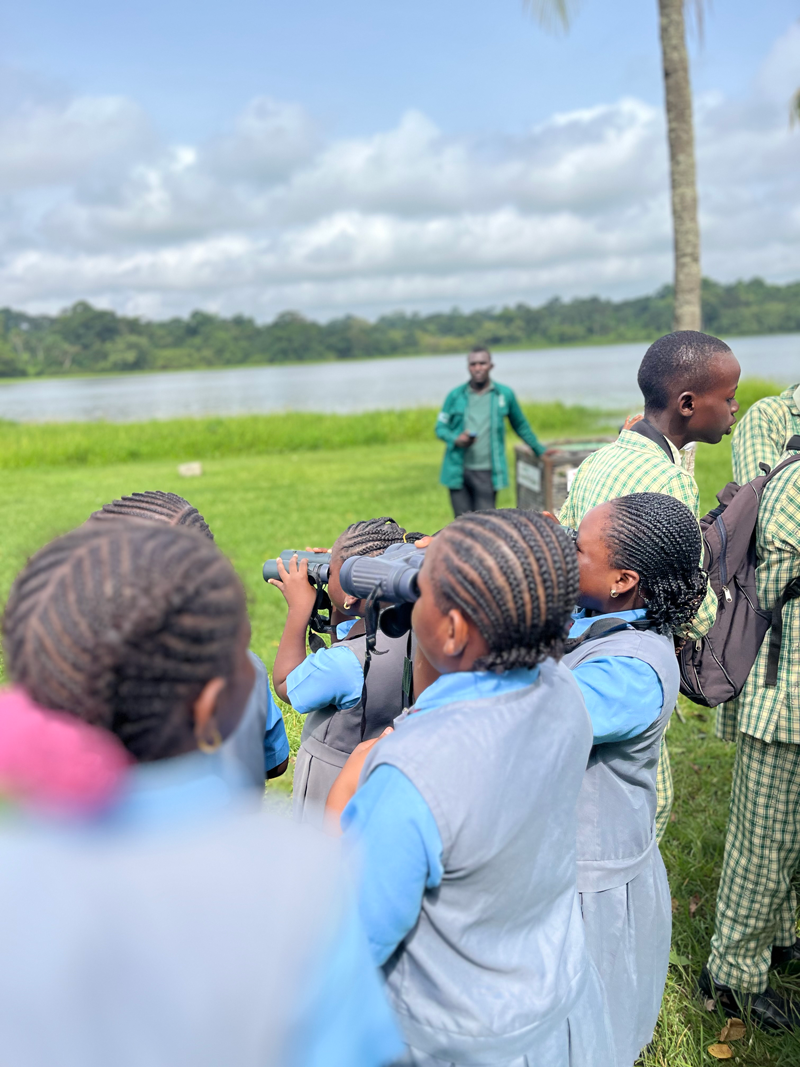
A student spots a migratory bird for the first time during World Migratory Bird Day activities at IITA. Photo: Ogheneovie Kome
collective picture. But she cautioned that if even one stitch breaks, if one critical habitat is lost, the journey becomes far more dangerous.
Her call to action “Look closely. Count the birds you see. Share what you observe. Be part of the story” was exactly what the students at IITA were doing.
Young Voices, Lasting Impressions
The impact of the day was most evident in the students’ own words, as they discovered the vital roles birds play in their own backyards.
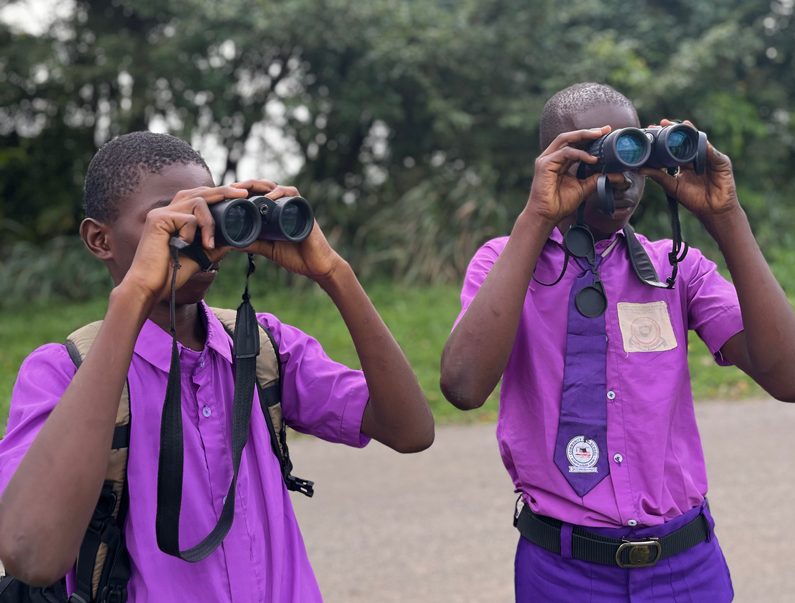
Young conservationists take turns observing birds through binoculars at the IITA Forest Centre. Photo: Ogheneovie Kome
Akinpelu Taofik, a Primary 5 student of King’s Junior Academy, was surprised to learn about the ecological cleanup crew. “Vultures help to clean the environment, and birds support plant growth,” he said. “Without birds, plant growth cannot improve.”
Adam Saris of The Builders School was amazed by the sheer endurance of the travelers: “Birds can travel from one far place to another, which is 100 kilometers.”
For Olayinka Olunlade, a student of Great Institution School of Science, the aesthetic beauty of the birds was just as striking as the science. “The experience is thrilling and exciting,” she said. “I saw a lot of birds—jacana, white-headed, and different kinds.”
Solomon Toluwanimi, an SS2 Science student, connected the dots between nature and human survival: “They support us in terms of plants and play a lot of roles for we human beings.”
And Eyafe Gift, an SS3 Science student of Amao Model College, found a deeply human connection: “Birds are just like humans, who do not stay in one place but migrate everywhere for survival.”
The Ripple Effect
The true measure of the day’s success won’t be found in the bird counts logged on IITA’s grounds, but in the classrooms and communities the students return to.
Armed with new knowledge and a fresh passion for the natural world, these students are no longer just observers. They are messengers. They are the ones who will tell their peers why a jacana matters, why a vulture isn’t scary but essential, and why the wetlands near their homes must be protected.
As a crucial sanctuary along international flyways, IITA continues to safeguard habitats for wildlife. But by opening its doors to curious young minds, the Forest Centre is ensuring that Africa’s biodiversity will be protected for generations to come, one student, one sighting, and one conversation at a time.
Contributed by Bamise Dada

No Comments