
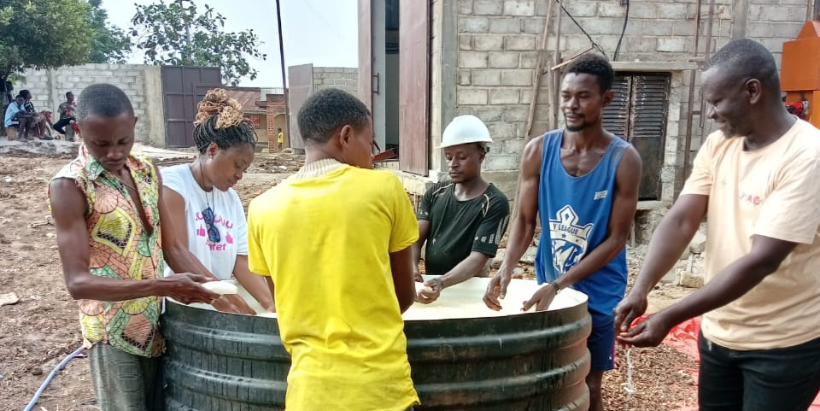
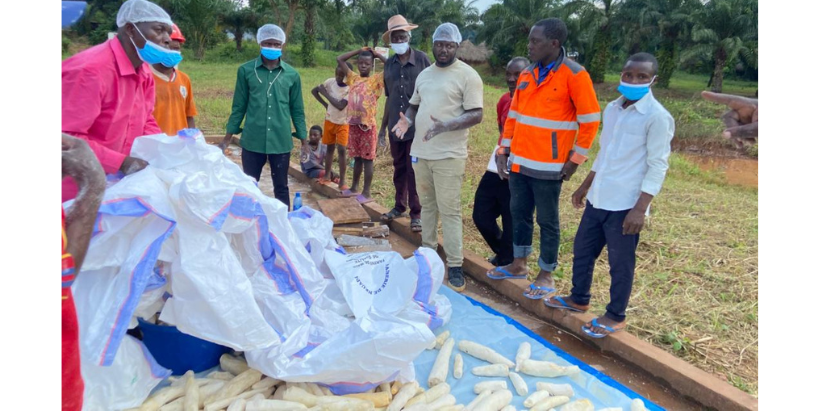
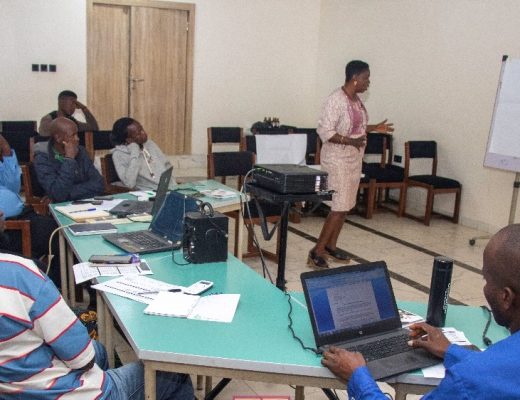
Capacity building for Cooperative HSD, DRC processing unit staff on good cassava processing practices and the effective use of processing equipment in Nkuadi, Kasai Oriental.
From high-quality cassava flour to mobile processing and technology delivery through TAAT, Dr Adebayo Abass reflects on how research, markets and partnerships can turn Africa’s cassava production into greater value for farmers and industry.
Producing more cassava does not necessarily mean farmers earn more. Without reliable markets, processing technologies and connections between farmers and industry, increased production can leave farmers with more cassava but less income. This is because demand often grows roughly with population, or more slowly than population, leading to gluts when farmers harvest more cassava than the population can consume. This is where an increase in yield or an increase in area under cultivation could lead to financial loss for the farmer. Hence, increasing industrial demand for cassava through value addition is key to raising farmers’ incomes and reducing rural poverty.
For Dr Adebayo Abass, TAAT Cassava Value Chain Coordinator, this has been one of the central lessons of more than three decades of work on cassava processing, value addition and food security. “You really will find it difficult to increase the income of smallholder farmers if you don’t create a market for the commodity that they are producing,” he said.
He further describes the approach as a “pull strategy rather than a push strategy.” Rather than encouraging farmers to produce more cassava without first establishing markets, the strategy focuses on creating demand for cassava products first. He explains, and that demand can pull more production, investment, and planting materials for improved varieties from breeders into the value chain.
From more production to new markets
In the early 1990s, Nigeria increased cassava production following investments in the production of planting materials of improved varieties. But greater production brought another challenge: finding new markets and uses for the crop.
Dr Abass and other IITA scientists, working with national partners, began developing intermediate cassava products, including high-quality cassava flour (HQCF). The process involved peeling and grating fresh cassava, pressing it to remove water and reduce cyanogenic potential, and drying it into flour.
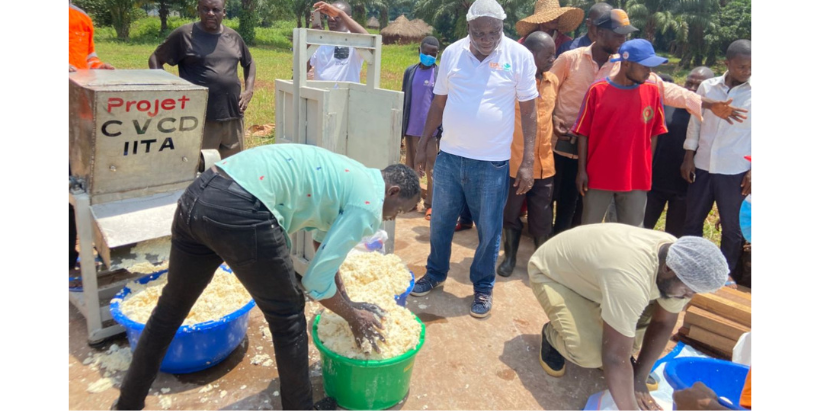
Practical cassava paste pressing session with the Bien-Être company team.
Researchers then tested HQCF as a partial substitute for wheat, finding that wheat could be reduced by at least 10–20% in bread and 35% or more in biscuits. It was also tested in products such as cakes, doughnuts, and chin-chin.
The significance went beyond creating another food product. HQCF offered a way to create additional demand for cassava while providing an alternative raw material for industries that rely on imported wheat. According to Dr Abass, the technology began in Nigeria through work involving IITA and national partners and has since become known globally, with several African countries exploring policies to promote HQCF as a substitute for imported wheat.
A crop that cannot wait
Creating markets is particularly important because cassava is highly perishable. “Cassava is highly perishable. Within 48 hours of harvesting, it begins to deteriorate,” Dr Abass said.
For farmers far from processing facilities, poor roads, high transportation costs, and distance can make it difficult to move fresh roots quickly enough. Sometimes, the loss happens before the cassava is even harvested. “When farmers don’t have a market for cassava, they will not harvest. They’ll leave it right on their farms. And the cassava will rot down there,” Dr Abass added.
This makes access to processing facilities and markets not simply a commercial issue. It is also a means of preserving the value of harvested crops that could otherwise be lost. Hence, reducing postharvest losses, and encouraging farmers to adopt improved varieties. Without reliable outlets for their produce, farmers have little incentive to increase production, even when better-performing varieties are available.
Bringing processing closer to farmers
To address some of these challenges, IITA and partners developed a mobile cassava processing innovation that brings key processing steps closer to the farmgate. Fresh roots can be peeled, washed, grated, and pressed into an intermediate product that is more stable than fresh cassava and easier to transport to factories for further processing.
The intermediate product is about half the weight of fresh cassava, reducing the volume that needs to be moved to factories. Cassava peels can also remain in rural communities for potential use as animal feed rather than being transported to urban processing centers where they cause environmental pollution and health hazards to the general population.
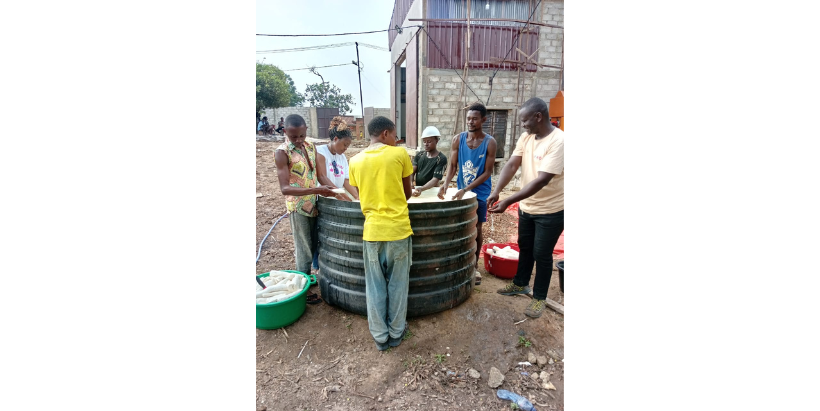
The Bien-Être company team learning how to properly clean cassava before processing.
The model was developed by IITA in partnership with the Federal Institute of Industrial Research, Oshodi (FIIRO) and tested with a starch and sweetener company in Nigeria. Dr Abass said it proved profitable at the scale tested.
Early adoption has been reported in Edo, Ogun, and Oyo states in Nigeria, as well as some provinces of the Democratic Republic of Congo. In some locations, vehicles and tricycles have been adapted for mobile processing. The approach now extends beyond HQCF to intermediate cassava products such as garri, starch, and tapioca, depending on local processing systems and markets requirements.
Measuring what changes
For Dr Abass, the true test of agricultural technology is not simply how many people were reached or trained. “What we should measure is actually the benefit that goes to those managing actors,” he said. That means looking at changes in income, production, nutrition, food imports, national savings, and employment, not simply counting participation in training activities.
He cited a DR Congo case study in which farmers who shifted from local to improved cassava varieties increased their annual income from $1,250 to $4,150. He presented this as an example from a single commodity in a single country, rather than a result that should be generalized to all farmers.
For the TAAT Cassava Compact, Dr Abass reported average cassava productivity of 30–31 hectare/ha at intervention sites in some African countries, compared with 8 hectare/ha in non-project locations. He also reported an average household income of about $5,440 for commercial cassava value chain actors, compared with $1,400 for food security-focused households across intervention sites, citing the DR Congo as an example. At least 84,000 people had been trained in good agricultural and climate-smart practices across at least 16 countries.
On a broader scale, Dr Abass estimates that about 13.2 million people in more than 24 countries are currently using or benefiting from mechanical cassava-processing technologies. The estimate covers farmers, processors, and businesses rather than farmers alone, which may be about 8 million.
From technology to scale
The cassava transformation also creates opportunities beyond farming. Dr Abass cited equipment fabrication companies including DeBan Faith Company in Abeokuta, Nigeria; Intermech Engineering in Tanzania; Agrimach in the DR Congo; and Tonnet Engineering in Uganda, as examples of machine producers that have benefited from IITA’s improved cassava-processing equipment designs and training for local engineers over the years.
However, developing technologies is only part of the challenge. They must also reach the people and institutions that can use and adapt them. This is where Dr Abass sees a key role for Technologies for African Agricultural Transformation (TAAT). “The difference with TAAT is that TAAT developed what we consider as technology delivery infrastructure,” he said.
TAAT works with national research institutions, universities, scientists, specialists, governments, and other partners to support the transfer and adaptation of new agricultural technologies across countries and agricultural value chains.
Dr Abass also makes an important distinction about technology ownership: “Most of these technologies are not entirely IITA technologies. There are several technologies that were approved within TAAT that came from our partners,” he said. The strength of the model, therefore, lies not only in the technology itself but also in the network capable of moving it from research and development to wider use.

Dr Adebayo Abass, TAAT Cassava Value Chain Coordinator.
The gaps that remain
Despite progress in cassava production, processing, and technology delivery, important gaps remain across the value chain. Dr Abass identified three major ones: extension, soil fertility, and seed systems.
Farmers need more specialized extension officers and subject-matter specialists who can translate technologies into practical farm-level decisions. They also need better access to soil fertility management and appropriate inputs to sustain productivity.
At the same time, improved varieties require regulated seed systems to accelerate farmers’ access to quality planting material. “A value chain can only grow when all the nodes are strong,” Dr Abass said. “The weakest point of the chain is the strength of the chain.”
For research to deliver sustained impact, investment must therefore extend across the entire chain from seed and production to processing, markets, infrastructure, extension, and human capacity.
From food crop to industrial raw material
The opportunity is increasingly shifting from cassava as a traditional food crop to cassava as an industrial raw material. Dr Abass points to growing applications in products such as flour, starch and ethanol, with policies and private investment helping stimulate new processing opportunities in some African countries.
His long-term vision is a stronger connection between farms and factories: processing facilities surrounded by networks of farmers who can consistently supply them with the right quality and quantity of raw materials at an equitable price. “I would like to see in the next five years, 10 years, you know, factories with thousands and thousands of farmers managing cassava plantations around that factory,” he said.
He further distills that vision into a simple statement: “Every factory should have a plantation around it.” It captures the transformation Dr Abass wants to see: not simply more cassava, but a stronger value chain that turns production into income, processing into enterprise, and agricultural research into lasting economic value.
Contributed by Bamise Dada and Anu Oyeleye


No Comments