
What if farmers could produce more food for their families from a small piece of land by managing it better? This is the idea behind SmartPlot Naija, a farming concept designed to show smallholder farmers and communities around IITA how to produce enough food for a family of six using their land, farm inputs, and labor.
Smallholder farmers often cultivate their entire 1–2 ha of available land yet still fail to produce sufficient food for their families. To address this challenge, many believe that expanding cultivated area or mechanization is the solution. However, neither option is always viable. Expanding production requires additional inputs and labor, and agronomic practices often become poorer, further reducing productivity. At the same time, mechanization remains financially inaccessible for most smallholder farmers.
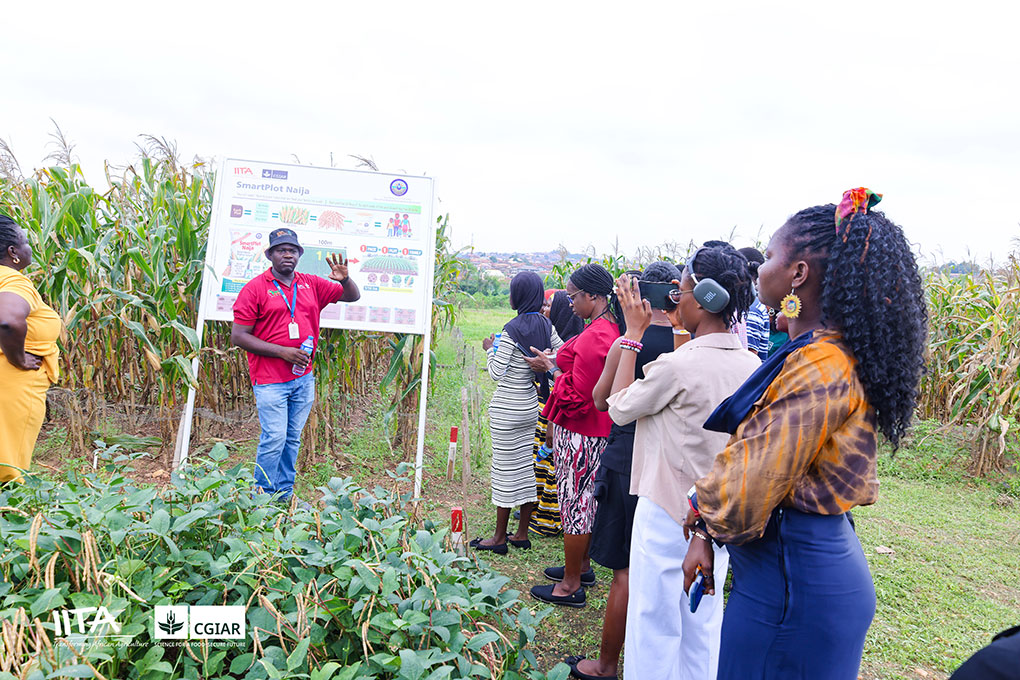
Dr Dean Muungani, IITA Product Trial Manager explaining the importance of the initiative to visitors on the Demonstration Plot.
Dean Muungani, Head of the Product Pipeline Development Unit (PPDU) and Product Manager for Grain Crops at IITA, explained that the concept was originally initiated by a commercial farmer, Berin Stockhill in Zimbabwe, and was developed by the Foundations for Farming.
At its core, the initiative seeks to answer a fundamental question: “How much land is required to feed a family of six per year?”
The model is based on the assumption that a family needs one 20 kg bucket of maize each week to meet its staple food requirements, combining this target with the principles of conservation agriculture: minimum soil disturbance, crop rotation, and permanent soil cover. This approach informed the development of the Pfumvudza Intwasa model, a name that means new season. IITA subsequently adapted the concept for Nigeria, renaming it SmartPlot Naija to give it local relevance.
The approach demonstrates how a relatively small piece of land, when intensively and efficiently managed, can produce a substantial quantity of food. The calculation begins with the amount of maize needed to fill one 20 kg bucket. Assuming an average cob weighs 360 grams, approximately 56 maize cobs would be required. If each maize plant produces at least one cob, a farmer would need just 56 plants to produce one bucket of maize.
With planting stations spaced 60 cm apart within a row and two plants established at each station, the required row length would be approximately 16 metres. To produce one 20 kg bucket of maize every week for a year, a household would need 52 such rows. At a row spacing of 75 cm, these rows would occupy a plot measuring 39 m by 16 m, equivalent to 624 m², or roughly one-sixteenth of a hectare.
The calculations illustrate the potential of intensive maize production to meet a family’s annual staple food requirements using a relatively small area of land. Rather than spreading limited fertilizer and other agricultural inputs thinly across a large farm, SmartPlot Naija encourages farmers to concentrate their available resources on a smaller plot, allowing them to manage their crops more effectively and potentially achieve better productivity.
SmartPlot Naija is not limited to maize production. The model also incorporates cowpea and soybean to promote dietary diversity while contributing to improved soil health. It further explores opportunities to make smallholder farming more economically rewarding by integrating crop and livestock production.
According to Muungani, combining maize and soybean cultivation with small-scale poultry farming could enable households to produce eggs for sale. The additional income could help families meet expenses such as children’s education while providing resources for further investment in their farming activities.
SmartPlot Naija recognizes the challenges many smallholder farmers face, including limited resources, labor, and access to mechanization. By starting small and applying good farming practices, farmers can learn to manage their resources more efficiently and gradually expand their operations as resources permit. IITA is working to improve the adoption of agricultural technologies by engaging public research institutions, universities, and private seed companies. These partnerships could help make improved crop varieties more visible and accessible to farmers. While the SmartPlot Naija is still at the pilot stage, further work is planned to adapt the concept to Nigerian household food needs, including the possible integration of crops such as cassava and yam.
Better farming does not always begin with more land. Sometimes, it begins with making better use of the land and resources already available.
Contributed by Victoria Idowu and Anu Oyeleye

No Comments