
Landmark decision recognizes non-GMO status of gene-edited banana events
12 May 2026 – Nairobi, Kenya: A quiet but significant shift in Kenya’s agricultural landscape is opening new opportunities and doors for innovation and renewed hope for banana farmers affected by bacterial wilt disease.
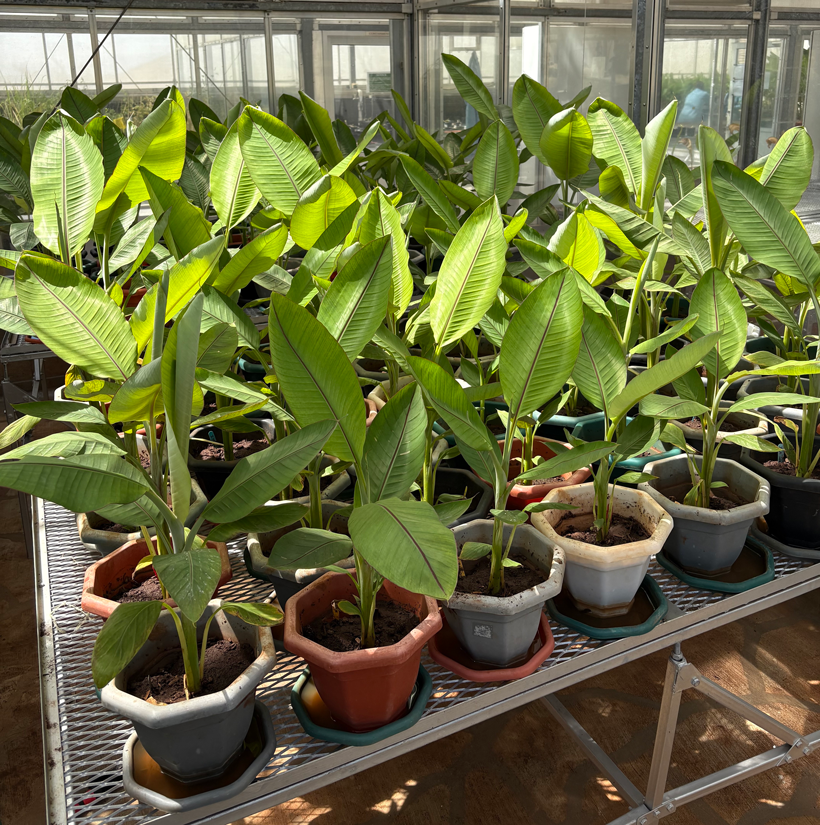
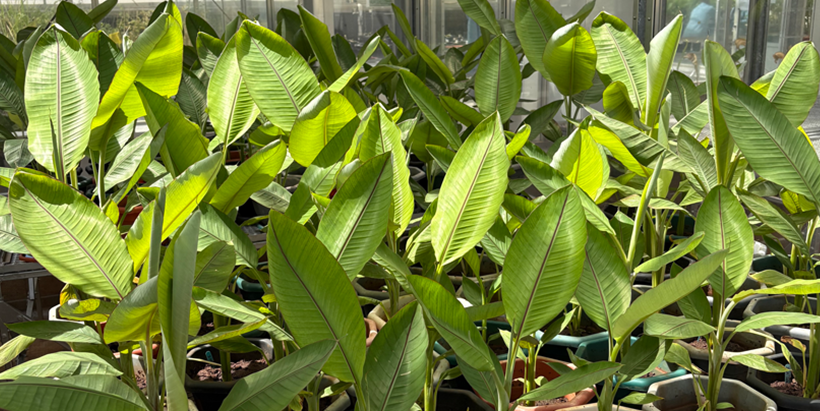
Gene-edited banana plants in the greenhouse. Photo credits: Dr Jaindra Tripathi.
In a landmark decision, the National Biosafety Authority (NBA) has confirmed that gene-edited banana events developed by the International Institute of Tropical Agriculture (IITA) in Kenya are not classified as genetically modified organisms (GMOs) as they do not contain any foreign genetic material. This determination allows the improved gene-edited bananas to advance through conventional research pathways, marking a major step in enabling the use of modern breeding technologies.
Following this clarification, the NBA has approved for field trials of the improved banana lines, developed to combat Banana Xanthomonas Wilt (BXW), a devastating disease that continues to threaten banana production and farmers’ livelihoods across East Africa. The new gene-edited bananas are designed to resist the disease while maintaining strong growth and yield.
The field trials will be conducted by IITA in partnership with the Kenya Agricultural and Livestock Research Organization (KALRO), focusing on agronomic performance and resistance to BXW under field conditions.
“This is a major step forward not just for banana research, but for agricultural innovation,” said Dr Leena Tripathi, Eastern Africa Hub Director and Principal Investigator leading the work. “It shows that science-based, proportionate regulation can enable the development of practical solutions for farmers.”
The decision reflects Kenya’s commitment to a science-driven and enabling regulatory environment. By distinguishing gene-edited crops without foreign DNA from traditional GMOs, the country is championing innovation while maintaining strong biosafety oversight.
With approval in place, the research moves from the laboratory to the field. The trials, strictly for research, will generate critical data on the performance of the improved bananas under real farming conditions.
“The opportunity to evaluate these bananas in the field is a critical step,” Dr Tripathi noted. “Our goal is to develop improved crop varieties that farmers can rely on—helping to boost production and strengthen resilience.”
For farmers across the region, the stakes are high. BXW remains one of the most destructive banana diseases, with limited long-term control options. The development of resistant varieties offers a promising and sustainable solution.
More broadly, this milestone signals growing confidence in gene editing as a practical tool for crop improvement in Africa, setting an important precedent that could accelerate the development of resilient crops and strengthen food security in the years ahead.
About IITA
The International Institute of Tropical Agriculture (IITA) is a not-for-profit institution dedicated to generating agricultural innovations to address Africa’s most pressing challenges of hunger, malnutrition, poverty, and natural resource degradation. Working with various partners across sub-Saharan Africa, IITA improves livelihoods, enhances food and nutrition security, increases employment, and preserves natural resource integrity. IITA is a member of CGIAR, a global agriculture research partnership for a food and nutrition secure future.
Media Contact
Dr Leena Tripathi
Eastern Africa Hub Director/ Biotechnology Program Lead
International Institute of Tropical Agriculture (IITA)
Email: l.tripathi@cgiar.org
Website: www.iita.org / genomeengineering.iita.org
Ms Rose Harriet Okech
Communication Associate
International Institute of Tropical Agriculture (IITA)
Email: r.okech@cgiar.org
Website: www.iita.org / genomeengineering.iita.org

No Comments