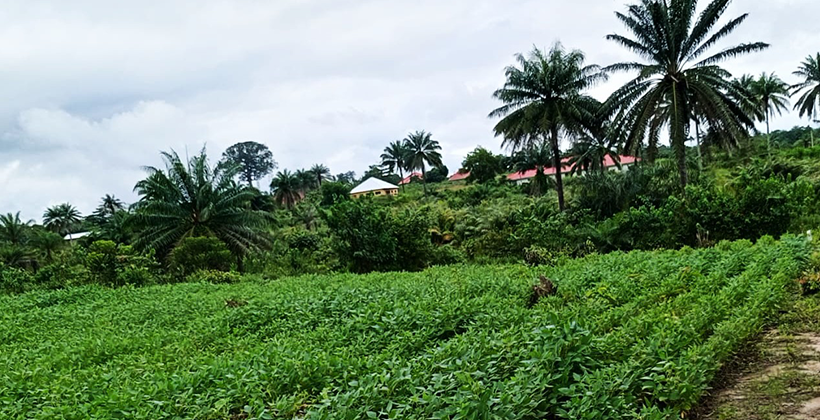
IITA, through the EU-funded Seeds4Liberia project, has introduced fast and medium soybean varieties to Liberia’s ecology.
In Liberia, the agriculture sector is considered a strategic pillar for alleviating poverty, improving food and nutrition security, and increasing farmers’ income. The sector provides livelihood for more than 68 percent of the country’s population. It is impacting Liberia’s quest for food and nutrition security despite climate change’s impact on agriculture, limited access to key research information, and weak seed systems.
National nutritional context
The Ministry of Agriculture’s findings from the 2025 Comprehensive Food Security and Nutrition Survey (CFSNS) show that national food insecurity has declined from 47 percent in 2022 to 20.7 percent in 2025. Also, chronic malnutrition was reported to have significantly dropped as of 2024. 26% of children under five years are chronically malnourished, then in 2012 when chronic malnourished children accounted for 34.6%.
The country’s gains in addressing food and nutrition insecurity show the possibility of a food-secure future, and development partners’ contributions cannot be ignored.
One example is the EU-funded Seeds4Liberia. The four-year (2024 -2028) project is strengthening the country’s seed systems to produce staple food and cash crops, boosting the country’s economic diversification agenda, and improving nationwide food and nutrition security.
Under the soybean component of the EU-funded Seeds4Liberia Project, the International Institute of Tropical Agriculture (IITA) is leading the introduction and adaptation of climate-smart, market-preferred soybean line varieties, i.e., TGx 1835-10E, TGx 1951-3F, TGx 1904-6F, TGx 2029-53F, TGx 2020-4E, TGx 2029-27F, into Liberia’s cropping system.
Why soybeans?
As Liberia continues efforts towards food and nutrition security, soybeans stand out as a crucial crop for achieving this goal. Soybeans are rich in protein, with 76-80% used for animal feed and 20% for human consumption, making it a strategic crop in combating food and nutrition insecurity in the country. Additionally, soybeans are a critical ingredient in animal feed production, benefiting the livestock, poultry, and aquaculture sectors by reducing the high cost of feed production and spurring growth, which means profitability for small-scale farmers.
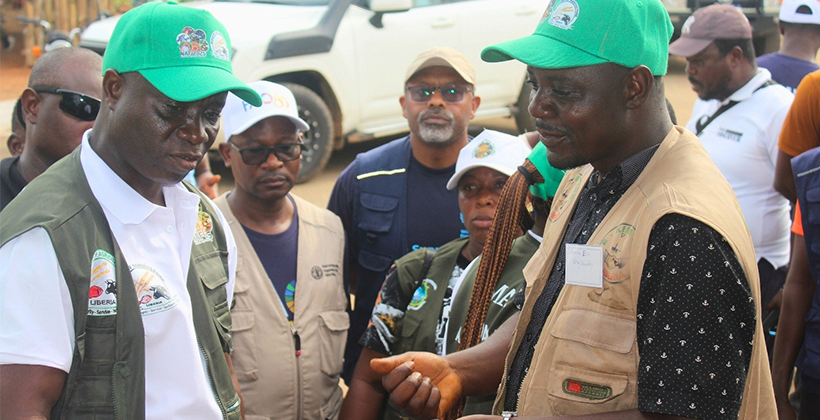
Stephen Ellie exchanging with Agriculture Minister Dr J. Alexander Nuetah at the National Agriculture Fair 2025 (Credit: George Harris, AfricaRice-Liberia Station).
Intervention approaches
Through IITA’s technical leadership of the soybean component, the project is promoting community-based adoption of improved soybean varieties by developing staff capacity from various government institutions and agencies. IITA is strengthening the capacity of private seed companies (PSCs), community-based seed enterprises (CBSEs), and community-based seed producers (CBSPs) to sustainably produce, store, and supply foundation and certified soybean seeds to soybean-producing farmers.
Liberia’s Ministry of Agriculture (MoA) and the Central Agricultural Research Institute (CARI) are collaborating with the project to mobilize farmers for training in adopting best agronomic practices for the production of the introduced soybean varieties.
Under IITA’s soybean capacity development program, 150 local seed producers have been trained in soybean foundation seed multiplication, good agronomic practices, post-harvest handling, and value addition techniques. These trained producers are now serving as community-level multipliers, expanding access to quality soybean seeds across participating counties in Liberia.
Local seed producers take the lead in soybean adaptation processes
One beneficiary, Stephen Ellie of the E-KIMA Agriculture Company, is leveraging the opportunity to diversify his agribusiness.
After participating in several technical training sessions led by scientists from IITA under the soybean component of the EU-funded Seeds4Liberia Project, Stephen allocated 1.5 acres to multiply the 75 kg of soybean seeds received from the project during its foundation seeds multiplication phase. He harvested about 500 kg of soybeans from the trial plot, applying some of the improved agronomic practices and crop management techniques. However, late planting and rainfall during harvest resulted in some production losses. He realized that overpopulated plants, weed competition, and little or no soil amendment can affect crop yield. Overall, the experience significantly strengthened his technical capacity and confidence in soybean cultivation.
Before integrating soybeans into his business, Stephen primarily cultivated cassava and produced value-added cassava products. According to him, he developed an interest in soybeans after receiving awareness messages from the project team about soybeans’ nutritional benefits and germination rate.
“First, we were curious about soybeans. What makes soybeans so special? Is it not the same type of bean that is around? Interestingly, we have heard that some farmers even went ahead to cook the soybeans but came back complaining that the beans were still hard after a long time of boiling. But through the training with the Seeds4Liberia Project team, we started to learn more about soybeans, like the nutritional benefits,” explained Stephen.
Stephen also described the production trial as an opportunity to diversify production and create additional income streams.
“A huge portion of my harvest has been sold. I go about that by talking about the nutritional benefits of soybeans and the production processes involved, almost the same message I heard. Other farmers around have bought soybeans for $5 per kg as well,” he said.
Way forward
With the ongoing technical support from the EU-funded Seeds4Liberia project team, Steven seeks to deepen his knowledge of soybean production and pledges to share the skills he has gained with his community.
“The support from the project is a life-changing opportunity for me, and I am grateful to the European Union and IITA, the implementing partner for soybeans under the Seeds4Liberia Project, for the skills they have taught me. I cannot say that I learned everything, but with what I have gained, I also want to train others who are interested in soybean production and even help them learn how to add value to soybeans,” he said.
About the EU-Seeds4Liberia project
The four-year (2024 -2028) project is a crucial initiative to boost Liberia’s seed systems, including soybean seed systems. It does this through demand-driven, structured, and regulated seed systems for soybean and other important value chains—rice, cassava, coffee, and fish.
The project aims to address the priorities of these sectors, including strengthening the capacity of farmers, private seed enterprises, and government ministries and agencies. Furthermore, it is collaborating with similar interventions to enhance quality assurance, increase varietal turnover, and boost yields, while also transferring cutting-edge knowledge and skills.
The EU-funded Seeds4Liberia Project is jointly implemented by Africa Rice Center (AfricaRice), the International Institute of Tropical Agriculture (IITA), and WorldFish, with each institution leading specific commodity components. The project is implemented in collaboration with the Ministry of Agriculture (MoA), the Central Agricultural Research Institute (CARI), the National Fisheries and Aquaculture Authority (NaFAA), the Seed Development and Certification Agency (SDCA), and the Liberia Agricultural Commodity Regulatory Authority (LACRA). It supports national development frameworks for enhanced food and nutrition security and job creation in Liberia.
DISCLAIMER: THE SEEDS4LIBERIA PROJECT IS FUNDED BY THE EUROPEAN UNION. ITS CONTENTS ARE THE SOLE RESPONSIBILITY OF THE AUTHOR AND IMPLEMENTING INSTITUTION(S) OF THE PROJECT AND DO NOT NECESSARILY REFLECT THE VIEWS OF THE EUROPEAN UNION.
Contributed by George A. Harris, Communication Officer, AfricaRice-Liberia Station/EU-funded Seeds4Liberia Project


No Comments