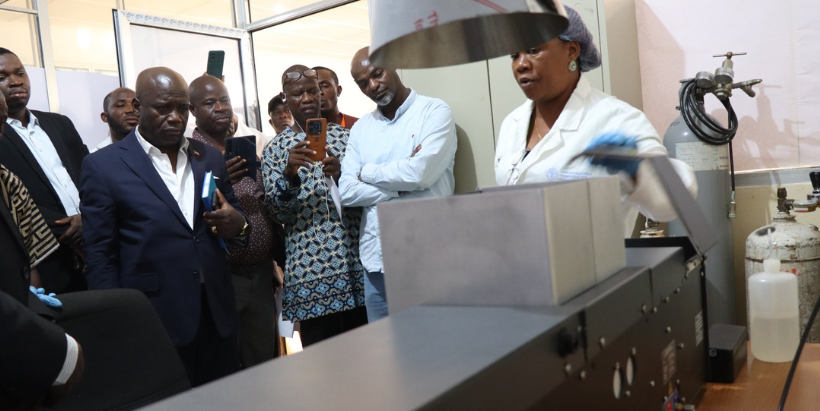
Deputy Minister for Technical Services, Honorable Solomon Hedd-Williams with others at the commissioning of the AAS in the soil testing lab.
When farmers receive fertilizer recommendations, they rarely see the scientists who spent days analyzing soil samples to produce it. When countries talk about boosting food production or building climate-resilient agriculture, the conversation hardly starts with laboratories. Yet it should. Every digital soil map, every nutrient recommendation, and every soil health intervention begins with a sample collected from the ground, transported to a laboratory, and analyzed using established scientific methods. The laboratory is where soil becomes data.
Without reliable laboratories, countries cannot generate the soil information needed to guide fertilizer use, improve crop productivity, or support evidence-based agricultural policy. Weak laboratory systems produce weak data — and weak data leads to poor decisions that ripple out to farmers, governments, and entire food systems.
That is why strengthening soil and plant laboratories is one of the core mandates of the Regional Hub for Fertilizer and Soil Health for West Africa and the Sahel. Established in mid-2024, the Hub’s mandate is to deliver technical assistance for fertilizer and soil health investments across 17 countries in the region. Scoping missions conducted in 11 of these countries in late 2024 produced a unanimous finding: laboratories needed strengthening. Because the demand came directly from the countries themselves, it quickly became one of the Hub’s central priorities.
Building on those scoping missions, the Hub conducted more detailed laboratory assessments in five countries — Nigeria, Ghana, Sierra Leone, Liberia, and Togo — selected based on their readiness and the availability of partners to support the work. The objective was to understand the state of laboratory systems in each country and identify the most appropriate forms of technical support.
Since its establishment, the Hub has worked with national institutions to assess laboratory capacity, identify gaps, strengthen technical expertise, and promote shared standards for soil analysis across the region. Much of that work happens out of public view, but its impact extends far beyond laboratory walls.
What is happening on the ground
From early to late 2025, the Hub organized Soil Information System (SIS) workshops in Togo, Sierra Leone, Nigeria, and Liberia, using each as an opportunity to evaluate the state of the country’s laboratories alongside broader digital-mapping work.
In Togo, laboratories already have good-quality equipment suitable for soil analysis. The Hub’s focus there is on ensuring the country hires trained technicians so that the equipment already in place is used consistently, thereby strengthening the lab’s contribution to Togo’s national Soil Information System.
In Sierra Leone, laboratories show strong potential for quality analysis, and the Hub aims to support the installation of key equipment that has been sitting unused, alongside hands-on training for laboratory staff.
In Nigeria, the Hub has begun a phased laboratory assessment, evaluating three laboratories so far as part of a planned review of roughly six. The labs already assessed show real strengths — qualified, experienced staff and solid analytical know-how — alongside clear opportunities for support, including equipment upgrades and stronger quality assurance systems. A second phase will complete assessments of the remaining laboratories, building toward a comprehensive picture of Nigeria’s laboratory capacity.
In Liberia, an initial assessment found the country had no functioning soil analytical laboratory. The Hub partnered with the University of Liberia and the EU-funded Soils4Liberia project to build the country’s first fully functional reference soil laboratory. Technicians completed extensive training on analytical procedures, equipment handling, and quality assurance, and the lab is now equipped with an Atomic Absorption Spectrometer — a piece of equipment Dr Samuel Mesele, a soil scientist at IITA and the Hub’s country focal person in Liberia, calls essential. “Without this kind of equipment, a laboratory cannot be considered fully functional for modern soil analysis,” Mesele said.
The work drew high-level attention throughout: Liberia’s Minister of Agriculture personally participated in the Hub’s initial visit, and after the equipment was installed and staff trained, the Deputy Minister returned to see the results firsthand.
Across the region, the selected laboratories share common traits: they are public institutions — national reference labs, universities, and government research centers — already trusted by their countries and positioned to anchor a future network of labs that share standards and support one another. In practice, this has meant standardized training, targeted equipment upgrades, and the early outlines of a shared regional quality framework.
The gaps behind the data
The Hub’s country-by-country assessments revealed a consistent regional pattern. West Africa and the Sahel do not lack scientific institutions — many countries already have laboratories playing critical roles in soil fertility management, fertilizer quality control, and agricultural research. The opportunity lies in helping those institutions operate at their full potential.
Common challenges included instruments requiring repair, maintenance, or installation; unreliable electricity and water supplies disrupting routine operations; and sample preparation and storage systems in need of strengthening to reduce the risk of contamination. Quality assurance was another area ripe for support: some labs had taken part in international proficiency testing, but participation was inconsistent, and certified reference materials were scarce, making it harder to ensure that results were accurate and comparable across institutions.
On the human side, many laboratories run on small teams, and in some cases, the most experienced staff are nearing retirement — making structured training and succession planning a priority. Meanwhile, despite growing investment in digital soil mapping initiatives, many laboratories still rely on basic file storage systems to manage data, with limited adoption of integrated platforms to track samples, results, and historical records.
Collectively, these gaps indicate clear opportunities for the Hub’s support. They also underscore a fundamental principle: the credibility of any soil information system is only as strong as the quality of the laboratory data that underpins it.
As Joseph Uponi, lab manager at IITA and a consultant to the Regional Hub, puts it: “The quality of data from laboratories determines the fertilizer recommendations that are made, the quality of the fertilizers themselves, and the quality of the soil maps that are produced.”
A demand-driven model
The Hub’s approach was deliberately designed as a bottom-up, demand-driven process. Early assessments consistently identified laboratory strengthening as a cross-cutting priority, leading to the integration of laboratory diagnostics directly into Soil Information System (SIS) workshops.
The assessment process combines structured questionnaires — covering infrastructure, staffing, and equipment — with on-site field visits to validate conditions and ensure the accuracy of reported information.
A standardized framework is applied across all countries and laboratories. The process begins with an assessment of analytical scope: the types of analyses a laboratory can perform (soil, plant, or fertilizer) and, for soil laboratories in particular, the specific parameters they can measure and the analytical methodologies used. Harmonizing these methods is critical to ensuring the comparability of results across countries and institutions.
Equipment functionality is then assessed in detail, distinguishing between operational instruments, those requiring maintenance, and those in need of replacement. This is complemented by an evaluation of quality assurance systems, including participation in inter-laboratory comparisons and the degree of alignment with peer performance standards.
Laboratory safety is also a key component of the assessment, including the availability and use of personal protective equipment (PPE) and systems for the safe handling and disposal of hazardous waste.
Finally, the framework assesses human capacity needs, differentiating between technician-level training requirements and gaps that require more advanced, degree-level expertise. Laboratory certification status is reviewed against national standards and, where applicable, international benchmarks such as ISO 17025. While full accreditation is often a longer-term objective, the Hub promotes interim steps such as participation in proficiency testing and inter-laboratory comparisons to strengthen analytical credibility and build confidence in results.
From national gains to a regional system
Liberia’s experience — from initial laboratory assessment to the establishment of a fully functional, government-backed reference soil laboratory — offers a clear demonstration of what sustained, coordinated investment in laboratory systems can achieve. This milestone, however, represents a starting point rather than an endpoint. Across the region, the Hub is advancing a deliberate, phased strategy to consolidate early gains and scale impact.
In Nigeria, ongoing work is focused on completing assessments of the remaining laboratories to develop a comprehensive national profile of capacity, strengths, and gaps. In Togo, the next phase of support is underway, with an emphasis on ensuring that trained personnel can fully operationalize and sustain the use of existing high-quality equipment.
Preparations are also underway to extend laboratory assessments to Côte d’Ivoire and Senegal. In parallel, early collaboration is emerging in Mali and Niger through the Hub’s partnership with the Soil Values Program, a 10-year initiative led by the International Fertilizer Development Center (IFDC) and funded by the Netherlands, which aims to strengthen soil fertility systems across the Sahel.
The Mali engagement illustrates this forward-looking approach. In March 2026, researchers and technicians from the Institut d’Économie Rurale (IER) received intensive training at IITA headquarters in Ibadan on Mid-Infrared (MIR) Spectrophotometry, a rapid soil analysis technique. The training covered analytical principles, sample preparation, instrument calibration, spectral scanning, and data interpretation using the AfSIS BART platform. This engagement not only strengthened technical capacity but also fostered collaboration and laid the groundwork for a national soil spectral database in Mali.
Looking ahead, the Hub is advancing a hub-and-spoke model for the next phase of implementation. Under this framework, the Regional Hub will support a network of national reference laboratories, which will, in turn, serve as in-country hubs, providing technical guidance and support to smaller, less-equipped laboratories. Rather than attempting to upgrade all laboratories simultaneously, the approach strategically concentrates resources on a select group of anchor institutions, enabling capacity to cascade more efficiently across national systems.
At the same time, the Hub remains committed to transparency and evidence-based planning. Assessment findings are being validated and will be formally shared with national counterparts to support informed decision-making and strategic investment planning. Increasingly, direct engagement with ministries of agriculture is positioning the Hub not as an external assessor, but as a trusted technical partner supporting national systems.
The long-term objective is to consolidate these efforts into a single regional proposal to systematically strengthen soil laboratories across West Africa and the Sahel. Developed in collaboration with ECOWAS, this initiative aims to build resilient laboratory systems that governments can rely on — and that ultimately produce the credible data needed to support farmers’ productivity and food security across the region.
About the Regional Hub
The Regional Hub for Fertilizer and Soil Health for West Africa and the Sahel is a collaborative initiative that brings together leading research, development, and private-sector partners to deliver science-driven solutions for sustainable agriculture. Hosted by the International Institute of Tropical Agriculture (IITA) and supported by organizations including the International Fertilizer Development Center (IFDC), OCP Africa, the African Plant Nutrition Institute (APNI), University Mohammed VI Polytechnic (UM6P), Accelerating the Impacts of CGIAR Climate Research for Africa (AICCRA), and the International Soil Reference and Information Centre (ISRIC), the Hub leverages data, soil testing, and fertilizer technologies to enhance productivity, efficiency, and resilience across regional food systems.
With financial backing from the World Bank through CGIAR’s AICCRA project and OCP Africa, the Hub is committed to translating research into actionable solutions for farmers and policymakers — promoting long-term soil health, food security, and sustainable development across West Africa and the Sahel.
Learn more: regionalhub-west.org
Media Contacts
Ilerioluwa Oladipupo — I.Oladipupo@cgiar.org
Barbra Muzata — B.Muzata@cgiar.org


No Comments