
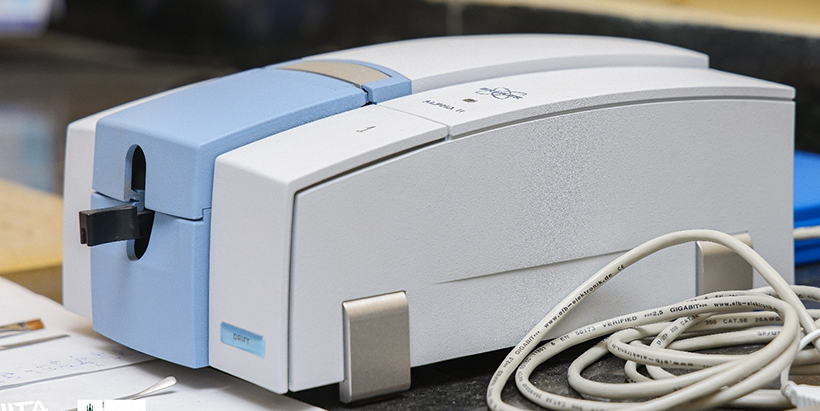
MIR spectrophotometer machine.
Reliable soil information is becoming increasingly important as countries across West Africa and the Sahel work to improve fertilizer recommendations, manage soil degradation, and strengthen climate-resilient agriculture.
Generating this information at the national and regional scales requires analytical systems that are not only scientifically rigorous but also faster, more affordable, and easier to scale.
At the Regional Hub for Fertilizer and Soil Health for West Africa and the Sahel, scientists are combining established laboratory approaches with advanced analytical technologies to transform how soil data is generated, interpreted, and applied across the region.
A faster pathway to soil information
Soil analysis has traditionally relied on wet chemistry, the global standard for measuring key soil properties such as pH, organic carbon, and total nitrogen. This method has been the backbone of high-quality soil diagnostics. While it is highly accurate, it is also resource-intensive, requiring reagents, skilled technicians, and significant processing time. A full analysis can cost between US$60 and US$70 per sample.
For large-scale soil characterization, these differences in time and cost become significant. Dry chemistry approaches offer a faster and more affordable pathway, with the capacity to analyze up to 100 soil samples within a day, compared with approximately three to four days required for wet chemistry analysis of the same number of samples, depending on the parameters being measured and laboratory capacity. The cost difference is also substantial, with dry chemistry analysis costing around US$7 per sample compared with approximately US$60–70 per sample for wet chemistry.
At the Regional Hub’s dry chemistry laboratory, scientists are working to complement this established system with faster, more scalable methods. The laboratory is equipped with Mid-Infrared (MIR) spectroscopy and X-Ray Fluorescence (XRF) technology. Together, these tools allow scientists to rapidly characterize soil samples and significantly reduce the need for full wet chemistry on every sample.
With MIR spectroscopy, finely ground soil is scanned to produce a unique spectral signature—effectively a “fingerprint” of the soil. Using chemometric and machine learning models calibrated against previously analyzed samples, scientists can predict a wide range of soil properties in minutes.
The XRF system adds another layer of precision by rapidly measuring the total elemental composition, including nutrients such as calcium, phosphorus, and iron. Originally developed for mineral exploration, it is now a critical tool for building a richer understanding of soil fertility dynamics.
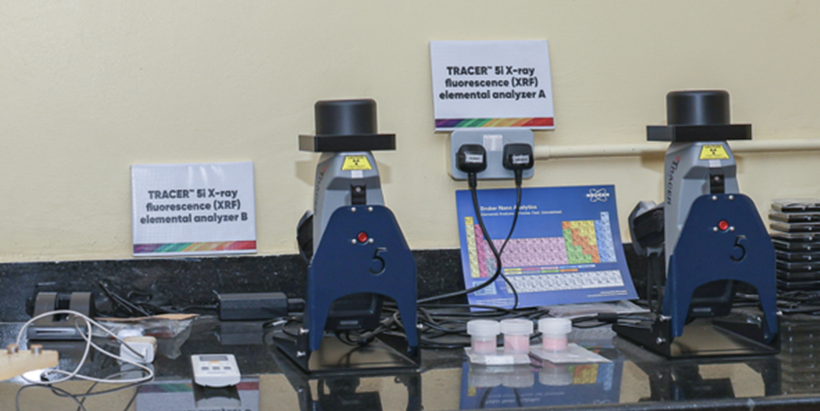
X-Ray Fluorescence (XRF) elemental analyxers.
Two systems, one scientific engine
Rather than replacing conventional laboratory methods, the dry chemistry laboratory works in close partnership with the International Institute of Tropical Agriculture (IITA)’s wet chemistry facility.
Wet chemistry provides the gold-standard measurements needed to calibrate and validate the predictive models used in dry chemistry analysis. A subset of samples is still analyzed through wet chemistry, ensuring that model predictions remain scientifically reliable.
As these calibrated datasets grow, the system becomes progressively more efficient. Fewer samples require full chemical analysis, while more can be processed through rapid spectral and elemental methods without compromising accuracy.
In effect, the two systems form a single scientific engine: wet chemistry provides depth and validation, while dry chemistry provides speed and scale.
Building one of Africa’s most valuable soil libraries
Behind these advances is another critical asset housed at IITA: a rapidly growing soil library that is becoming one of the region’s most important scientific resources.
Every soil sample analyzed by wet chemistry is carefully archived, creating a reference database that strengthens future soil predictions and improves the accuracy of digital soil mapping and fertilizer recommendations.
IITA currently analyses between 10,000 and 15,000 soil samples annually, building a continuously expanding repository of soil data from across West Africa and beyond. Samples generated through the Regional Hub’s activities also contribute to this growing library, reinforcing its regional relevance and scientific depth.
As the library expands, it enhances the predictive power of the dry chemistry models. IITA Analytical Services Manager Joseph Uponi noted that once a country builds a sufficiently large, well-characterized dataset—typically in the range of 20,000 to 30,000 samples—model calibration becomes more robust. At that stage, as little as 5% of new samples may require full wet-chemistry verification.
The implications are significant: faster turnaround times, lower costs, and the ability to generate reliable soil information at national and regional scales.
In practical terms, every new sample analyzed today strengthens the accuracy and efficiency of tomorrow’s recommendations.
From laboratory innovation to food system impact
Advances in laboratory science are increasingly shaping how agricultural decisions are made. Faster soil analysis enables more detailed digital soil maps, more precise fertilizer recommendations, and more responsive national soil information systems. These tools are becoming essential for governments seeking to improve productivity, manage soil degradation, and strengthen climate-smart agriculture policies.
By reducing the cost and time required for soil analysis, dry chemistry technologies are reshaping the economics of soil data. Governments and development partners can process more samples, build richer national soil databases, and generate more accurate, location-specific recommendations at scale.
This shift moves soil information beyond isolated research activities into broader, system-wide agricultural planning.
For farmers, the implications are equally significant. As soil testing becomes more affordable and accessible through government programs, extension systems, and private-sector advisory services, more farmers can receive field-specific information to guide fertilizer use. This improves nutrient efficiency, reduces input waste, and supports higher productivity.
Over time, these gains translate into healthier soils, more productive farms, and more resilient agricultural systems. At scale, they strengthen food security by enabling countries to produce more food sustainably while improving returns on agricultural investment and resilience to climate variability.
The Regional Hub is already supporting countries in developing tailored soil information systems and nutrient recommendations aligned with specific crops, soils, and production zones. It also provides analytical services to governments, research institutions, and development partners, extending access to high-quality soil data beyond core research programs.
Together, the complementary strengths of IITA’s wet- and dry-chemistry laboratories are enabling a shift away from isolated soil tests toward continuous, data-driven soil intelligence systems. These systems support faster decision-making, more efficient fertilizer use, and more effective soil management across the region.
Contributed by Ilerioluwa Oladipupo


No Comments