
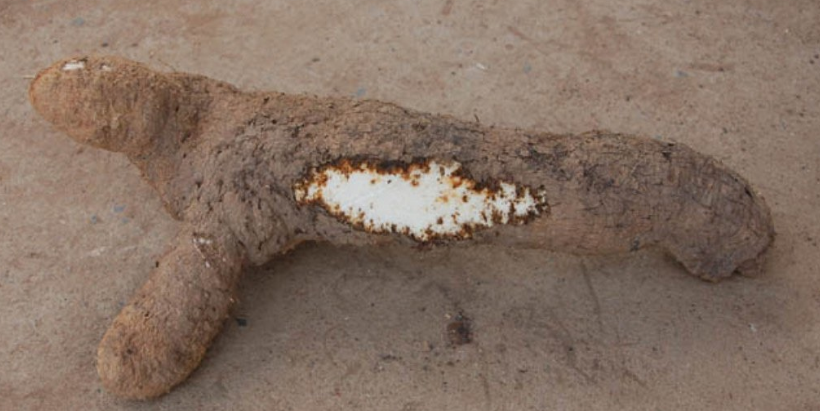
Infected yam tuber.
New genomic evidence could help scientists distinguish ancient viral remnants from active infections—and support safer yam germplasm exchange
Yams are prone to several viruses, and some of their genomes contain diverse viruses known as endogenous pararetroviral sequences (EPRVs), inherited over generations, these viruses complicate diagnostics and germplasm exchange because the sequences resemble the DNA of infectious viruses.
A recent genomic study of five yam species—D. rotundata, D. alata, D. praehensilis, D. abyssinica, and D. dumetorum—identified inactive integrations of four major groups of badnavirus-derived DNA in the yam genome. The findings provide new information that could help scientists clarify a persistent challenge for plant health testing and yam germplasm exchange.
Why this research matters
Yam is a key staple crop in West Africa, contributing to food security, rural incomes, and cultural traditions. Improving and distributing yam varieties for research is often difficult because tuber propagation allows virus spread from one generation to the next. Therefore, genebanks and breeding programs rely on virus-indexing and phytosanitary systems before distributing planting material within or between countries.
EPRVs are virus-derived DNA sequences that are integrated into the yam genome during ancient encounters between viruses and their plant hosts. These sequences are inherited as part of the plant’s DNA and are usually fragmented and inactive. However, in certain plants, for example, Musa sp., the EPRVs can be infectious, exist in episomal form— actively existing independently in the plant cell and can multiply— and cause disease. Some EPRVs closely resemble free or potentially infectious episomal viruses. Conventional PCR tests may detect both forms, yielding positive results even in the absence of active infection. This ambiguity can delay or prevent the movement of valuable germplasm.
A recent publication provides a comprehensive analysis of EPRV diversity in yams. The aim was not only to understand yam badnavirus diversity but also to generate evidence to support more precise diagnostics and proportionate phytosanitary decisions.
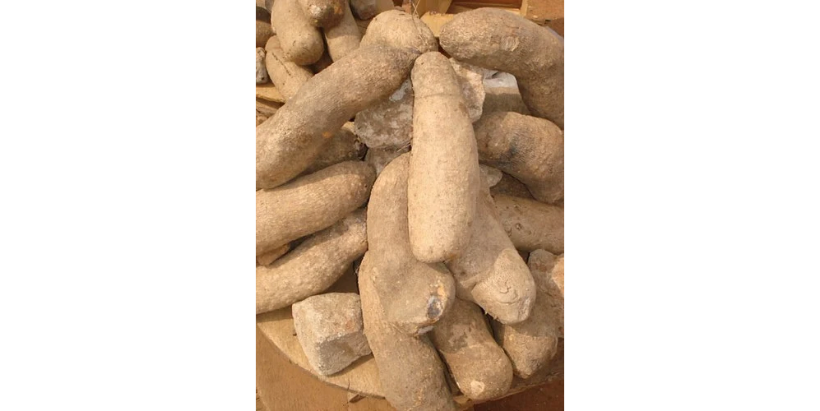
Yam tubers in the market.
What the researchers found
This study analyzed 86 publicly available whole-genome sequences from five yam species: Dioscorea rotundata, D. alata, D. praehensilis, D. abyssinica, and D. dumetorum. The collection comprised cultivated accessions, landraces, improved varieties, and wild relatives. Using the CAULIFINDER bioinformatics pipeline to analyse the DNA of the different yam species, the researchers identified traces of ancient viruses belonging to the Caulimoviridae family, providing new insights into the crop’s viral history Additional detection methods captured both highly fragmented repeated elements and lower-copy integrations.
The analysis revealed nearly 3,789 copies of EPRV repeat sequences across yam genomes
The analysis reconstructed 3,789 EPRV repeat sequences across yam genomes. Among these, researchers identified 673 genetic markers that provided clues about the origins and evolution of these viral remnants. In D. rotundata, these elements formed four major groups of viruses: Yam Badnavirus 1, Yam Yendovirus, Yam Endovirus 1, and a Dioscovirus-like lineage.
The discovery of Dioscovirus-like elements is significant, as previously researchers had found only one active virus from this group in D. nummularia.
The study uncovered previously hidden traces of virus-like DNA embedded in yam genomes and provides the first detailed look at these ancient viral remnants in yams. Most of the sequences were broken and incomplete, suggesting they entered the yam genome long ago and have gradually deteriorated over time. In some cases, there was not enough evidence to determine whether the sequences were permanently embedded in the plant’s DNA or belonged to active viruses. The researchers found no evidence that these ancient viral remnants are currently active or causing infections in yams.
The distribution of EPRVs reflects evolutionary history.
D. praehensilis and D. abyssinica shared more clusters with D. rotundata than did D. alata or D. dumetorum, supporting evidence that D. rotundata originated from hybridization between D. praehensilis and D. abyssinica.
EPRVs may serve as useful genomic markers for studying yam ancestry and species divergence, though integration dates require further investigation.
Why the findings are significant
One of the biggest challenges is accurately detecting virus infections in yam. Common laboratory tests can pick up both active viruses and harmless remnants of ancient viruses hidden in the plant’s DNA, making it difficult to tell the difference. As a result, a positive test does not always mean a plant is infected.
The new genetic information from this study can help scientists develop more accurate testing methods that distinguish inactive viral remnants from active, disease-causing viruses. This will allow plant health experts to make more informed decisions based on multiple lines of evidence rather than relying on a single test result.
The findings are important for genebanks, plant breeders, regulators and plant health agencies. Mistaking harmless viral remnants for active infections can lead to valuable yam varieties being unnecessarily excluded from conservation, research or breeding programs. By improving the accuracy of virus testing, the research could help protect genetic diversity, reduce costs and support the safe exchange of yam planting materials around the world.
This work reframes many yams’ EPRVs as evidence of ancient relics and helps identify what is embedded in yam genomes, enabling phytosanitary systems to distinguish true biological threats from inherited molecular relics.
The study highlights how improved diagnostics can protect plant health while supporting the timely and responsible exchange of yam germplasm for crop improvement, climate resilience, and food security. Further research on transcription, epigenetic regulation, chromosomal location, and reactivation potential will deepen understanding of EPRVs and their biological significance.
Contributed by Lava Kumar
Note: AI tool used for language review of this blog.

No Comments