
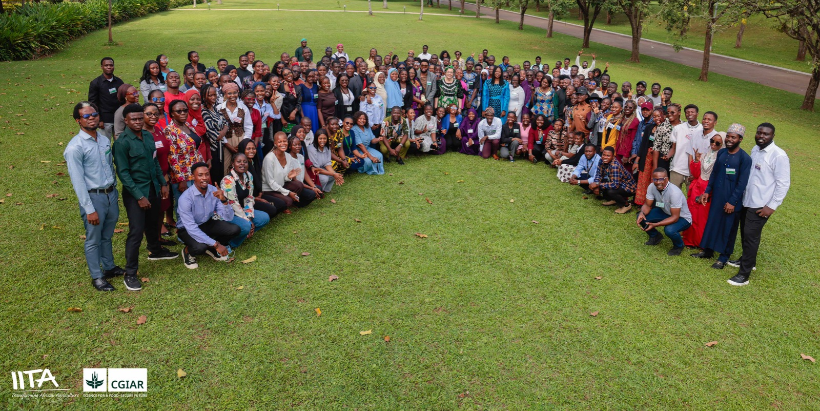
IARSAF members and invited speakers after Day 1 morning session at the IITA Headquarters in Ibadan.
From improving crop yields to delivering better nutrition and building climate resilience, African agricultural researchers have been challenged to rethink how research contributes to food systems transformation.
African agricultural research must move beyond measuring success through increased crop yields to embrace innovations that improve nutrition, strengthen climate resilience and deliver tangible benefits to farmers and communities.
This was the recurring message at the 29th Annual Symposium of the International Association of Research Scholars and Fellows (IARSAF), held from 3 to 5 November 2026 at the IITA headquarters in Ibadan, Nigeria, and icipe–IITA campus in Nairobi, Kenya, with both physical and virtual participation.
Under the theme, Productive, Nutrient-Dense and Resilient Agrifood Systems: Scaling Climate-Smart and Nutrition Innovations, the symposium brought together researchers, academics and development practitioners to examine how scientific discoveries can better respond to the interconnected challenges of food insecurity, malnutrition and climate change.
A key message emerging from the discussions was that agricultural productivity must be understood beyond the volume of food produced, with greater attention to its nutritional value, economic benefits, and sustainability.
Delivering the first keynote address, Dr Ekemini Obok, Associate Professor of Crop Improvement at the University of Calabar, challenged researchers to broaden their understanding of agricultural success. He noted that while increased yields remain important, they do not necessarily translate into improved nutrition, profitability or efficient use of resources.
Against the backdrop of an estimated 733 million people experiencing hunger globally, he argued that agricultural research must deliberately integrate productivity, nutrition, and resilience.
Using Rwanda’s iron-rich beans as an example, he demonstrated how crop improvement can contribute simultaneously to food production and better nutrition.
“Integration is not an option; it is the operating model for agricultural transformation,” he said.
The need to bridge the gap between research discoveries and practical applications also featured prominently in the discussions.
Speaking on From Innovation to Impact: Scaling Climate-Smart and Nutrition Innovations for Africa’s Agrifood Systems, the second keynote speaker, Prof. Charles O. Adetunji, Deputy Vice-Chancellor of the Federal University of Agriculture and Development Studies, Osun State, called on African universities to become more deliberate about translating research into market-ready solutions.
He identified inadequate funding, weak industry partnerships, insufficient intellectual property protection, and limited commercialization strategies as major obstacles preventing promising research innovations from reaching the marketplace.
He highlighted the potential of climate-smart agricultural practices, including drought-tolerant crop varieties, conservation agriculture and digital weather advisory services, alongside nutrition-sensitive innovations involving soybean, cowpea and improved food processing.
However, he noted that scaling these innovations would require more than scientific breakthroughs. Access to affordable technologies, effective extension services, financing and improved rural infrastructure remain critical to ensuring that innovations reach the people who need them.
He encouraged young researchers to build strategic partnerships and take advantage of professional networks, emphasizing that collaboration is essential to achieving research impact.
Beyond technology and commercialization, speakers also stressed the importance of placing farmers and communities at the center of agricultural research and policy development.
Prof. Janice Olawoye, a retired professor at the University of Ibadan, cautioned against adopting uniform agricultural policies without considering the different realities of farming communities. She advocated greater recognition of indigenous knowledge and called for a shift from conventional top-down agricultural extension approaches to more responsive, demand-driven systems.
“Our research should not just be to describe the problem, but suggest solutions,” she said, urging researchers to ensure their work addresses practical challenges.
The importance of inclusive innovation was further highlighted by Dr Olubukola Idowu of AMREC-FUNAAB, who drew attention to the structural barriers confronting women and young people in agriculture, particularly their limited access to land, finance and markets.
She argued that training programs alone would not address these challenges unless women and young people were actively involved in identifying problems, developing solutions and evaluating innovations under realistic conditions.
She also emphasized the importance of collecting and analyzing data disaggregated by sex and age to better understand the different experiences and needs of agricultural stakeholders.
“The future of African agriculture depends on how fairly we share opportunity,” she said.
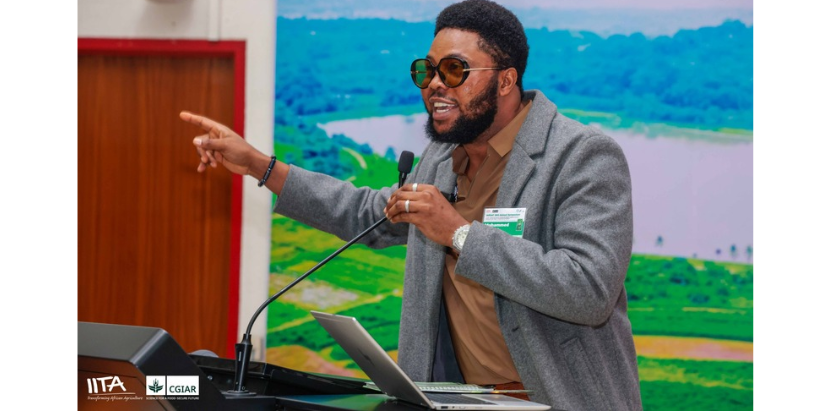
IARSAF President Jumuah Muhammed Jimoh delivering the keynote address.
Climate resilience was another important dimension of the symposium, with Dr John Choptiany, a Climate Resilience and Adaptation Expert at IITA Kenya, drawing attention to the growing pressures of climate change on African food systems.
Citing an estimated 309 million Africans facing hunger in 2025, he noted that the continent is warming faster than the global average, making the need for effective adaptation strategies increasingly urgent.
He presented a resilience assessment tool that combines survey information and satellite data to measure resilience at the farm level. He also encouraged young researchers to approach their work with clear development decisions in mind, measure nutritional outcomes and resilience alongside productivity, and establish partnerships with governments, private sector actors and farmers from the outset. “Climate change is already reshaping African food systems,” he observed.
For IARSAF, the symposium also provided an opportunity to strengthen the research community’s commitment to collaboration, knowledge exchange, and collective action.
In his remarks, IARSAF President Muhammed Jimoh Jamiu acknowledged the support of IITA Director General, Dr Simeon Ehui, the IITA Capacity Development Office, icipe, sponsors and partners, as well as the association’s executive and local organizing committees.
He encouraged members to see IARSAF as more than an association, but as a community in which every member has a responsibility to contribute. “IARSAF is not merely an association to belong to, but as a community to contribute to,” he said.
He further called for stronger collaboration among scientists, farmers, policymakers and private sector actors, urging participants to leave the symposium with new knowledge, meaningful connections and commitments that would advance agricultural research and development.
Earlier, Sougrynoma Zaïnatou Soré, Head of the IITA Capacity Development Office, commended the association and the organizing committee for convening the symposium. She underscored the importance of nutrition in building resilient food systems and encouraged researchers to deepen their scientific knowledge, read widely, master fundamental scientific principles and move beyond research approaches that rely solely on basic surveys.
In her vote of thanks, Omolara Akinyoola, Chairperson of the Local Organising Committee, appreciated the speakers, participants and partners for their contributions, noting that the diversity of expertise and perspectives had enriched the discussions and broadened participants’ understanding of the issues shaping Africa’s agrifood systems.
As the symposium concluded, its central message was clear: the future of African agriculture will depend not only on the innovations researchers develop, but also on how effectively those innovations are translated into solutions that improve livelihoods, deliver better nutrition and build resilience.
For young African researchers, this presents both a challenge and an opportunity to make research more responsive, collaborative and impactful.
Contributed by Alice Omoteji


No Comments