
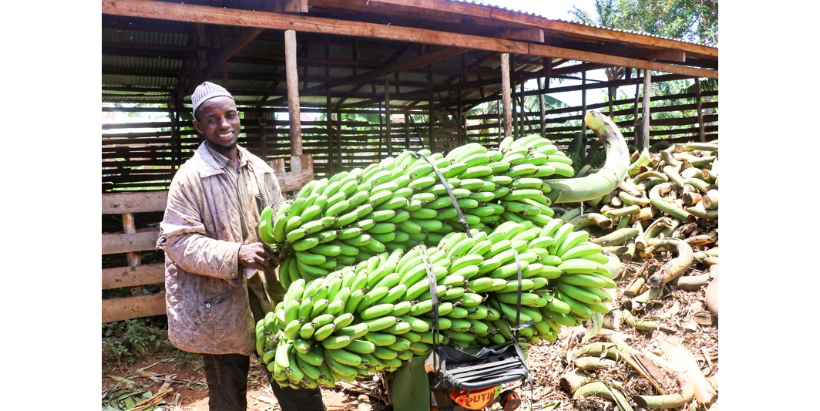
A farmer supplying his FHIA bunches to Katoma market for onward sale to traders.
In Tanzania’s Kagera region, 48% of farmers have now adopted improved banana varieties developed through IITA’s breeding approach. To demonstrate, learn about, and explore how the Institute’s innovative approach to banana breeding led to the successful adoption, IITA and long-time national partner the Tanzania Agricultural Research Institute (TARI) hosted a delegation from INRAPE (Institut National de la Recherche pour l’Agriculture, la Pêche et l’Environnement), Comoros, from 4 to 6 October. The visit gave the delegates a first-hand look at the approach and what it could mean for their own work.
The eight-member delegation, which included extension workers, farmers, government officials, and IITA staff, learned how banana hybrids such as FHIA have raised yields and improved daily life. The visit aims to provide lessons for overcoming cultural and market barriers in the Comoros.
Dr Mpoki Shimwela, the National Banana Crop Coordinator from TARI, recounted how the FHIA variety was introduced in the mid-1990s, from facing rejection by local farmers to becoming an important source of food security and income.
“Initially, local communities relied mainly on ‘Inshakara’ traditional Matooke varieties. But with time, FHIA bananas have gradually gained acceptance and become an important part of daily diets,” said Dr Shimwela.
Moreover, Msabila Rafael, an Agricultural Officer from Katoma village, explained that familiarity with the traditional Matooke variety was the main challenge during the intervention, but other advantageous traits of some FHIA varieties, including disease resistance, drought tolerance, and maturity time, gained it some attention. “Practical advantages changed farmers’ minds. Traditional varieties take up to two weeks to ripen and about four months to mature, while FHIA ripens much faster, maturing in three months. These qualities opened demand from major markets in Dar es Salaam, and farmers began to see the variety’s potential,” said Rafael.
A recent impact study reveals that the adoption of banana hybrids has increased productivity by 15% (equivalent to 119,194 tons) in Kagera by 2024, contributing nearly US$7 million worth of bananas to the region’s economy while generating more tax revenue due to increased trade volume and value in fresh and processed banana products.
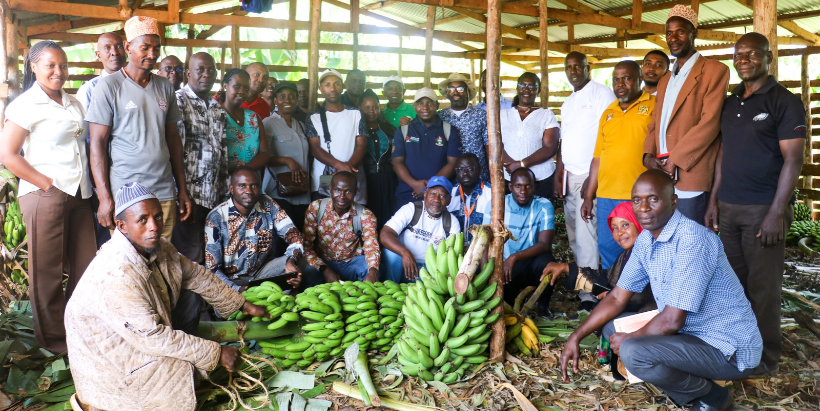
The Comorian delegates with FHIA sellers in Katoma Market. Photo: Hadi Rashid
The adoption was also linked to reduced crop losses from pests and diseases, and to a growing number of farmers producing a surplus for the market. Nearly 48% of farmers in the region had adopted improved varieties, according to the findings. The study found that daily caloric intake among adopting families increased by 27%, pointing to improved food availability and diversity.
FHIA was also introduced in Côte d’Ivoire and Uganda, where it struggled to win over farmers. Doto Titto, a farmer and an early FHIA adopter, said TARI researchers who were promoting the improved FHIA variety convinced him to grow the variety.
“It was clear that FHIA was a more commercially viable form of farming. “I was persuaded because it helps me generate income while also providing food for my family,” Titto explained. “Traditional banana farming could no longer meet my needs; I have now been farming FHIA for 15 years. I generate TZS 2.5 million per year as my profit,” he further buttressed.
On the other hand, the delegates heard from growers who are using new matooke hybrids that resist pests and diseases. With Fusarium wilt TR4 now a concern for Comoros, the visit centered on resilient varieties and practical farming methods. The delegates also learned about macropropagation for plantlet production and the value of intercropping with bush beans.
For the Comorian delegation, the visit came as IITA and INRAPE Comoros have introduced 200,000 banana plants in Comoros to boost food supply. Tanzanian farmers’ experience offered a glimpse of what could be achieved. The delegation discussed compost, ways to add value along the banana chain, and approaches to increase income. Exchange visits like these give farmers and extension agents ideas they can use and share.
Contributed by Hadi Rashid, Gloriana Ndibalema and Rony Swennen
Theme: Improving livelihoods, Improving crops
Tags: FHIA variety, Improved varieties, Banana production, Partnership, Crop improvement, Comoros, Tanzania, Smallholder farmers,


No Comments