
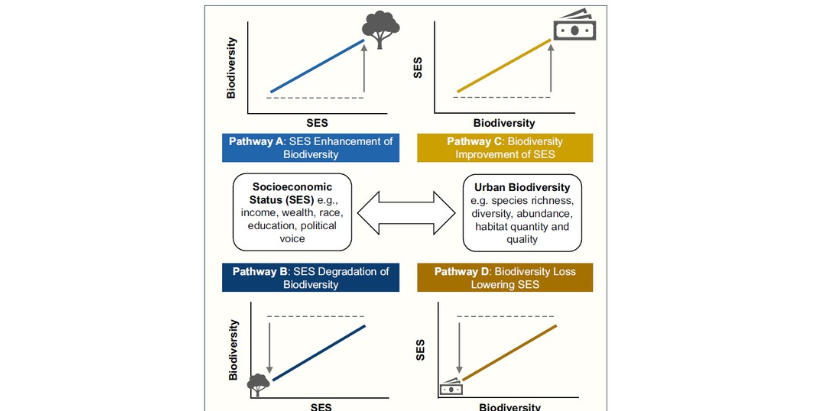
The four socio-economic status and biodiversity pathways framework.
Why do wealthier neighborhoods often support more urban biodiversity than poorer ones? Is it because wealthier residents and communities can invest more in trees, gardens, parks, and other green spaces? Or could the pattern also reflect the gradual loss of nature in disadvantaged neighborhoods? Perhaps, in some cases, access to green spaces itself influences property values and the socioeconomic composition of communities.
These questions are at the heart of a new open-access paper, Socioeconomics and biodiversity in cities: moving beyond patterns to mechanisms, co-authored by the Head of IITA Forest Center, Dr Adewale Awoyemi, who also represents the A.P. Leventis Ornithological Research Institute (APLORI), for perspectives from the Global South. The paper grew out of the Urban Ecology Synthesis Workshop, led by Prof. Chevonne Reynolds. It was held physically at the University of the Witwatersrand in Johannesburg, South Africa, from 30 June to 4 July 2025. Funded by the British Ecological Society, the workshop brought together 12 urban ecologists from the Global South and Global North to examine questions in urban ecology and synthesize knowledge across research perspectives.
Published in Trends in Ecology and Evolution, the paper argues that although researchers have repeatedly documented associations between socioeconomic status and urban biodiversity, much of the existing evidence remains correlational. In other words, studies often show that wealthier neighborhoods have more biodiversity but do not explain the underlying cause of the relationship or how it develops over time.
The authors propose a framework that moves beyond describing these patterns to investigating the processes behind them. This distinction matters because urban biodiversity is more than the presence of trees and green spaces. It includes the variety, abundance, and composition of organisms, as well as ecological features, across urban green and blue spaces. These natural assets contribute to urban well-being through services such as cooling, flood regulation, improved air quality, and access to useful natural resources.
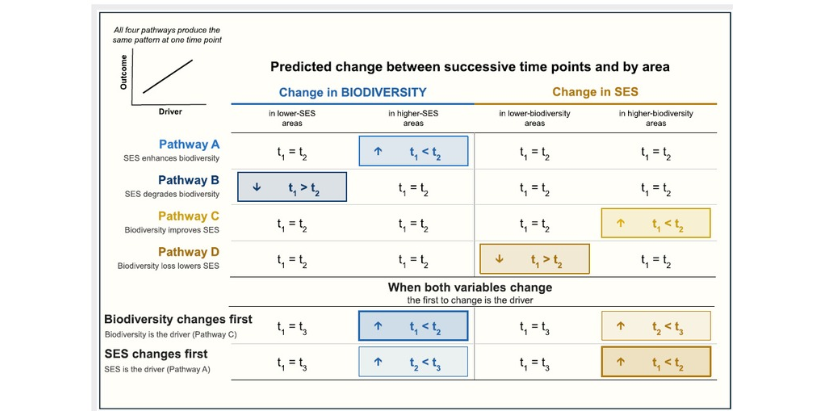
The predicted signatures of the four pathways.
However, these benefits are not necessarily distributed equally among urban residents. The paper brings together mechanisms discussed across urban ecology, environmental justice, urban planning, and related disciplines into four hypothesized causal pathways.
The first, investment-driven biodiversity enhancement, describes how wealthier households and communities may invest in private gardens, street trees, parks, and other green infrastructure, increasing habitat availability and supporting some components of biodiversity.
The second, disinvestment-driven biodiversity degradation, highlights a contrasting process. Where investment and institutional support are limited, the neglect of public green spaces, habitat destruction, and the expansion of built infrastructure may contribute to biodiversity loss. Consequently, the difference between wealthier and poorer neighborhoods may reflect not only the addition of nature in affluent areas but also the loss of nature in disadvantaged ones.
The third pathway, biodiversity-driven socioeconomic improvement, considers how attractive green spaces and biodiversity-related amenities can raise property values and attract higher-income residents. Although such changes may improve some environmental conditions, they can also contribute to residential displacement, potentially excluding existing residents from the benefits of neighborhood improvements.
The fourth, biodiversity loss reinforcing socioeconomic decline, examines how losing access to ecosystem services and natural resources may increase environmental risks and weaken livelihoods, potentially deepening existing disadvantages.
Together, these pathways show why similar patterns of urban biodiversity can arise through very different processes. The authors caution that interventions intended to make cities greener may reduce inequality in some circumstances, but risk reproducing or worsening it in others if their social consequences are not considered.
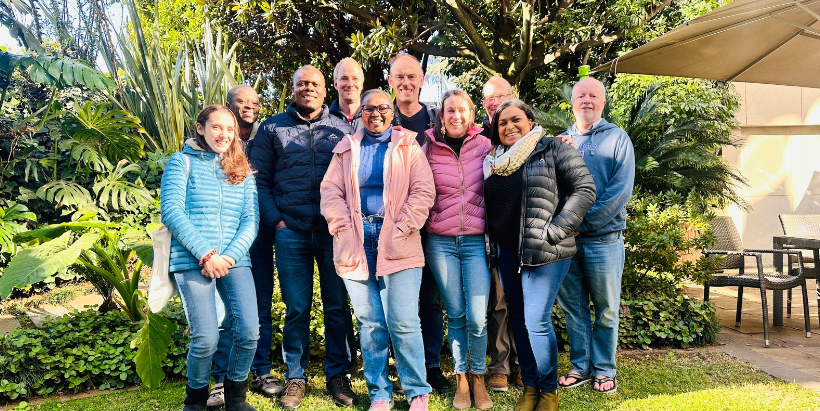
Dr Adewale Awoyemi, representing IITA Forest Center and APLORI for Global South perspectives, with co-participants at the Urban Ecology Synthesis Workshop, at the University of Witwatersrand, Johannesburg, South Africa, in July 2025.
The authors call for research that combines repeated measurements over time, approaches capable of evaluating effects of interventions, and qualitative evidence that can reveal social and institutional processes. Such work can help establish whether socioeconomic change precedes biodiversity change, whether biodiversity influences socioeconomic outcomes, or whether both processes interact. For rapidly urbanizing cities, particularly across the Global South, this understanding is important. Protecting existing habitats and preventing biodiversity loss in disadvantaged neighborhoods may be as critical as creating new green spaces elsewhere.
Ultimately, the paper calls for urban biodiversity strategies that address the causes of unequal environmental conditions rather than simply responding to their visible effects. As cities pursue sustainability targets, the challenge is not merely to make urban environments greener, but to ensure that interventions support biodiversity while contributing to fairer, healthier, and more inclusive communities.
Read the open-access paper: https://doi.org/10.1016/j.tree.2026.09.009
Contributed by Folake Oduntan


No Comments