
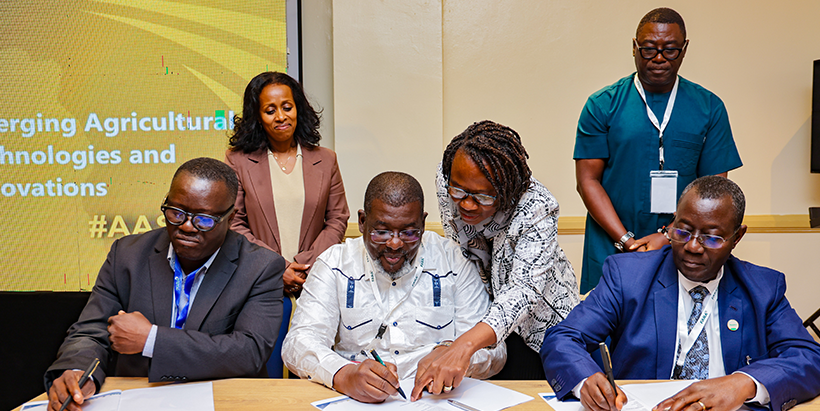
Head of the CGIAR Liaison Office for Africa, Covic Namukolo, IITA Deputy Director General for Partnership for Delivery and Scaling, Dr Tahirou Abdoulaye; ASARECA, Executive Director, Dr Sylvester Baguma, and Geoffrey Onaga representing Knowledge Management Community of Practice during the signing of the Framework at AASW9.
Knowledge is increasingly recognized as one of Africa’s most valuable agricultural resources, not only for generating innovations, but also for ensuring that proven solutions reach the last-mile users—smallholder farmers—that need those most. Against this backdrop, continental partners have renewed a strategic five-year commitment to strengthen knowledge management as a cornerstone of Africa’s agricultural transformation.
The African Union Commission (AUC), the CAADP-XP4 Consortium, and CGIAR signed a renewed Knowledge Management Partnership Framework for Agricultural Research for Development (AR4D) in Africa during a high-level session at the 9th Africa Agriculture Science Week (AASW9) and 10th Forum for Agricultural Research in Africa (FARA) General Assembly in Abuja.
The framework signals a shift in how knowledge management is viewed across Africa’s agricultural research and innovation ecosystem. Rather than serving primarily as a mechanism for documenting and disseminating research outputs, knowledge management is being repositioned as strategic tool for adaptive learning, evidence-based decision-making, innovation scaling, and institutional transformation.
The signing took place during a session themed “Knowledge, Learning, and Innovation Systems for Agrifood Transformation in Africa,” held on 28 July under AASW9’s Sub-Theme 1, “Emerging Agricultural Technologies and Innovations.” The event was jointly organized by the AUC, the CAADP-XP4 Consortium—comprising FARA, African Forum for Agricultural Advisory Services (AFAAS), Association for Strengthening Agricultural Research in Eastern and Central Africa (ASARECA), Conseil Ouest et Centre Africain pour la Recherche et le Développement Agricoles (CORAF), and North Africa Agricultural Sub Regional Organization (NAASRO)—alongside CGIAR, German Federal Ministry of Research, Technology and Space (BMFTR)-supported INTERFACES Project, the KM4AgD Community of Practice, and the Agricultural Research Council of Nigeria (ARCN).
The renewed agreement builds on the first partnership framework signed during the 8th Africa Agriculture Science Week in Durban, South Africa in 2023. That initial framework concluded in December 2025 after helping establish stronger collaboration among continental institutions working to improve how agricultural knowledge is generated, shared, and applied.
Partners said the new 2026–2030 framework aligns with the Kampala CAADP Declaration and the CAADP Strategy and Action Plan (2026–2035), both of which identify knowledge management as an essential pillar for accelerating agricultural transformation across Africa through a continent-wide Knowledge Management Support System.
Jointly endorsed the AUC, FARA, AFAAS, ASARECA, CCARDESA, CORAF, and CGIAR, the framework commits partners to strengthening digital and AI-enabled knowledge systems, improving collaboration across institutions, and ensuring that indigenous and local knowledge are valued alongside scientific research. By 2030, the partners envision knowledge management becoming fully institutionalized across AR4D institutions, supported by more accessible continental knowledge infrastructure, and stronger evidence demonstrating how knowledge systems contribute to innovation scaling and institutional change.
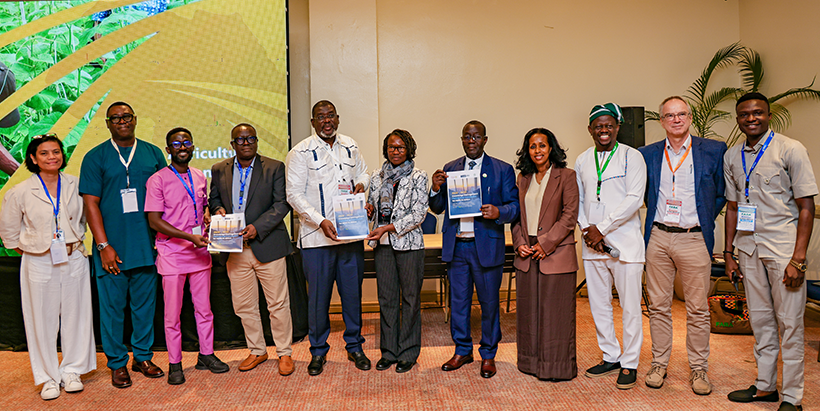
Dr Tahirou Abdoulaye, IITA Deputy Director General for Partnerships for Delivery and Scaling; Dr Sylvester Dickson Baguma, Executive Director of ASARECA; and Godfrey Onagwa, representing the KM4AgD Community of Practice, join other partners holding copies of the renewed Knowledge Management Partnership Framework (2026–2030) following its signing at the high-level parallel session during AASW9 in Abuja.
Beyond the signing ceremony, discussions focused on one of Africa’s biggest agricultural challenges: ensuring that innovations move beyond research laboratories to widespread adoption by farmers, agribusinesses, and food system actors.
Presenting CGIAR’s Scaling for Impact approach, Dr Solomon Gizaw, Head of the Technologies for African Agricultural Transformation (TAAT) Clearinghouse at IITA argued that successful scaling extends far beyond increasing the distribution of technologies.
According to Dr Gizaw, scaling requires understanding farmers’ realities, strengthening the institutions that support them, building strategic partnerships, and embedding innovations within interconnected food, land, and water systems.
He highlighted several examples of CGIAR innovations already making a difference across Africa, including climate-smart and pest -resistant crop varieties, the biocontrol product Aflasafe, digital decision-support tools for fish farmers, youth agripreneur programs, and technology that convert cassava peels into livestock feed. However, he noted that while scientific breakthroughs are essential, achieving sustained adoption at scale remains a greater challenge.
A panel discussion moderated by Dr Namukolo Covic, Head of the CGIAR Liaison Office for Africa, explored what is needed to move promising innovations from research into widespread use.
Joining the discussion were Professor Lateef Sanni, an academic and agricultural research and post-harvest technology expert, and HarvestField Industries CEO, Dr Abdullahi Ndaruba.
Panelists agreed that agricultural transformation cannot be achieved by researchers alone. Instead, stronger collaboration is needed among research institutions, governments, financial institutions, extension services, agribusinesses, farmer organizations, and the private sector.
Professor Sanni emphasized that agricultural transformation should no longer follow isolated institutional pathways. Researchers, the private sector, and stakeholders, he said, must co-create solutions across the entire innovation value chain—from research and production to markets and long-term sustainability. He also called for farmers and entrepreneurs to play a more active role in shaping research priorities.
Other participants echoed the importance of tailoring knowledge to users’ needs. Noting that farmers are more likely to adopt innovations when they receive appropriate information, on expected economic returns and market opportunities.
Dr Ndaruba stressed that innovations should be designed with end users in mind from the outset. Adding that researchers should view themselves not only as knowledge generators but also as service providers responding to the needs of farmers and agribusiness entrepreneurs. Dr Ndaruba said, for meaningful adoption to be achieved, technologies should be accompanied by practical information on packaging, commercialization, market access and value chain opportunities.
The discussion also featured perspectives from young people. Speaking from the audience, a young farmer challenged stakeholders to ensure that discussions at agricultural conferences translate into tangible outcomes beyond the conference venue. He questioned the administrative hurdles—including proposal and concept note processes—that often prevent young farmers and entrepreneurs from accessing opportunities and called for more practical and accessible pathways to agricultural knowledge, technologies, and support services.
The session also provided an opportunity to reflect on progress made under the 2023-2025 Knowledge Management Partnership.
The German government-supported Sustainable Land Management for sub-Saharan Africa (INTERFACES) Project pre-launched a knowledge synthesis report highlighting lessons and achievements from implementing the Knowledge Management for Agriculture and Rural Development (KM4AgD) agenda across the continent. The final publication is expected later this year.
The renewed partnership framework closes one chapter while opening another—one in which knowledge is treated not merely as information to be stored, but as a strategic asset that connects research, policy, innovation, and practice.
As Africa pursues the ambitions of the Kampala CAADP Declaration and the CAADP Strategy and Action Plan, the agreement positions knowledge management as a key enabler of stronger institutions, faster innovation scaling, and more resilient agrifood systems across the continent.
Contributed by Anu Oyeleye and ‘Timilehin Osunde

No Comments