
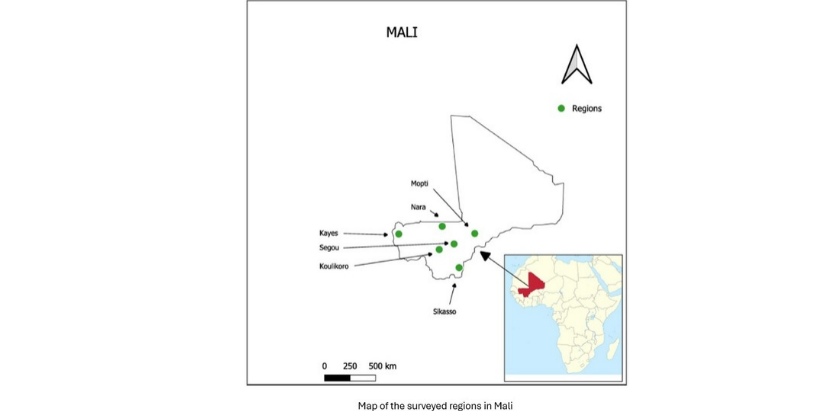
Surveyed regions.
Climate-smart agriculture (CSA) practices could play an important role in strengthening food security and improving the nutritional quality of diets among smallholder farming households in Mali, according to a new study by researchers from IITA and the Institut d’Economie Rurale (IER).
The research comes amid persistent food and nutrition challenges in Mali, where hunger and malnutrition continue to be compounded by climate change and insecurity in the Sahel region. The country ranks 85th out of 113 countries on the Global Food Security Index, with an undernourishment prevalence of 9.8%. Meanwhile, projected changes in rainfall and temperature are expected to negatively affect crop yields and pastoralism, increasing the need for agricultural approaches that can strengthen farmers’ ability to adapt and make agrifood systems more sustainable.
Led by IITA Agricultural and Environmental Economist Abel-Gautier Kouakou, the study examined the adoption of five CSA practices including minimum tillage, changes in sowing dates, climate-smart varieties, crop diversification, and tree planting, and their effects on food security among cereal- and legume-producing farmers.
The researchers used household- and farm-level data collected in 2024 from 3,709 households and 8,391 plots across six regions of Mali: Kayes, Koulikoro, Segou, Sikasso, Mopti, and Nara. The analysis covered four agroecological zones, which are the Sudano-Guinean, Sudanian, Sudanian-Sahelian, and Sahelian zones, as well as major cereal and legume farming systems.
The findings show that the adoption of CSA practices varies considerably according to farmers’ locations and the crops they grow. Among cereal-producing farmers, adoption of all five practices was highest in the Sudano-Guinean zone and lowest in the Sahelian zone. A similar pattern was observed among legume-producing farmers, although the adoption of individual practices varied across the other agroecological zones.
Crop type also influenced adoption. Sorghum-producing farmers were less likely than maize-producing farmers to adopt crop diversification and tree planting. According to the researchers, this may be linked to the more challenging conditions in areas where sorghum is predominantly grown, including lower rainfall and poorer soils. Sorghum farmers also tend to operate in more subsistence-oriented systems, where limited market incentives may reduce the motivation to invest in diversification and longer-term practices.
Access to agricultural extension services emerged as another important factor. Contact with extension agents positively influenced the adoption of most of the five CSA practices, while household size also increased the likelihood of adoption. The findings revealed the role of technical knowledge, advisory services and household capacity in enabling farmers to adopt practices suited to changing climatic conditions.
Beyond adoption, the study found important links between CSA practices and household food security. All five practices had a significant positive effect on dietary diversity among cereal-producing households. Among legume-producing households, changes in sowing dates, climate-smart varieties and crop diversification also significantly improved dietary diversity.
During the study, survey results showed that cereal-producing households adopting minimum tillage were significantly less likely to experience food insecurity. It was the only CSA practice found to be significantly associated with food availability, with adoption linked to an estimated 94% reduction in the likelihood of food insecurity. This result reflects an observed association in the survey data and does not necessarily imply a direct causal relationship between minimum tillage and crop productivity. However, changes in sowing dates and crop diversification were also associated with improvements in dietary diversity of 50% and 30%, respectively.
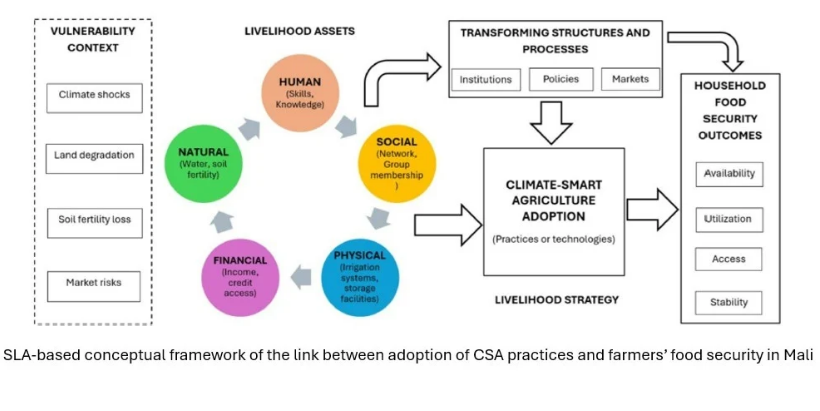
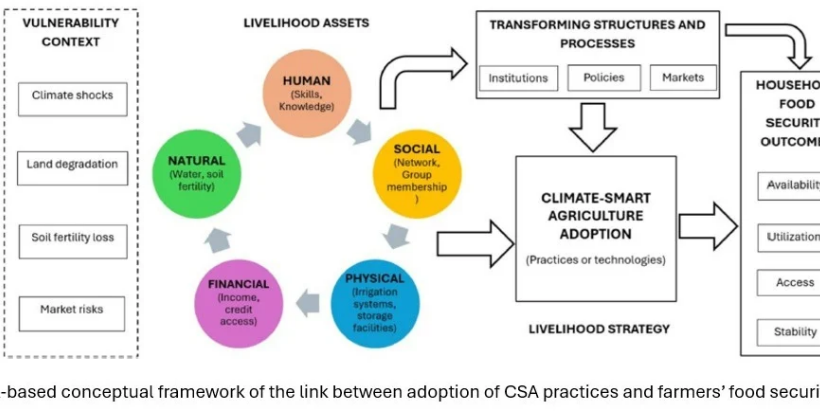
Conceptual framework.
The findings point to the importance of tailoring climate-smart agriculture interventions to farmers’ local environments, cropping systems and circumstances. Rather than applying a one-size-fits-all approach, the researchers emphasize the need to consider the agroecological conditions and crops that shape farmers’ adoption decisions.
Based on the evidence, the study recommends increased investment in extension and technical support, particularly in the Sudanian-Sahelian and Sahelian zones and in sorghum-producing areas. It also calls for market and financial incentives to encourage adoption in subsistence-oriented farming systems, particularly those centred on millet and sorghum.
Strengthening farmers’ access to appropriate technologies, knowledge and incentives could help build resilience to climate change while improving the nutritional quality of rural households’ diets. The findings therefore add to the growing evidence on the role of climate-smart agriculture in supporting more resilient and food-secure farming communities in the Sahel.
However, the researchers caution that the findings have geographical limitations. Due to security conditions, the study could not cover some areas of northern Mali, meaning the results cannot be generalized to those locations. They also recommend further research examining additional dimensions of food security, including food access and stability.
Overall, the study highlights the potential of climate-smart agriculture to address interconnected challenges of climate resilience, agricultural production and household nutrition in Mali, while emphasizing the importance of locally appropriate support to help farmers adopt and sustain these practices.
Contributed by Ochuwa Favour Daramola

No Comments