
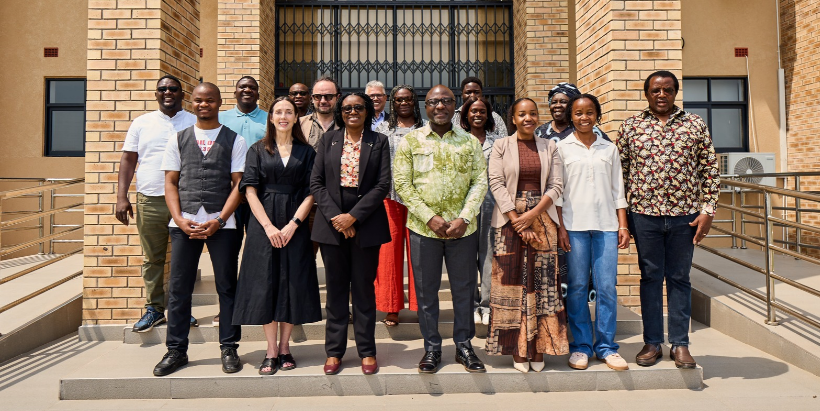
Participants at the Demand Intelligence workshop in Zambia.
Zambia stands on the brink of an agricultural transformation as stakeholders from CGIAR centers and allies such as IWMI, WorldFish, IITA, and Landscape Alliance (ICRAF/CIFOR), convened in Lusaka, Zambia, from September 29 to 30 to unveil a digital tool. The AI-powered platform, “Demand Intelligence Portal,” designed to support science programs, centers, and national partners better understand country demand and use that understanding to inform research, scaling, and investment decisions, bringing together data, evidence, and local expertise to spotlight the real needs and opportunities across Zambia’s agricultural sector.
The engagement comes as Zambia places greater emphasis on research, innovation, and investment that respond to priorities across the agricultural value chain, including the country’s broader ambitions under the Grow Zambia agenda.
CGIAR centers, working under the Scaling for Impact program, conveyed the workshop guided by the question: “How can agricultural innovations move from promising ideas to practical solutions that reach more people and create measurable impact?” At the center of the discussions was the Demand Intelligence Portal, a digital platform that combines evidence and artificial intelligence to help users understand agricultural needs, identify gaps, and assess the conditions required for innovations to achieve impact.
Rather than presenting the portal as a finished product, the workshop enabled potential users to test its relevance, challenge the underlying data, and suggest improvements to make it more useful for decision-making in Zambia’s agricultural sector.
Speaking during the workshop, Regional Director for IITA Southern Africa Hub, Dr David Chikoye, emphasized that stakeholder participation was important in connecting national agricultural priorities with research and solutions being developed by CGIAR and its partners. “We are here to co-design and improve this platform with you and ultimately strengthen the connection between what Zambia needs, what the evidence tells us, and the solutions that CGIAR and its partners can help develop and deliver,” he said.
He further explained that institutions involved in agriculture have different responsibilities, experiences, and information needs, making their input important in ensuring that the evidence used by the platform reflects the realities of decision-making in Zambia.
Speaking at the workshop, Matieyedou Konlambigue, IITA Senior Agribusiness Specialist at the and Coordinator for Country Strategy and Coordination under the CGIAR Scaling for Impact Program, said the portal was initially developed from a research perspective, making feedback from Zambian stakeholders important in determining how it should evolve.
“From the feedback we received, I was really impressed by the candid conversations from the different stakeholders, and overall, they find it useful, but they have given us feedback, and we have to work to improve it as people continue to use it,” said Konlambigue.

Participants during a group discussion to review and explore the Demand Intelligence Portal, sharing insights and feedback on how the platform can support evidence-based decision-making and strengthen the scaling of CGIAR innovations.
The discussions showed that identifying an agricultural problem alone may not be enough, as decision-makers also need to understand which solutions exist and whether financing, markets, extension services, insurance, infrastructure, and other support systems are available.
In addition, IITA Scaling and Artificial Intelligence Consultant, Dr Murat Sartas, said agricultural innovations needed to be assessed within the wider environment in which they are expected to operate if Zambia is to achieve ambitious production targets. “If we want to reach something as ambitious as 10 million tons of maize, we need to understand the whole demand structure, including national and international funding, private sector investment, banks, insurance, service providers, and the market,” said Sartas. He said this approach could help identify weaknesses that may prevent an innovation from scaling, while also showing where investment or institutional support could make an existing solution more effective.
IITA Agricultural Economist, Julius Manda, added that the portal could also help identify where there is effective demand for agricultural innovations and where gaps remain in financing, implementation, or other conditions needed to scale solutions. “The Demand Intelligence Portal allows us to see where the gaps are in making an innovation scalable, where there is effective demand, where we need to improve, and where we need to maintain what is already working,” said Manda.
Speaking at the same event, Masuhwa Kayoya, Chief Seeds Officer at the Seed Control and Certification Institute (SCCI), emphasized that the use of high-quality certified seed is crucial for addressing Zambia’s low agricultural productivity and enhancing crop yields. He suggested that the Demand Intelligence Portal could be strengthened by incorporating data on seed quality and certification, and by benchmarking Zambia’s system against those of other countries to identify areas for potential improvement.
Panuka Agribusiness Hub Chief Executive Officer, Bruno Mweemba, highlighted the need for such agricultural innovations to address broader challenges faced by farmers and agribusinesses. He pointed out that issues such as limited financial literacy and insufficient record-keeping of production and financial data continue to impede progress in the sector.
“The absence of reliable data makes it challenging for farmers to access financing and to make informed, data-driven decisions regarding production choices and cost management,” Mweemba noted.
Participants generally found the insights generated by the Demand Intelligence Portal and related reports valid, relevant, useful, and grounded in credible evidence across key agricultural themes, including seeds and inputs, livestock systems, and market access. They also identified opportunities to strengthen the tools by incorporating more comprehensive country-specific evidence, broader systems perspectives, and clearer information on potential funders and investment opportunities to better inform decision-making. They also called for the platform to eventually accommodate agripreneurs, farmers, and other actors across the agricultural value chain.
The workshop therefore demonstrated that the success of the Demand Intelligence Portal will depend not only on its technology, but on whether the information it provides remains relevant, understandable, and useful to the people making agricultural research, investment, and policy decisions. CGIAR indicated that as the platform continues to develop, the focus will be on incorporating stakeholder feedback and improving the quality of information so that decision-makers can move beyond asking which agricultural innovation is available to also understanding where the need is greatest, what evidence supports investment, and what must be in place for solutions to deliver lasting impact.



No Comments