
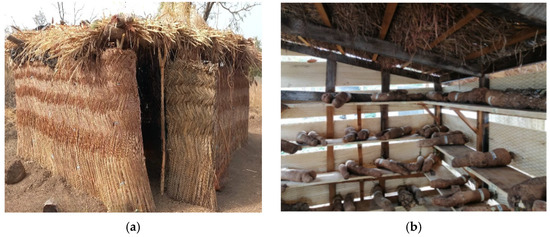
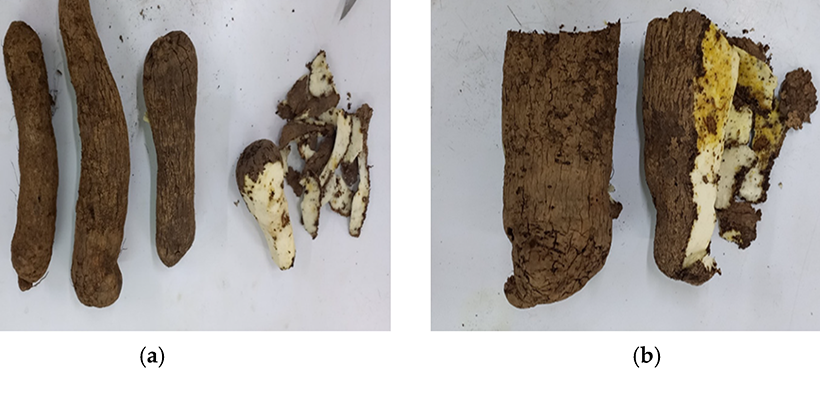
Yam diseases during storage, (a) diseased yam showing cracks and dark brown patches beneath skin; (b) dry rot symptoms and yellowing beneath skin.
In West Africa, yam production is far more than an agricultural activity. It is a deeply embedded system that sustains millions of livelihoods, shapes rural economies, and reinforces cultural identity. Across the region, yams occupy a central place not only in food systems but also in social traditions, cultural rituals, and seasonal cycles.
Within this landscape, Ghana has emerged as a key actor, combining centuries-old indigenous knowledge with evolving market participation to become one of the most influential players in the global yam economy. While Nigeria dominates overall production, Ghana has carved out a distinct niche as a leading exporter, linking smallholder farmers to international markets and positioning yams as both a subsistence crop and a strategic commodity.
This dual role underscores the crop’s broader significance: yams serve as a vital source of food security for millions of smallholders while simultaneously anchoring value chains that extend beyond local communities into global trade networks.
Together, these dynamics highlight yam production as a critical intersection of tradition, livelihood resilience, and economic transformation in West Africa.
However, while Ghana’s yams travel to high-end markets, yam production by smallholder farmers is constrained by several challenges, including postharvest losses, resulting from yam nematodes. To investigate the status of nematode infestation, management practices and other socio-economic factors contributing to yam production in the country, a study titled; “Yam Nematodes as a Production Constraint in Ghana” has revealed that farmers are only achieving 20% of their potential yield. The reason for this is that most farmers were unaware of the microscopic worm, known as a yam nematode (Scutellonema spp.).
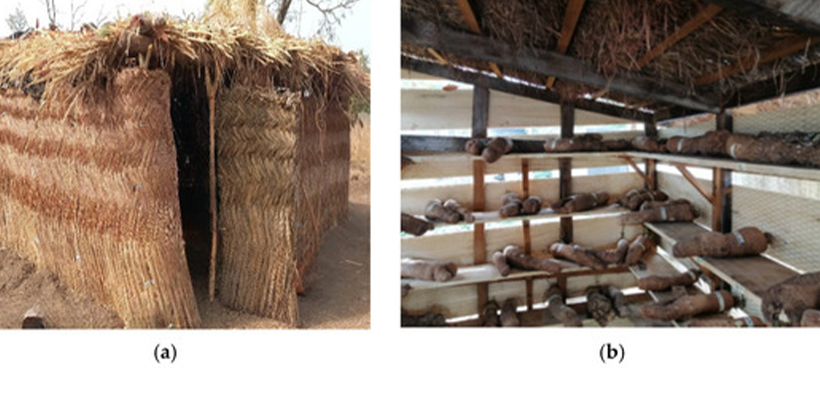
Yam storage facilities used by surveyed farmers, (a) storage in farms; (b) yam barn.
While many farmers reported experiencing pests and diseases, about 77% of the 150 yam farmers selected across seven yam-growing districts for the field survey had no knowledge about nematode infestations in their farms as pests causing damage to the tubers.
During the study, 12 genera of nematodes were identified in the soils of the yam rhizosphere across the seven districts. Tylenchus spp. (35.5%) and Scutellonema spp. (92.8%) were the most
abundant nematodes in soil samples and tuber peels, respectively, while the second highest
nematode in tuber peels was Meloidogyne spp. (4.0%).
According to the study, nematodes like Scutellonema bradys, cause dry rot disease by feeding inside yam tubers, and its implications extend far beyond the yields. As the parasites feed and multiply, they create deep cracks and lesions, which severely degrade the quality of the yam produced. This damage only becomes apparent after harvest, and the yams after being put in storage, begin to decay rapidly, thus, leading to post-harvest losses as high as 63%.
The researchers from IITA–CGIAR and the University of Ghana found that traditional practices, such as reusing small pieces of tubers, saved as seeds from the previous harvest, and storing yams in poorly ventilated barns, contribute to the spread of nematodes. Also, women who often have less access to land and resources are especially vulnerable to these losses. According to the study, when infected tubers are replanted, it creates an endless cycle where infested harvest leads to infested seeds and the parasite lives on.
While most farmers remain unaware of the true culprit behind shrinking harvests and rotting tuber.
Over 77% of surveyed farmers during the study did not recognize nematodes as a threat, and more than 60% reported major storage losses, with symptoms like cracks, discoloration, and decay in their yams.
Identifying the practices that lead to recycling nematodes in their farms, the study recommends farming practices to combat these challenges and manage postharvest losses better in yam farming in the region.
From farmer education that will help the farmers identify and manage nematode infestations, especially after harvest to improved planting materials that will help break the cycle of infection, the researchers also recommended support for women farmers and strengthening policies to drive sustainable farming.
By empowering farmers with knowledge to improve their farming and storage practices and contributing to seed systems through development of resistant varieties that will supply the yam seed system, Ghana can begin to close its yield gap and protect its most important crop.
The study highlights the critical need to tackle the nematode problem to protect Ghana’s yam industry. This will boost farmer incomes and preserve the cultural status of the crops. With coordinated efforts from farmers, scientists, and policymakers, there is hope that Ghana’s yam industry, and the communities that depend on them can thrive once again.
Contributed by Oloruntomiwa Oluwole and ‘Timilehin Osunde

No Comments