
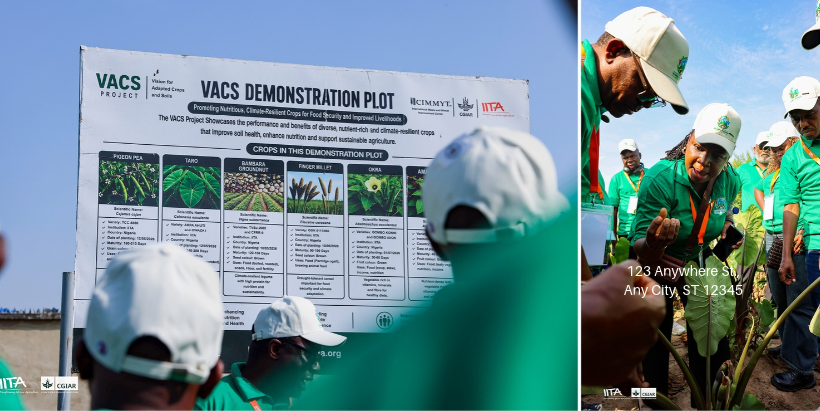
Participants observe taro pollination at the VACS demonstration plot in Abuja, highlighting ongoing efforts to advance taro research and breeding.
The inaugural convening of the Global Alliance for Taro (GAfT) has marked a significant step towards repositioning taro as a strategic crop for food and nutrition security, climate resilience, and inclusive agribusiness, bringing together research institutions, PhD students, development partners, and government officials to build a coordinated global platform to position taro as a superfood for all.
The two-day gathering, held 10-11 November, was convened through collaboration with the National Root Crops Research Institute (NRCRI), the International Potato Center (CIP), IITA–CGIAR, and the Vision for Adapted Crops and Soils (VACS) Breeding Project. The alliance seeks to address longstanding challenges that have limited the crop’s development and commercial potential.
A new chapter for an underutilized crop
Described as one of the oldest food crops known to humanity, taro offers considerable opportunities beyond its traditional role as a staple food. Its nutritional and functional properties, including its easily digestible starch and resistant starch content, make it a promising crop for developing healthier food products and expanding its range of available food options.
However, despite its importance to farming communities, particularly smallholder farmers, taro has historically received limited research attention, investment, policy prioritization, and coordinated global advocacy. The launch of GAfT marked the beginning of a chapter to change this narrative by bringing together the expertise, resources, and partnerships needed to advance the entire taro value chain.
In his welcome address, NRCRI Executive Director and Chief Executive Officer, Professor Chiedozie Egesi, described the gathering as a defining moment for a crop that has nourished generations but remains largely overlooked in agricultural research, policy, and investment. He highlighted the need to reposition taro beyond its traditional consumption patterns and explore its potential in medicine, food, health, nutrition, and business. He pointed to the innovative taro products showcased at the exhibition as evidence of the possibilities beyond conventional consumption.
Dr Roberto Camacho of Universidad Técnica Nacional (UTN), Costa Rica, explored “Taro as a strategic crop for food security, climate resilience and agricultural transformation: Lessons from Latin America.” He highlighted taro’s nutritional value, adaptability to diverse tropical environments, and rich genetic diversity as important attributes for strengthening food systems. The crop’s ability to thrive in both wetland and upland farming systems also presents opportunities for production across different agroecological conditions.
On behalf of the Honorable Minister of Livestock Development, Hon. Idi Muktar Maiha, Barr Mark Mbaram, Special Adviser to the Minister of Livestock Development on Knowledge Management and Communication, and a representative of the Ministry with the African Development Bank (AfDB) called for research into taro’s potential as an alternative livestock feed ingredient. He highlighted the importance of establishing its nutritional composition, appropriate processing methods, and safe inclusion levels in animal diets, noting the opportunities this could create for local feed industries, farmers, women, and young entrepreneurs.
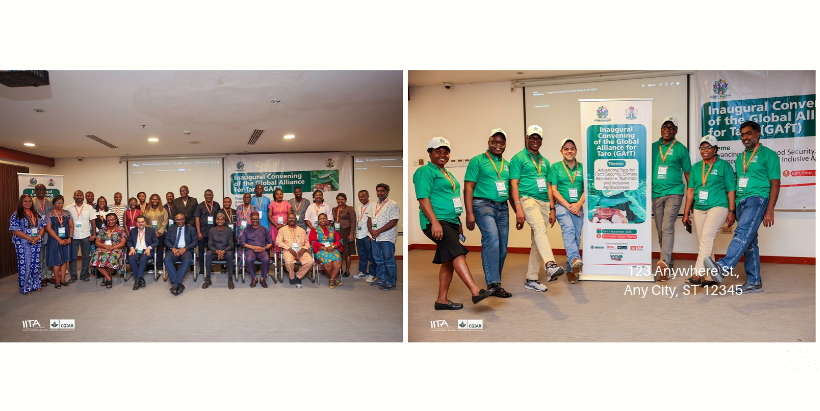
“Go Taro!” Participants and representatives of the GAfT conveners express their commitment to driving the mainstream adoption of taro as a versatile food with immense potential for nutrition, food security, and agribusiness.
The Global Alliance for Taro was officially launched by the Executive Secretary of the Agricultural Research Council of Nigeria (ARCN), Dr Adamu Abubakar Dabban, ably represented by Dr Oluwafemi Salako, the Director of Plant Resources, ARCN, signaling institutional support for a stronger, more coordinated approach to advancing taro research, production, and utilization. The presence of representatives from the Federal Ministry of Agriculture and Food Security, the National Agricultural Seed Council, and the African Development Bank provided an important opportunity to connect research priorities with policy and development financing.
GAfT highlights priorities for accelerating taro breeding
Dr Hapson Mushoriwa, Head of Breeding at IITA, presented the VACS Taro Breeding Project, outlining its partners, objectives, milestones, and priorities for the next phase. Among the key priorities identified were fast-tracking the release of five promising taro varieties and developing adequate seed stocks to support their dissemination and adoption. Other priorities include conducting demand-creation trials to stimulate awareness and farmer adoption; developing a seed roadmap with clear adoption targets; establishing anthocyanin thresholds and integrating this important trait into the Taro Target Product Profile (TPP); strengthening the taro breeding network; and improving project communication and visibility.
These priorities reinforce the importance of connecting breeding research with functional seed systems, farmer demand, and market opportunities to ensure that improved varieties move beyond research stations and reach intended users. The second day featured country presentations on progress and upcoming activities under the VACS Taro Breeding Project. Dr Lydia Jiwuba presented Nigeria’s update, Dr Ernest Baafi shared Ghana’s progress, while Dr Tewodros Mulualem presented Ethiopia’s activities.
PhD students of the International Association of Research Scholars and Fellows (IARSAF), working on Taro at IITA, also made presentations, sharing progress on their research on Assessing the Taro Leaf Blight Prevalence, Production, Constraints, and Field Trends in Nigeria by Mary Diekade; Exploration and Morphological Characterization of Nigerian Taro Germplasm by Uzoma Chizaram Oluebube; and Harnessing Nigerian Taro Genetic Resources for Conservation and Utilization in Taro Improvement by Elizabeth Ebiti. The presentations provided opportunities to exchange experiences, identify common challenges, and strengthen collaboration among participating countries and researchers.
A coordinated global alliance and roadmap to 2036
A high-level panel brought together perspectives on how Africa and other regions can transform taro from a largely underutilized and subsistence crop into a commercially attractive agricultural commodity. The panel further highlighted the importance of generating credible research data to support the inclusion of taro in national agricultural development plans and budgetary priorities.
Stakeholders called for mobilizing a broader network of farmers, private-sector actors, policymakers, and development partners to ensure the alliance represents the interests of the entire taro value chain. The discussions also underscored the potential for women, young people, and smallholder farmers to benefit from expanded opportunities in taro farming, processing, marketing, and enterprise development.
A proposed coordinated global roadmap extending from 2026 to 2036, supported by thematic and regional working clusters, would translate research priorities into practical action. The proposed thematic areas include genetic improvement and seed systems; climate-smart production; nutrition and food systems; and trade and policy frameworks. Regional clusters covering Africa, Asia, the Americas, and other taro-producing regions would facilitate knowledge exchange, resource mobilization, and stronger South–South and triangular cooperation.
Among the key recommendations emerging from the discussions were stronger national-level promotion and advocacy, increased investment in breeding for disease resistance and nutritional traits, improved access to quality planting materials, expanded agro-processing, consumer awareness campaigns, and structured market development. Data scientists and research institutions were also encouraged to develop shared digital platforms to collect, manage, and disseminate reliable information on taro research and production across countries.
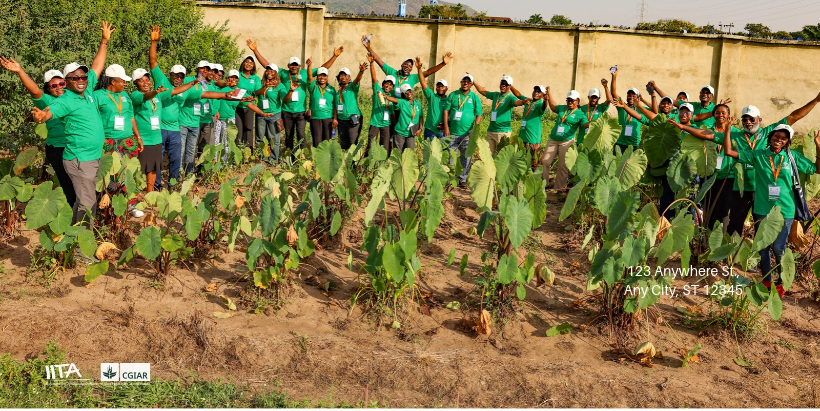
Participants at the inaugural launch of the Global Alliance for Taro (GAfT) at the Abuja VACS demonstration plot, marking a collective commitment to promoting taro as a versatile global superfood.
Giving taro a stronger voice in global agriculture
GAfT provides an opportunity to amplify the global voice for taro, strengthen cooperation, and create a platform for countries to collectively advance the crop’s development.
Beyond establishing governance and advisory structures to guide its operations, the alliance is expected to advance the Abuja Statement on the Global Alliance for Taro, strengthen policy engagement, attract investment expressions of interest, and develop shared market intelligence and data platforms. With breeding research receiving support through VACS, participants stressed that additional investments would be required to address the broader value chain, from improved planting materials and production technologies to processing, product development, and market access.
The message from Abuja was clear: taro has considerable untapped potential, but unlocking it will require coordinated science, sustained investment, stronger policies, and partnerships that connect farmers to markets. Through GAfT, stakeholders are seeking to establish the global platform needed to turn this potential into measurable impact, creating new opportunities for food and nutrition security, climate resilience, rural livelihoods, and inclusive economic growth.
The Global Alliance for Taro has arrived, with a mandate to give this historically neglected crop the visibility, investment, and coordinated global action it deserves.
Contributed by Folake Oduntan
Related story:
VACS Fellows strengthen capacity through regional learning tour in Zimbabwe – IITA


No Comments