
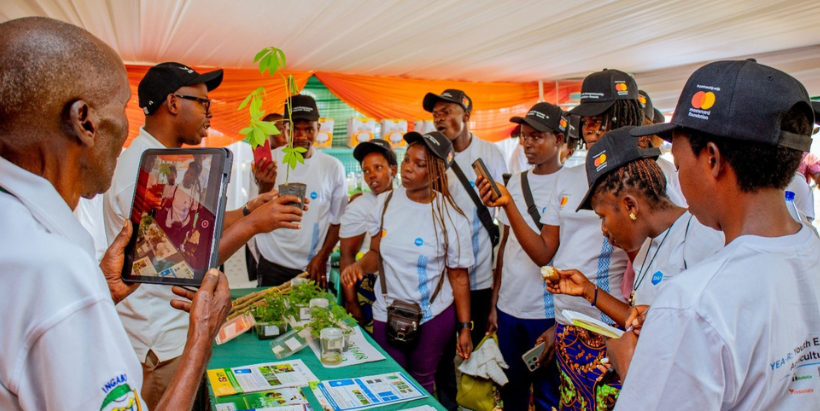
IITA Rwanda staff Charles Mwizerwa explains the cassava value chain to visitor farmers at the Rwanda Agrishow 2026.
At the IITA–CGIAR stand during Rwanda’s 2026 Agrishow, visitors could trace the journey of cassava across the value chain: from clean planting materials for farmers to flour, bakery products, and animal feed. The display highlighted how agricultural research and innovation can create new opportunities for farmers, entrepreneurs, and consumers while contributing to a more productive and sustainable agrifood system.
Held from 22 to 31 July, the 19th Rwanda Agricultural Show brought together farmers, researchers, policymakers, private-sector actors, students, and other stakeholders under the theme: “Accelerating agrifood systems transformation through innovation and strategic partnerships.”
IITA, along with partners, showcased innovations from different projects, mainly the cassava seed systems, a critical foundation for increasing productivity and ensuring farmers have access to healthy planting materials. IITA is working to strengthen national capacity in Semi-Autotrophic Hydroponics (SAH), a rapid multiplication technology that supports the production of high-quality, disease-free cassava plantlets.
Alongside this capacity building, IITA is working with cassava seed entrepreneurs to expand the multiplication of clean seed and strengthen its distribution across the country, helping bring quality planting materials closer to more farmers. By strengthening the capacity of national actors and private seed entrepreneurs, the approach aims to create a more sustainable cassava seed system that can continue serving farmers beyond projects.
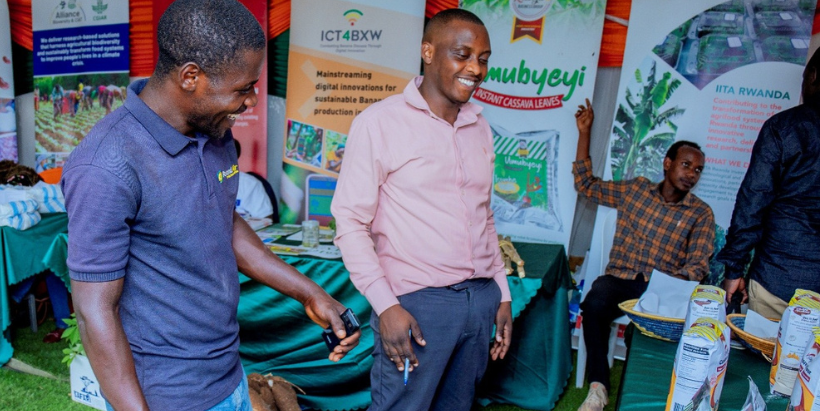
Staff from the IITA partner, Kabizu Company, showcase cassava-derived products, including High-Quality Cassava Peels (HQCP), High-Quality Cassava Flour (HQCF), and baked products, to visitors at the IITA stand during Rwanda Agrishow 2026.
From improved planting materials, visitors were introduced to innovations that add value to cassava after harvest. High-Quality Cassava Flour (HQCF) was displayed alongside a range of products made from it, including doughnuts, cakes, bread, biscuits, etc., showing how cassava can be transformed beyond traditional consumption and create opportunities for food processors and entrepreneurs.
The stand also featured High-Quality Cassava Peels (HQCP), demonstrating how cassava peels, often treated as waste during processing, can be transformed into a valuable resource, particularly for animal feed. The innovation offers an opportunity to reduce waste while creating additional value from cassava processing.
“What impressed me most is that IITA is not only working on cassava production, but on the whole value chain: from clean planting materials to products that can be consumed or used as animal feed. This shows how research can respond to real challenges faced by farmers.” Urges Claudine Mukagahutu, a farmer who visited the stand.
The cassava innovations attracted farmers, students, entrepreneurs, researchers, and members of the public, prompting discussions on how research-based solutions can address practical challenges and unlock new opportunities within Rwanda’s agricultural sector.
Contributed by Ritha Bumwe and Confiance Mugisha


No Comments