
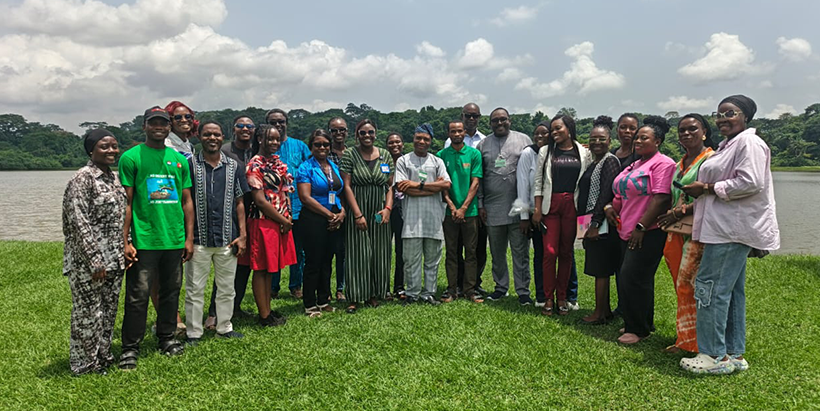
University of Ibadan sustainability leaders pose by the iconic IITA Lake following an insightful tour showcasing IITA’s environmental conservation initiatives.
For students studying sustainability, few learning experiences are as impactful as witnessing environmental conservation in practice. This became a reality for Master’s students from the Department of Sustainability Studies, Centre for Sustainable Development (CESDEV), University of Ibadan, who on 21 May, embarked on an academic excursion to the IITA Forest Center in Ibadan.
Organized under the guidance of the course lecturer, Dr Olawale Olayide, as part of the Ecological Systems (SDP 702) curriculum, the field trip was designed to bridge the gap between classroom theory and real-world environmental management. The visit exposed students to innovative conservation approaches, biodiversity protection strategies, and the critical role of science communication in promoting sustainable development.
The excursion commenced with an engaging interaction with the IITA Forest Center Manager, Dr Adewale Awoyemi, and IITA Forest Center Field Supervisor, Ademola Ajayi. Their presentations explored the complex relationship between humans and nature, with particular emphasis on the growing phenomenon known as the “extinction of nature experience”—a trend in which increasing urbanization reduces people’s direct interaction with natural environments.
The session encouraged students to reflect on how individuals and communities connect with nature and the implications of this relationship for conservation efforts. A lively question-and-answer session followed, during which participants discussed challenges facing conservation policies, the importance of community participation in environmental stewardship, and the preservation of indigenous ecological knowledge.
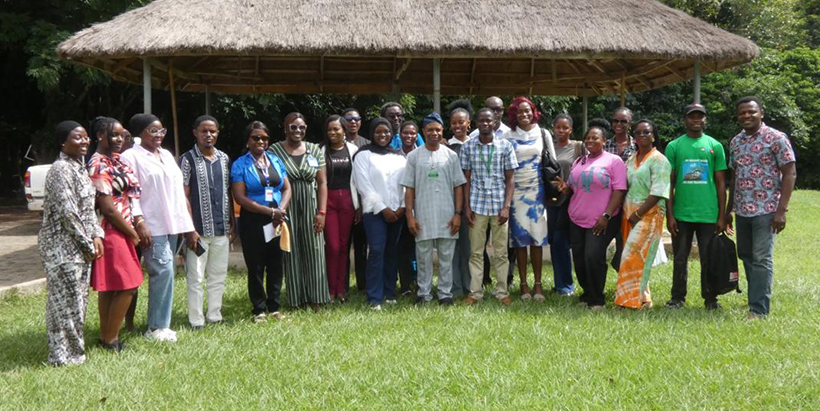
The postgraduate students pose for a group photograph after an engaging and interactive session with the Manager and Staff of IITA Forest Center, Adewale Awoyemi, and Ademola Ajayi.
Following this, the students visited RadioIITA, where they gained firsthand insight into how science communication supports agricultural extension, public awareness, and environmental sustainability. They also shared ideas on environmental sustainability initiatives that can help drive public health and ecological stability. The tour of the broadcast studio demonstrated the role the media play in translating scientific knowledge into practical information that benefits farmers, policymakers, and the wider public.
A major highlight of the excursion was a guided nature walk through the 350-hectare IITA Forest Reserve. Nestled within the urban landscape of Ibadan, the reserve serves as a vital ecological refuge and one of the region’s most important biodiversity hotspots. The forest provides critical ecosystem services, including carbon sequestration, climate regulation, environmental cooling, and flood mitigation for surrounding communities.
During the tour, students observed several conservation and restoration initiatives being implemented within the reserve, including afforestation, reforestation, and climate-smart apiculture practices. They also encountered a remarkable diversity of plant and animal species, underscoring the ecological significance of the forest.
Among the species highlighted were the rare Pararistolochia goldieana (PG Plant), known for producing the largest flower in West Africa, and the critically endangered Ibadan Malimbe, found only in this local ecosystem. The students also learned about valuable timber species such as Obeche and observed the distinguishing characteristics of male and female Iroko trees. Medicinal plants, including the Miracle leaf (Abamoda) and Guinea pepper (Ata ire), further showcased the forest’s rich ecological and cultural heritage.
The excursion concluded with a visit to the IITA Lake, a three-kilometer-long and 43-feet-deep water body recognized under the Ramsar Convention as a wetland of international importance. The site provided students with an opportunity to appreciate the interconnectedness of forest and aquatic ecosystems and their collective role in supporting biodiversity and environmental resilience.
Reflecting on the experience, participants noted that the excursion offered compelling evidence that biodiversity conservation and urban development can coexist when guided by sound management practices and long-term sustainability goals. The visit not only enriched their academic understanding but also reinforced the importance of conserving natural ecosystems for future generations.
Through initiatives such as this, the IITA Forest Center continues to serve as a living laboratory for environmental education, inspiring the next generation of sustainability professionals while advancing conservation and biodiversity stewardship in Nigeria and beyond.
Contributed by Folake Oduntan
Related stories:
IITA Forest Center welcomes the community to the first Tree Heritage Park Open Day
New study explores human-nature interactions in the Afrotropics

No Comments