
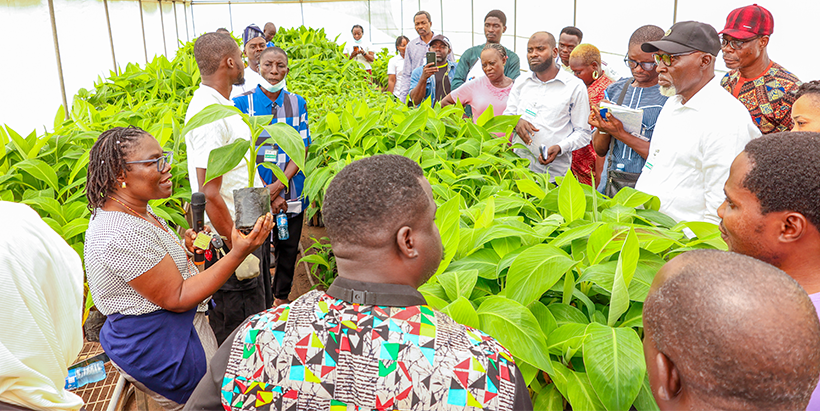
Dr Delphine Amah demonstrating nursery management practices that support the production of quality banana plantain materials.
The Program for Seed System Innovations for Vegetatively Propagated Crops in Africa (PROSSIVA) has trained Nigeria’s first cohort of banana and plantain seed entrepreneurs, marking an important milestone in efforts to strengthen the country’s emerging formal seed system. The training equipped seed entrepreneurs, farmer cooperatives, seed companies, and public-sector partners with the technical, business, and regulatory skills needed to produce and market quality planting materials.
Held from 3 to 5 June 2026 at the International Institute of Tropical Agriculture (IITA) headquarters in Ibadan, the training brought together participants from Oyo, Ogun, Osun, and the Federal Capital Territory, alongside representatives from the National Horticultural Research Institute (NIHORT), National Agricultural Seeds Council (NASC), Resourced, and Chlorophyll.
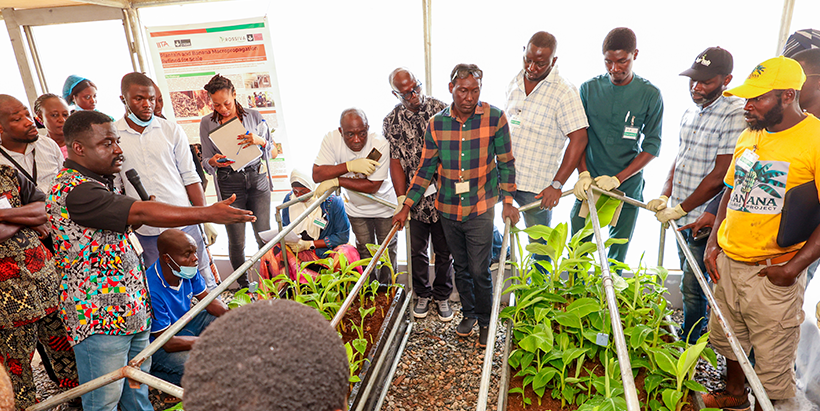
Temitope Ademulegun introducing the participants to the IITA standard macropropagators.
Opening the workshop, IITA Head of the Capacity Development Office, Zaina Sore, reaffirmed the institute’s commitment to strengthening capacities across agrifood systems through initiatives such as PROSSIVA. The training forms part of broader efforts to transform banana and plantain seed production from largely informal planting material exchange into a more structured, commercially sustainable system that delivers quality-assured planting materials to farmers.
To support the sustainable production of high-quality planting materials, participants received practical training in banana macropropagation, a simple technology that enables the rapid multiplication from well-managed mother plants. Temitope Ademulegun of IITA introduced participants to a standardized propagator developed to improve the efficiency and consistency of seed production. The technical sessions covered the construction and operation of macropropagation facilities, establishment and management of mother gardens, variety identification, selection of healthy source materials, propagator management, and good nursery management practices. According to PROSSIVA Project Coordinator and IITA Plantain Breeder Dr Delphine Amah, “The technology can generate between 20 and 100 plants from a single corm, offering a viable pathway for scaling commercial banana and plantain seed enterprises.”
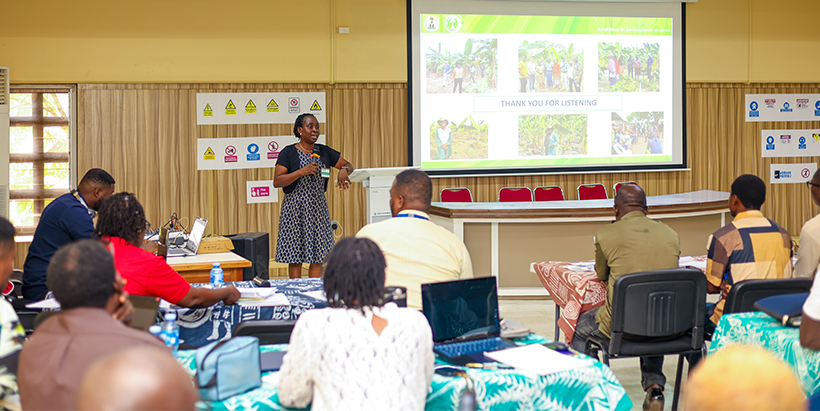
Dr Dorcas Ibitoye of NIHORT presenting on banana seed systems in Nigeria and released varieties.
The training also highlighted recent progress in formalizing Nigeria’s banana and plantain seed system. Dr Dorcas Ibitoye of NIHORT shared updates on collaborative efforts by NIHORT, IITA, and NASC under PROSSIVA. She further noted other breeding efforts, including the release of two banana varieties (HORTIBAN 1 and HORTIBAN 2) and two plantain varieties (HORTIPLAN 1 and HORTIPLAN 2). The release of these varieties provides a foundation for improved varietal identification, traceability, and quality assurance across the seed value chain.
Ensuring the health of planting materials was another key aspect of the training. Participants learned best practices for identifying and managing pests and diseases that threaten the quality and productivity of planting material. IITA’s Dr Yao Kolombia led sessions on the identification and management of major pests and diseases affecting banana and plantain production, while Dr Lava Kumar highlighted the risks posed by Banana Bunchy Top Disease (BBTD), a devastating viral disease that has already been detected in parts of Ogun State and threatens banana and plantain production. Through demonstrations and discussions, participants learned approaches for disease prevention, monitoring, and the production of healthy planting materials.
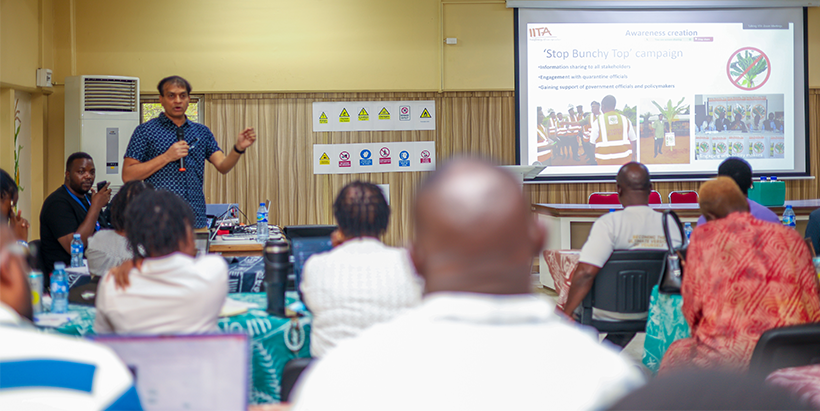
Dr Lava Kumar raising awareness about the risks of Banana Bunchy Top Disease (BBTD).
Recognizing that sustainable seed systems require viable businesses, the training also prioritized entrepreneurship and market development. Will Rogers of Resource guided participants through business planning using the Business Model Canvas, while Fathiya Accram and Nzilani Muya of Chlorophyll introduced practical approaches to customer segmentation, value propositions, branding, and marketing. Through practical exercises, participants developed mission statements, marketing messages, and value propositions tailored to their individual seed enterprises. These sessions equipped participants with tools to develop seed enterprises capable of responding to farmer demand while generating sustainable income.
Participants were also introduced to Seed Tracker™, a digital platform that connects seed producers with buyers while strengthening traceability and quality assurance across the seed system. Dr. Lava Kumar highlighted the platform’s role in supporting transparency and accountability, while Busayo Ogunya demonstrated how certified seed producers can use the platform to improve market visibility and access new customers.
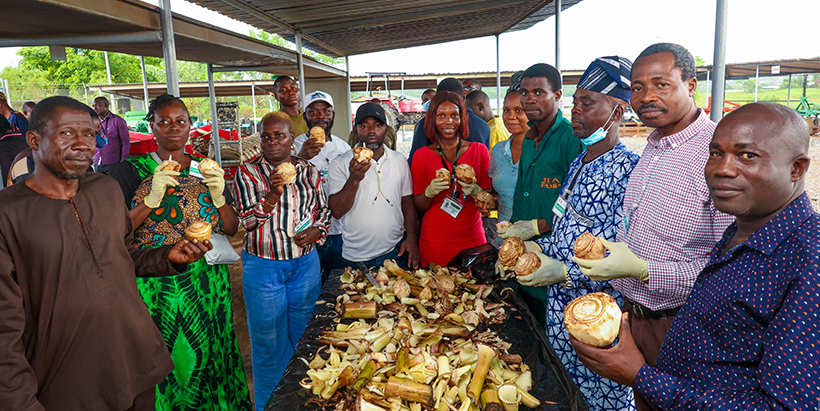
Participants display prepared corms after a practical session on corm preparation techniques.
To strengthen participants’ understanding of the regulatory environment, Segun Ibitoye of NASC provided guidance on seed certification procedures, quality assurance requirements, and Nigeria’s revised seed policy, including provisions for Community-Based Seed Production. The session helped participants understand the pathway from released varieties to certified seed production and farmer adoption.
Participants described the training as both enlightening and transformative, noting that it expanded their understanding of the banana and plantain seed sector beyond seed production. One participant reflected, “Coming here, I thought I would only learn how to plant bananas and plantains. But I’ve come to see the bigger picture of the seed system and how we can help ensure farmers have access to quality planting materials.” Participants also highlighted the value of learning about digital marketing and traceability through Seed Tracker, as well as certification requirements that can help seed enterprises improve their visibility and access market opportunities.
As PROSSIVA advances its scaling agenda, these entrepreneurs are expected to play a critical role in expanding access to high-quality banana and plantain planting materials, strengthening seed system resilience, and improving farmers’ productivity across Nigeria. The training marks an important milestone in ongoing efforts to build a more efficient, traceable, and commercially viable banana and plantain seed system.
Contributed by Isaac Ajayi and Delphine Amah


No Comments