
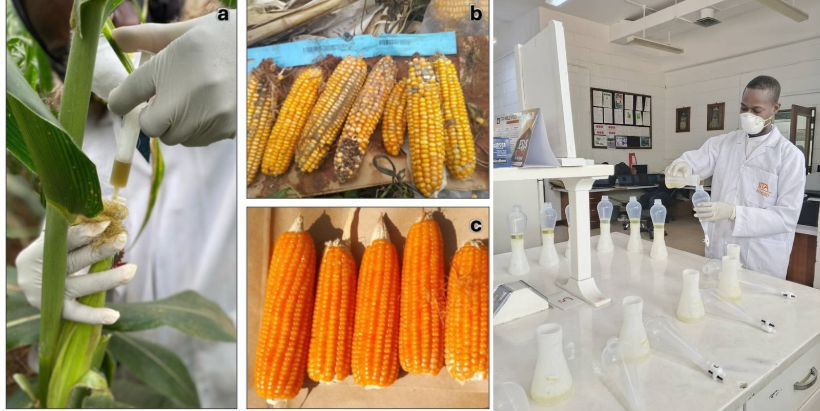
Field and laboratory evaluation of maize genotypes for resistance to aflatoxin accumulation. (a) Field inoculation of maize ears with a highly toxigenic Aspergillus flavus isolate; (b) susceptible genotype showing severe ear rot approximately one month after inoculation; (c) resistant genotype showing no visible ear rot at the same time point despite inoculation; and (d) extraction of aflatoxins from maize samples in the IITA Pathology and Mycotoxin Laboratory prior to quantification by thin-layer chromatography coupled with scanning densitometry.
The collaboration between IITA’s Maize Improvement Program, Pathology and Mycotoxin/Aflasafe Unit, and the University of Ibadan has generated new evidence that resistance to aflatoxins can be combined with productivity and agronomic stability—bringing host-plant resistance closer to becoming a practical component of integrated aflatoxin mitigation.
Aflatoxins, produced primarily by the fungus Aspergillus flavus, are a major food safety challenge across the tropics and subtropics. Although breeding for resistance has been pursued for decades, developing high-yielding maize that consistently limits aflatoxin contamination has remained elusive.
In a 2026 study, the research team evaluated 166 testcrosses derived from 83 maize inbred lines crossed with two testers across four environments. The hybrids were artificially inoculated with a highly toxigenic A. flavus isolate and assessed for grain yield, agronomic stability, ear rot, and aflatoxin accumulation.
Using modern quantitative genetics approaches, the researchers identified five promising hybrids that combine competitive yield, stability, and aflatoxin resistance for further evaluation. A particularly important finding was that grain yield was not significantly correlated with aflatoxin accumulation (r = 0.08). This provides direct evidence that selecting for higher yield need not come at the expense of aflatoxin resistance—an important question that has challenged maize breeding programs across the globe for decades.
A companion study characterized quantitative trait loci associated with kernel aflatoxin accumulation and A. flavus colonization, strengthening the genetic basis for incorporating aflatoxin resistance into breeding pipelines.
The work was recognized when Victor Diekade, an IITA research fellow earned first place in the student competition of the African Division of the American Phytopathological Society (APS) in August 2026.

Recognizing outstanding student achievement in plant pathology. Victor Diekade, IITA–University of Ibadan Research Fellow, was recognized by the American Phytopathological Society (APS) with First Place in the Oral Competition during the annual meeting of the APS African Division for his research on breeding maize with reduced aflatoxin risk.
From pathology research to a breeding trait
The collaboration between both institutes brings together complementary expertise and provides a platform for student training. IITA’s Maize Improvement Program provides germplasm, breeding populations, hybrid development, and multi-environment evaluation, while the Pathology and Mycotoxin/Aflasafe Unit contributes expertise in A. flavus, controlled inoculation, ear rot assessment, aflatoxin quantification, and resistance screening. The University of Ibadan provides an academic platform for training students in research, linking their education with hands-on experience in maize breeding, pathology, and aflatoxin research.
This integration is important because aflatoxin resistance is a polygenic trait. Its expression is strongly influenced by interactions among the maize genotype, the pathogen, and the environment. Reliable screening under appropriate disease pressure is therefore essential for identifying genetic differences that breeders can use.
The current work builds on a much longer IITA research trajectory, moving from the evaluation and development of resistant germplasm to resistant inbred lines, molecular and QTL characterization, combining-ability studies, and now multi-trait selection of promising tropical hybrids.
For aflatoxin mitigation, the goal is not to replace existing interventions but to add another layer of protection. Maize with greater inherent resistance to aflatoxin accumulation complements the use of biocontrol (e.g., Aflasafe®) and other management measures, reducing the risk of contamination from the crop itself while farmers and value-chain actors address other points in the contamination pathway.
The identification of promising hybrids marks an important step toward moving aflatoxin resistance from a long-standing research objective into a more practical component of maize improvement. The next phase will focus on advancing the most promising materials through broader multi-environment testing and integrating validated resistance into breeding pipelines.
Publications
- Diekade et al. Multi-trait selection of tropical maize hybrids for combined productivity, agronomic stability, and aflatoxin resistance.Frontiers in Plant Science 17: 1964715.
- Diekade et al. Temperate aflatoxin-resistance QTLs in tropical maize: effects on kernel aflatoxin accumulation and Aspergillus flavuscolonization. Food and Humanity 7: 101394.
Contributed by Alejandro Ortega-Beltran, Victor Diekade, John Derera, and Hapson Mushoriwa

No Comments