
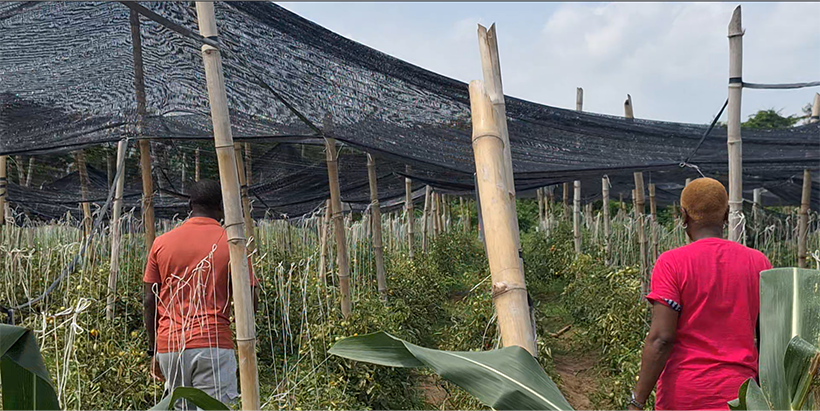
Tomatoes farm at Ajaja farm settlement in Oyo State.
For more than 16 years, maize farmer Oyeniyi Julius in the Akufo farm settlement, Ido LGA, relied on experience to guide his farming decisions.
Like many smallholder farmers in Oyo State, he understood the rhythm of the seasons. He knew when the rains normally arrived, when to plant, and when to expect a harvest.
But this year, that experience failed him.
After planting maize on three acres of land in March 2026, the rains stopped unexpectedly. His crop dried up before maturity.
“I planted maize on three acres, and the entire crop died,” Julius said. “Climate change makes us look like we don’t understand farming.”
His experience reflects a growing reality facing farmers across Oyo State and much of Nigeria. Increasingly unpredictable rainfall patterns, prolonged dry spells, rising temperatures, and extreme weather events are disrupting agricultural production and threatening livelihoods.
Yet while climate change poses significant risks, researchers, extension workers, government agencies, and development partners are working to connect farmers with climate-smart solutions that improve resilience and productivity.
Climate change is no longer a future threat
For farmers across Akinyele, Ido, and Afijio Local Government Areas, climate change is no longer a distant concern.
Farmers interviewed for this report consistently described delayed rainfall, shorter growing seasons, crop failure, and declining yields.
At Ajaja Farm Settlement in Akinyele, farmer Victoria Gabriel said delayed rains affected the establishment of her cassava crop.
“The delay in rainfall affected our cassava. Some seedlings did not germinate,
and some got burnt,” she said.
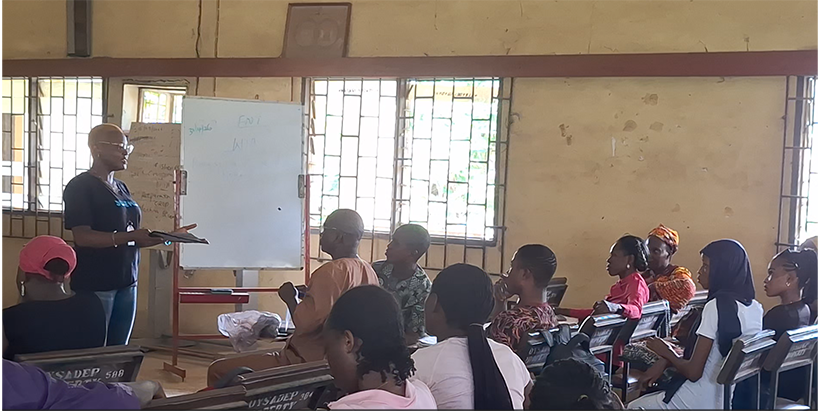
During a training session of Oyo state Extension Officers, Apata.
Another farmer, Lateefat Abdulrazaq, explained how rising temperatures have affected yam production.
“Many of the yams get burnt because of the harsh weather,” she said.
According to researchers, these experiences align with broader climate trends observed across southwestern Nigeria.
Deborah Nwanze, Senior Research Associate and Gender Responsive, Youth and Social Inclusion Researcher at IITA–CGIAR, said climate variability is becoming increasingly evident in farming communities.
“Rainfall has become completely unpredictable,” she explained. “Either it arrives three weeks late or comes with heavy downpours that wash away topsoil and flood root crops.”
Such changes create uncertainty for farmers whose planting decisions depend heavily on weather conditions.
Solutions exist, but access remains uneven
Despite the challenges, researchers emphasize that climate-smart solutions already exist.
Over the years, institutions including IITA and other agricultural research organizations have developed improved crop varieties, sustainable soil management practices, climate information services, and adaptation strategies to help farmers cope with changing conditions.
“There is no shortage of climate-smart solutions,” Nwanze said. “The truth is these solutions exist. What is broken is the pipeline between the solution and the smallholder farmer who needs it.”
Among the interventions being promoted are drought-tolerant cassava and maize varieties, climate information services delivered through radio and mobile platforms, participatory breeding programs, demonstration farms, and farmer training initiatives.
Nwanze noted that IITA and partner institutions regularly engage farming communities through participatory research approaches that allow farmers to evaluate improved technologies under local conditions.
These efforts help ensure innovations respond to real farming challenges while increasing farmer confidence in new technologies.
Extension services: The bridge between science and farmers
One of the most important channels connecting research to farmers is agricultural extension.
Extension workers serve as intermediaries between scientific institutions and rural communities, helping farmers understand and apply new information.
According to extension officers interviewed during this reporting project, weather forecasts and climate advisories have become increasingly important in recent years.
Farmers are being advised to adjust planting dates, adopt drought-tolerant varieties, diversify crops, and stagger planting schedules to reduce climate-related risks.
Through field visits, demonstrations, farmer meetings, and community engagements, extension agents are helping farmers translate climate information into practical decisions.
However, extension systems continue to face challenges related to staffing, logistics, funding, and coverage, limiting their ability to reach every farmer who needs support.
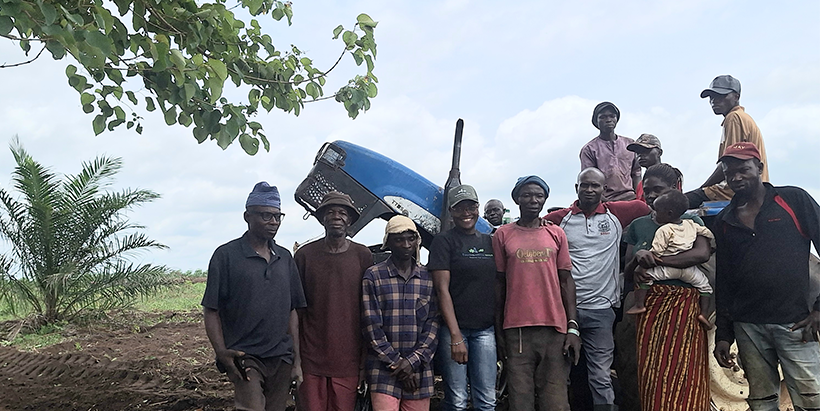
Dajie Odok with farmers at Tafa-tafa Area, Ijaiye Farm Settlement, Akinyele LGA.
Building resilient soils
Climate resilience extends beyond weather forecasting.
Experts say healthy soils are essential for helping farmers withstand climate shocks.
Muhammad Tukur Musa, an agronomist and extensionist with the International Fertilizer Development Centre (IFDC), identified declining soil fertility, erosion, drought spells, and early cessation of rainfall as major challenges affecting farmers.
To address these issues, IFDC promotes climate-smart practices including compost production, biochar, Bokashi organic fertilizers, mulching, and soil and water conservation techniques.
“These technologies help improve soil fertility, productivity, and food security,” Musa explained.
Healthy soils retain moisture more effectively, reduce nutrient losses, and improve crop performance under climate stress.
However, adoption remains relatively low, partly due to limited awareness, insufficient technical knowledge, labour requirements, and financial constraints.
Why gender matters in climate adaptation
Climate change affects men and women differently.
Research increasingly shows that women farmers face additional barriers in accessing agricultural information, productive resources, and adaptation support.
According to Nwanze, formal agricultural extension services reach men at significantly higher rates than women.
“Women primarily access agricultural information through social networks such as church groups, markets, and women’s associations,” she said.
Many women also face challenges related to land ownership, access to credit, labour availability, and decision-making authority within households.
These barriers limit their ability to invest in long-term adaptation measures.
“Information that does not reach women is not climate-smart,” Nwanze noted. “It is climate-selective.”
Addressing gender inequalities, experts argue, is essential for building resilient agricultural systems and strengthening food security.
Looking ahead
The experiences of farmers in Oyo State highlight both the urgency of climate adaptation and the opportunities that already exist.
Climate-smart solutions are available.
Research institutions continue to generate innovations.
Government agencies are investing in farmer support programs.
Extension workers are helping communities navigate uncertainty.
Yet significant gaps remain between innovation and adoption.
For many farmers, the challenge is no longer whether solutions exist, but whether they can access them in time.
As climate change continues to reshape agricultural production, strengthening the connections between research, extension services, policy, and farming communities will be critical.
Because when the rains no longer follow the rules, resilience depends on how effectively knowledge reaches the people who need it most.
This reporting was completed with the support of the Centre for Journalism Innovation and Development, CJID
Contributed by Dajie Odok

No Comments